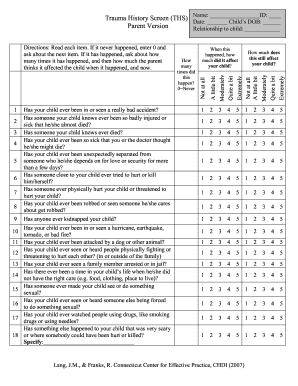
Trauma History Screen (THS) Name: ID: Date: Childs DOB: Parent Version Relationship to child: 6 7 8 9 10 11 12 13 14 15 16 17 18 Has anyone ever kidnapped your child? Has your child ever been in or.

How it works
  • Open form

    Open form follow the instructions

  • Easily sign form

    Easily sign the form with your finger

  • Share form

    Send filled & signed form or save

How to use or fill out the Trauma History Screen (THS) Parent Version online

Filling out the Trauma History Screen (THS) Parent Version is an essential step in understanding your child's experiences and needs. This guide provides clear instructions to help you complete the form online, ensuring that you can provide the necessary information regarding your child's trauma history.

Follow the steps to fill out the form effectively.

  1. Press the ‘Get Form’ button to access the Trauma History Screen (THS) Parent Version. This will allow you to open the document in an online editor for convenient completion.
  2. Begin by entering the necessary identification information. Fill in the child's name and date of birth, as well as your relationship to the child.
  3. Carefully read each question regarding various traumatic experiences your child may have encountered. Respond to the questions by indicating whether these events have occurred.
  4. For each question that applies, specify how many times the event happened. Use the given scale to assess how much each experience still affects your child, ranging from ‘Not at all’ to ‘Extremely’.
  5. Ensure clarity and accuracy in your responses. If necessary, provide additional context in the space provided for 'Specify' when related questions arise.
  6. Once you have completed the entire form, review your answers to ensure all fields are accurately filled out and there are no omissions.
  7. After reviewing, you can save your changes, download a copy of the completed form, or print it for your records. You may also have the option to share the completed form as needed.

Start filling out the Trauma History Screen (THS) Parent Version online today to support your child's well-being.

Get form

Experience a faster way to fill out and sign forms on the web. Access the most extensive library of templates available.

Related content

Trauma History Screen (THS) - PTSD: National...

A brief, 13-item self-report measure that examines 11 events and one general event...

Learn more
Trauma Checklist (Parent version) To be completed...

The checklist includes events like being in a disaster, being hit, seeing a dead body, and...

Learn more
Adolescent Domestic Battery Typology Tool Manual

by W Nussbaum · 2015 · Cited by 7 — Items are rated based on a short interview with...

Learn more
Questions & Answers

Get answers to your most pressing questions about US Legal Forms API.

Contact support

What are the 7 emotional stages of trauma?

The seven emotional stages of trauma include shock, denial, anger, bargaining, depression, testing, and acceptance. These stages illustrate the complex emotional journey individuals often undergo after experiencing trauma. Using tools like the Trauma History Screen (THS) Parent Version can help parents understand where their children are in this process, facilitating compassionate support and healing.

The parent version score from the Trauma History Screen (THS) Parent Version reflects how well the screening identifies trauma symptoms in children. This score plays a significant role in determining the level of support and intervention needed. By analyzing these scores, parents can take informed steps toward addressing their child's unique needs.

Processing past trauma involves acknowledging your experiences, expressing emotions, and gradually working through the pain. Utilizing resources like the Trauma History Screen (THS) Parent Version can guide you in recognizing trauma patterns and open pathways to healing. Seeking professional help can also provide valuable insights and coping mechanisms.

The 4 R's of trauma response include recognizing, responding, resisting, and reprocessing trauma. Each step is essential for understanding your reactions to traumatic experiences. Implementing the Trauma History Screen (THS) Parent Version can facilitate this process, allowing parents to support their children effectively during recovery.

A trauma screening is a preliminary evaluation that helps identify individuals who may need further evaluation for trauma. In contrast, an assessment offers a detailed understanding of an individual's trauma history and needs. The Trauma History Screen (THS) Parent Version serves as an effective tool for screenings, ensuring you can begin the healing process quickly.

Dealing with past trauma effectively involves several steps, including seeking support, understanding your feelings, and learning coping strategies. The Trauma History Screen (THS) Parent Version can help identify specific areas needing attention, guiding parents toward appropriate resources. Engaging with a mental health professional often provides tailored support and fosters healing.

The children's trauma screening tool is designed to assess trauma-related symptoms in young people. This tool helps caregivers and professionals understand the impact of trauma on the child. The Trauma History Screen (THS) Parent Version complements these assessments by providing a broader picture of the child's trauma history and behavioral responses.

The best trauma assessment tool often varies based on specific needs, but many professionals recommend tools like the Trauma History Screen (THS) Parent Version due to its comprehensive approach. It allows parents to provide detailed insights into their child's experiences, making it a valuable resource. Always consult with a professional to determine which tool best fits your situation.

To score the trauma screening questionnaire, tally the responses based on the established scoring rubric. Each answer quantifies symptoms experienced by the child. Utilizing the Trauma History Screen (THS) Parent Version alongside the questionnaire can provide a deeper understanding of the child's emotional landscape.

The child trauma screen is scored by adding up the verified responses according to the scoring guidelines provided with the tool. Scores reflect the severity and frequency of reported trauma symptoms. For a thorough analysis, consider complementing it with insights from the Trauma History Screen (THS) Parent Version, which effectively outlines the child's trauma background.

Get This Form Now!

Use professional pre-built templates to fill in and sign documents online faster. Get access to thousands of forms.

If you believe that this page should be taken down, please follow our DMCA take down process here.

Get Trauma History Screen (THS) Parent Version