Loading
Form preview
  • US Legal Forms
  • Other Templates
  • Industry Forms
  • Industry Insurance & Medical Forms
  • Lone Star Allergy & Asthma Center Peak Flow Tracking Chart

Get Lone Star Allergy & Asthma Center Peak Flow Tracking Chart

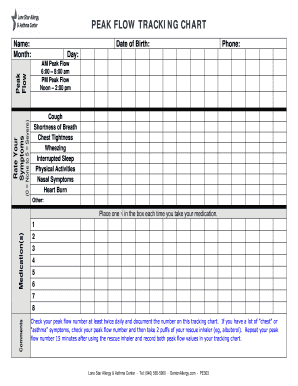
Flow Rate Your Symptoms Phone: Cough Shortness of Breath Chest Tightness Wheezing Interrupted Sleep Physical Activities Nasal Symptoms Heart Burn Other: Place one √ in the box each time you take your medication. Medication(s) 1 2 3 4 5 6 7 Comments 8 Check your peak flow number at least twice daily and document the number on this tracking chart. If you have a lot of "chest" or "asthma" symptoms, check your peak flow number and then take 2 puffs of your rescue inhaler (eg, ). R.

How it works

  1. Open form

    Open form follow the instructions

  2. Easily sign form

    Easily sign the form with your finger

  3. Share form

    Send filled & signed form or save

How to fill out the Lone Star Allergy & Asthma Center Peak Flow Tracking Chart online

This guide provides clear and comprehensive instructions on how to accurately fill out the Lone Star Allergy & Asthma Center Peak Flow Tracking Chart online. By following these steps, users can effectively track their peak flow readings and manage their asthma and allergy symptoms.

Follow the steps to complete your peak flow tracking chart online.

  1. Click ‘Get Form’ button to obtain the form and open it in the editor.
  2. Begin by entering your name and the month for which you are tracking your peak flow. This information helps personalize your chart and makes it easier to reference your readings.
  3. Input your date of birth. This data can be useful for medical history documentation purposes.
  4. Record your peak flow measurements twice daily, once in the morning (from 6:00 to 8:00 am) and once in the afternoon (from noon to 2:00 pm). Enter the values in the designated AM and PM peak flow sections.
  5. Rate your symptoms on a scale from 0 (none) to 5 (severe) for various symptoms of asthma and allergies, including cough, shortness of breath, chest tightness, wheezing, interrupted sleep, physical activities, nasal symptoms, heartburn, and any other additional symptoms you may have experienced.
  6. Document any medications you take by placing a checkmark in the corresponding boxes each time you take them. This will help you keep track of your medication usage.
  7. Use the comments section for any additional notes or observations that may be relevant to your peak flow readings or symptoms.
  8. After entering all the necessary information, save your changes, then you can download, print, or share the form as needed.

Start filling out your peak flow tracking chart online today to take control of your asthma and allergy management.

Get form

Experience a faster way to fill out and sign forms on the web. Access the most extensive library of templates available.
Get form

Related content

Action Against Asthma: A Strategic Plan for the...
Apr 30, 2000 — Daily peak flow monitoring is recommended for patients with...
Learn more
(PDF) EAACI Molecular Allergology User's Guide
Part A of the EAACI MAUG introduces allergen molecules, families, extracts, databases, and...
Learn more
Goro Majima/History of the story
Sep 10, 2025 — A document summarizing the whereabouts of Goro Majima, a character in the...
Learn more

Related links form

Egypt Visa Application Form Pdf Iacp Membership Tp 215 Fill In Form Denial Codes

Questions & Answers

Get answers to your most pressing questions about US Legal Forms API.

Contact support

To use a peak flow meter step by step, begin by setting the indicator to zero. Take a deep breath, and blow out forcefully into the mouthpiece. Record the value on the Lone Star Allergy & Asthma Center Peak Flow Tracking Chart, and repeat the process two more times to obtain an average reading, which assists in tracking changes in your asthma condition.

To diagnose asthma using a peak flow meter, first establish personal best scores through consistent monitoring. Assess these scores over time to identify patterns of variance. The readings documented in the Lone Star Allergy & Asthma Center Peak Flow Tracking Chart help healthcare professionals make informed decisions regarding your asthma management.

A peak flow meter aids in diagnosing asthma by measuring how well air moves out of your lungs. By comparing peak flow readings to baseline measurements, healthcare providers can determine asthma severity. Regular use of the Lone Star Allergy & Asthma Center Peak Flow Tracking Chart can provide essential insights into your lung function.

To take a peak flow reading, first, stand up straight and hold the peak flow meter horizontally. Take a deep breath, place your lips tightly around the mouthpiece, and exhale forcefully. Capture this reading on the Lone Star Allergy & Asthma Center Peak Flow Tracking Chart to keep a record for your healthcare provider.

When using a peak flow meter, a patient with asthma should start by ensuring the meter is at zero. Next, take a deep breath and then blow out as hard and fast as possible into the mouthpiece. Finally, record the reading on the Lone Star Allergy & Asthma Center Peak Flow Tracking Chart to track your asthma management effectively.

A peak flow score indicating asthma usually falls below the patient's personal best score. This varies by individual, but a score in the yellow zone suggests that your asthma may not be well controlled. Using the Lone Star Allergy & Asthma Center Peak Flow Tracking Chart can help monitor your scores, guiding you to understand when to seek medical advice.

It is definitely better to have a high peak flow, as this indicates better lung function and control of asthma symptoms. A lower peak flow can signify reduced airflow, which may lead to asthma attacks. Stay proactive about your lung health by keeping track of your peak flow measurements with the Lone Star Allergy & Asthma Center Peak Flow Tracking Chart.

Whether 250 is a good reading on a peak flow meter depends on your individual baseline and health status. For some, it may indicate optimal lung function, while for others, it may be concerning. Use the Lone Star Allergy & Asthma Center Peak Flow Tracking Chart to help interpret your results in a meaningful context.

A good lung capacity percentage typically ranges between 80% to 100% of predicted values based on age, height, and gender. Values below this range may indicate issues that warrant further evaluation. To keep track of your lung capacity, the Lone Star Allergy & Asthma Center Peak Flow Tracking Chart serves as a helpful tool.

Asthma peak flow meter results should ideally fall between 80% to 100% of your personal best for healthy management. When readings drop below this threshold, it may signal the need for additional care or adjustment to your asthma action plan. Consider using the Lone Star Allergy & Asthma Center Peak Flow Tracking Chart for effective tracking and management.

Get This Form Now!

Use professional pre-built templates to fill in and sign documents online faster. Get access to thousands of forms.
Get form
If you believe that this page should be taken down, please follow our DMCA take down processhere.
Get Lone Star Allergy & Asthma Center Peak Flow Tracking Chart
Get form
  • Adoption
  • Bankruptcy
  • Contractors
  • Divorce
  • Home Sales
  • Employment
  • Identity Theft
  • Incorporation
  • Landlord Tenant
  • Living Trust
  • Name Change
  • Personal Planning
  • Small Business
  • Wills & Estates
  • Packages A-Z
  • Affidavits
  • Bankruptcy
  • Bill of Sale
  • Corporate - LLC
  • Divorce
  • Employment
  • Identity Theft
  • Internet Technology
  • Landlord Tenant
  • Living Wills
  • Name Change
  • Power of Attorney
  • Real Estate
  • Small Estates
  • Wills
  • All Forms
  • Forms A-Z
  • Other Templates
  • Legal Hub
  • About Us
  • Help Portal
  • Legal Resources
  • Blog
  • Affiliates
  • Contact Us
  • Delete My Account
  • Site Map
  • Industries
  • Forms in Spanish
  • Localized Forms
  • State-specific Forms
  • Forms Kit
  • Real Estate Handbook
  • All Guides
  • Notarize
  • Incorporation services
  • For Consumers
  • For Small Business
  • For Attorneys
  • USLegal
  • FormsPass
  • pdfFiller
  • signNow
  • altaFlow
  • DocHub
  • Instapage
Form Packages
  • Adoption
  • Bankruptcy
  • Contractors
  • Divorce
  • Home Sales
  • Employment
  • Identity Theft
  • Incorporation
  • Landlord Tenant
  • Living Trust
  • Name Change
  • Personal Planning
  • Small Business
  • Wills & Estates
  • Packages A-Z
Form Categories
  • Affidavits
  • Bankruptcy
  • Bill of Sale
  • Corporate - LLC
  • Divorce
  • Employment
  • Identity Theft
  • Internet Technology
  • Landlord Tenant
  • Living Wills
  • Name Change
  • Power of Attorney
  • Real Estate
  • Small Estates
  • Wills
  • All Forms
  • Forms A-Z
  • Other Templates
Customer Service
  • Legal Hub
  • About Us
  • Help Portal
  • Legal Resources
  • Blog
  • Affiliates
  • Contact Us
  • Delete My Account
  • Site Map
  • Industries
  • Forms in Spanish
  • Localized Forms
  • State-specific Forms
  • Forms Kit
Legal Guides
  • Real Estate Handbook
  • All Guides
Prepared for you
  • Notarize
  • Incorporation services
Our Customers
  • For Consumers
  • For Small Business
  • For Attorneys
Our Sites
  • USLegal
  • FormsPass
  • pdfFiller
  • signNow
  • altaFlow
  • DocHub
  • Instapage
Social Media
Call us now toll free:
+1 833 426 79 33
As seen in:
© Copyright 1999-2026 airSlate Legal Forms, Inc. 17 Station Street, Ste. 203, Brookline, MA 02445
  • Your Privacy Choices
  • Terms of Service
  • Privacy Notice
  • Content Takedown Policy
  • Bug Bounty Program