Loading
Form preview
  • US Legal Forms
  • Other Templates
  • Industry Forms
  • Industry Insurance & Medical Forms
  • Cdc Measuring Orthostatic Blood Pressure

Get Cdc Measuring Orthostatic Blood Pressure

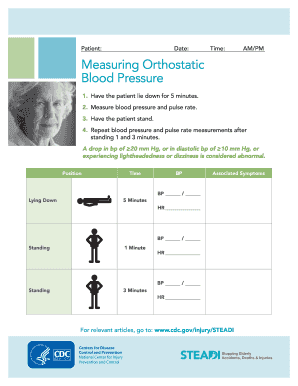
Patient: Date: Time: AM/PM Measuring Orthostatic Blood Pressure 1. Have the patient lie down for 5 minutes. 2. Measure blood pressure and pulse rate. 3. Have the patient stand. 4. Repeat blood pressure.

How it works

  1. Open form

    Open form follow the instructions

  2. Easily sign form

    Easily sign the form with your finger

  3. Share form

    Send filled & signed form or save

How to fill out the CDC Measuring Orthostatic Blood Pressure online

Filling out the CDC Measuring Orthostatic Blood Pressure form is crucial for accurately assessing a patient's blood pressure changes upon standing. This guide will provide clear, step-by-step instructions to ensure you complete the form effectively and accurately.

Follow the steps to complete the form with ease.

  1. Press the ‘Get Form’ button to access the measuring orthostatic blood pressure document online.
  2. Enter the date at the top of the form where indicated. This date is important for tracking the patient’s blood pressure monitoring.
  3. Specify the time of the measurement. Indicate whether it is AM or PM to maintain accurate records.
  4. Instruct the patient to lie down for a minimum of 5 minutes before taking any measurements. This is essential for obtaining baseline readings.
  5. Measure the patient’s blood pressure and pulse rate while they are lying down. Record these values in the designated fields on the form.
  6. Have the patient stand up. This step is critical as it allows for further assessment of blood pressure changes.
  7. Measure and record the blood pressure and pulse rate again after the patient has been standing for 1 minute. Make sure to note these results accurately.
  8. Repeat the blood pressure and pulse rate measurements after the patient has been standing for 3 minutes and document the readings on the form.
  9. Review the recorded information. If there is a drop in systolic blood pressure of ≥20 mm Hg, diastolic blood pressure of ≥10 mm Hg, or if the patient reports lightheadedness or dizziness, this should be noted as abnormal.
  10. Once all sections are completed, save the changes made to the form. You can also download, print, or share the completed document as needed.

Complete your documents online for efficient and accurate record-keeping.

Get form

Experience a faster way to fill out and sign forms on the web. Access the most extensive library of templates available.
Get form

Related content

Measuring Orthostatic Blood Pressure
1 Have the patient lie down for 5 minutes. 2 Measure blood pressure and pulse rate. 3 Have...
Learn more
Measuring Orthostatic Blood Pressure
1. Have the patient lie down for 5 minutes. 2. Measure blood pressure and pulse rate. 3...
Learn more
Older Adult Oncology - Urology Guidelines
Dec 9, 2024 — Check orthostatic blood pressure. • Diagnose and treat underlying...
Learn more

Related links form

Instructions For 2010 Schedule R Form 1040 1041 Schedule D Instructions 2010 Form Form 1116 Instructions 2010 Schedule O Instructions

Questions & Answers

Get answers to your most pressing questions about US Legal Forms API.

Contact support

To calculate orthostatic blood pressure, you need to compare the readings taken from different positions. Subtract the seated or supine blood pressure from the standing blood pressure. This difference can help determine the presence of orthostatic hypotension. For a thorough approach, follow the CDC Measuring Orthostatic Blood Pressure recommendations to ensure precise calculations.

Documenting orthostatic blood pressure involves accurately recording the patient's blood pressure in different positions. Begin with measurements in a supine position, then while seated, and finally while standing. Each reading should be noted in a consistent format to ensure clarity. Using the CDC Measuring Orthostatic Blood Pressure guidelines can enhance accuracy in documentation.

To document orthostatic blood pressure, first measure the blood pressure of the patient while they are sitting or lying down. Next, have the patient stand up and measure their blood pressure again after a short period. Record these readings clearly, noting the positions for each measurement. Utilizing tools like CDC Measuring Orthostatic Blood Pressure can help streamline this process.

To qualify as orthostatic hypotension, systolic blood pressure must drop by at least 20 mmHg or diastolic blood pressure must decrease by at least 10 mmHg when moving from sitting or lying to standing. These thresholds help identify individuals who may be at risk for dizziness or falls due to blood pressure drops. It's important to follow CDC guidelines to ensure accurate assessment during these measurements. If you're looking for additional resources, USLegalForms can offer templates and documentation to assist you in this area.

Orthostatic blood pressure is measured by taking readings while the person is lying down, and then again after standing. First, you should record the systolic and diastolic blood pressures after the person has rested for several minutes. Next, have the individual stand and measure the blood pressure again within a minute. This method provides valuable insights into how well the body adapts to changes in posture, and you can rely on CDC Measuring Orthostatic Blood Pressure for more detailed guidance.

The 30/20/10 rule outlines the acceptable ranges for blood pressure changes when transitioning between positions. This means systolic pressure should exhibit a drop of less than 20 mmHg, diastolic pressure should ideally decrease by no more than 10 mmHg, and these observations should be made after a 30-second transition. Utilizing these parameters allows healthcare providers to assess orthostatic hypotension efficiently. For precise measurement techniques, consider consulting the CDC’s materials on measuring orthostatic blood pressure.

The 10 20 30 rule relates to how blood pressure changes when a person shifts from a lying position to standing. In this rule, a person's systolic blood pressure should not fall more than 20 mmHg, diastolic blood pressure should not drop over 10 mmHg, and these changes should occur within 30 seconds of standing. Adhering to these standards helps gauge potential orthostatic hypotension more effectively. For a detailed understanding, refer to the CDC guidelines on measuring orthostatic blood pressure.

To obtain accurate information about orthostatic blood pressure measurements, you can visit the CDC's official website. There, you will find resources and guidelines on how to properly measure and interpret orthostatic blood pressure. It's essential to follow these instructions to ensure you collect the right data. If you need further assistance, USLegalForms can guide you in understanding these processes.

Diagnosing orthostatic hypertension typically requires monitoring blood pressure changes when you change positions. After taking baseline readings, standing measurements can reveal significant blood pressure fluctuations. Utilize the CDC Measuring Orthostatic Blood Pressure recommendations to facilitate this diagnosis. If you suspect you have this condition, consult with your healthcare provider for a thorough evaluation.

Confirming orthostatic hypotension involves a systematic approach to measuring blood pressure in different positions. Start by taking a baseline reading while seated, then take readings while standing after one to three minutes. A drop in blood pressure upon standing, as per the CDC Measuring Orthostatic Blood Pressure guidelines, can confirm orthostatic hypotension. A healthcare professional can assist you in interpreting these results accurately.

Get This Form Now!

Use professional pre-built templates to fill in and sign documents online faster. Get access to thousands of forms.
Get form
If you believe that this page should be taken down, please follow our DMCA take down processhere.
Get CDC Measuring Orthostatic Blood Pressure
Get form
  • Adoption
  • Bankruptcy
  • Contractors
  • Divorce
  • Home Sales
  • Employment
  • Identity Theft
  • Incorporation
  • Landlord Tenant
  • Living Trust
  • Name Change
  • Personal Planning
  • Small Business
  • Wills & Estates
  • Packages A-Z
  • Affidavits
  • Bankruptcy
  • Bill of Sale
  • Corporate - LLC
  • Divorce
  • Employment
  • Identity Theft
  • Internet Technology
  • Landlord Tenant
  • Living Wills
  • Name Change
  • Power of Attorney
  • Real Estate
  • Small Estates
  • Wills
  • All Forms
  • Forms A-Z
  • Other Templates
  • Legal Hub
  • About Us
  • Help Portal
  • Legal Resources
  • Blog
  • Affiliates
  • Contact Us
  • Delete My Account
  • Site Map
  • Industries
  • Forms in Spanish
  • Localized Forms
  • State-specific Forms
  • Forms Kit
  • Real Estate Handbook
  • All Guides
  • Notarize
  • Incorporation services
  • For Consumers
  • For Small Business
  • For Attorneys
  • USLegal
  • FormsPass
  • pdfFiller
  • signNow
  • altaFlow
  • DocHub
  • Instapage
Form Packages
  • Adoption
  • Bankruptcy
  • Contractors
  • Divorce
  • Home Sales
  • Employment
  • Identity Theft
  • Incorporation
  • Landlord Tenant
  • Living Trust
  • Name Change
  • Personal Planning
  • Small Business
  • Wills & Estates
  • Packages A-Z
Form Categories
  • Affidavits
  • Bankruptcy
  • Bill of Sale
  • Corporate - LLC
  • Divorce
  • Employment
  • Identity Theft
  • Internet Technology
  • Landlord Tenant
  • Living Wills
  • Name Change
  • Power of Attorney
  • Real Estate
  • Small Estates
  • Wills
  • All Forms
  • Forms A-Z
  • Other Templates
Customer Service
  • Legal Hub
  • About Us
  • Help Portal
  • Legal Resources
  • Blog
  • Affiliates
  • Contact Us
  • Delete My Account
  • Site Map
  • Industries
  • Forms in Spanish
  • Localized Forms
  • State-specific Forms
  • Forms Kit
Legal Guides
  • Real Estate Handbook
  • All Guides
Prepared for you
  • Notarize
  • Incorporation services
Our Customers
  • For Consumers
  • For Small Business
  • For Attorneys
Our Sites
  • USLegal
  • FormsPass
  • pdfFiller
  • signNow
  • altaFlow
  • DocHub
  • Instapage
Social Media
Call us now toll free:
+1 833 426 79 33
As seen in:
© Copyright 1999-2026 airSlate Legal Forms, Inc. 17 Station Street, Suite 303, Brookline, MA 02445
  • Your Privacy Choices
  • Terms of Service
  • Privacy Notice
  • Content Takedown Policy
  • Bug Bounty Program