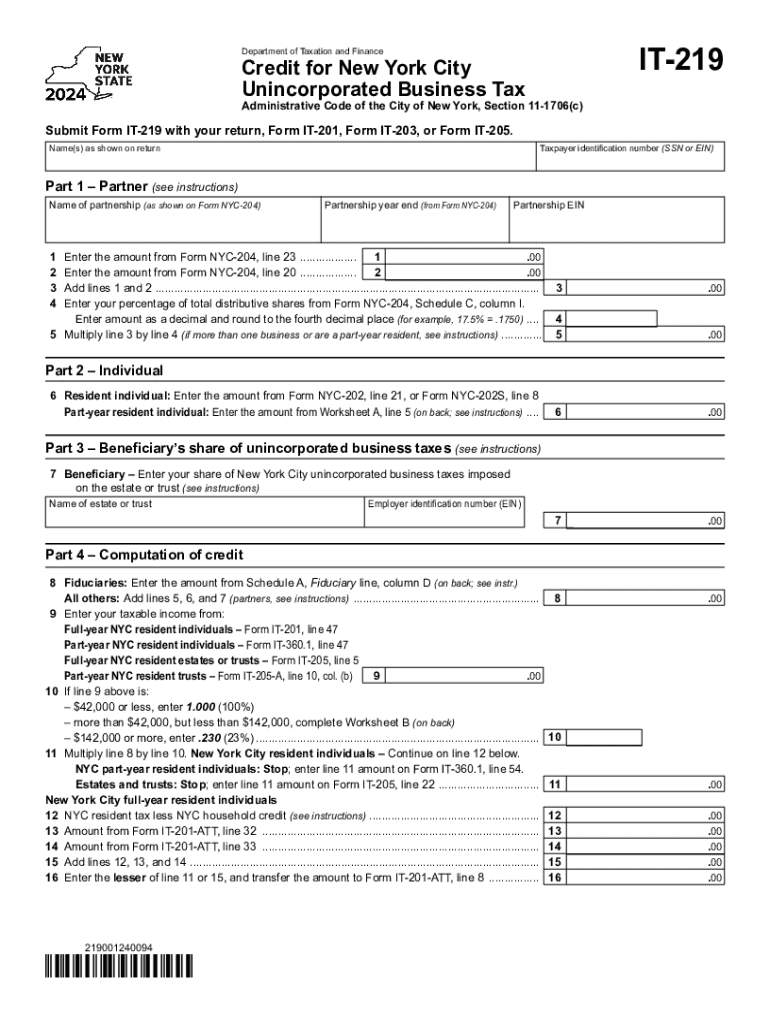
Urn, Form IT-201, Form IT-203, or Form IT-205. Name(s) as shown on return Taxpayer identification number (SSN or EIN) Part 1 Partner (see instructions) Name of partnership (as shown on Form NYC-204) Partnership year end (from Form NYC-204) Partnership EIN 1 Enter the amount from Form NYC-204, line 23 ................... 1 .00 2 Enter the amount from Form NYC-204, line 20 ................... 2 .00 3 Add lines 1 and 2 .
Loading

Open form follow the instructions

Easily sign the form with your finger

Send filled & signed form or save
How to fill out the NY DTF IT-219 online
The NY DTF IT-219 form is utilized to claim a credit for the New York City unincorporated business tax. Completing this form correctly is essential for ensuring you receive the proper tax credits applicable to your situation.
Follow the steps to fill out the NY DTF IT-219 online.
- Click ‘Get Form’ button to access the form and open it for editing.
- Provide your name as shown on your return and enter your taxpayer identification number (either your Social Security Number or Employer Identification Number).
- In Part 1, for the partner information section, enter the name of the partnership as indicated on Form NYC-204 along with the partnership year-end and partnership EIN.
- Enter the amounts from Form NYC-204, specifically line 23 in the first box and line 20 in the second box.
- Add the amounts from the first two lines and record the total in the next field.
- Next, input your percentage of total distributive shares from Form NYC-204, Schedule C, column I. Represent this as a decimal rounded to the fourth decimal place.
- Multiply the total amount from the previous step by your percentage to compute the applicable amount.
- For Part 2, as an individual, enter the required amounts depending on whether you are a resident or part-year resident individual.
- In Part 3, if applicable, enter your share of New York City unincorporated business taxes imposed on an estate or trust.
- Proceed to Part 4 to compute your credit; record the amounts as directed.
- Finally, review your entries. You can then save your changes, download, print, or share the form as needed.
Complete and submit your NY DTF IT-219 form online for an efficient tax process.
Experience a faster way to fill out and sign forms on the web. Access the most extensive library of templates available.
Related content
Dec 23, 2024 — IT-219 (Fill-in) · IT-219-I (Instructions), Credit for New York City...
Mark your choice at line 68: • Direct deposit is still the easiest, fastest way to get...
Read these instructions carefully and complete all applicable sections on the form. We...
Get answers to your most pressing questions about US Legal Forms API.
What is the throwback rule?
The throwback rule generally provides that when receipts from the sale of tangible personal property[1] are sourced to a state (i.e., the purchaser's state) where the taxpayer is not taxable, the sales are “thrown back” into the numerator of the taxing state's sales factor.
What is the throwback tax on a trust?
The throwback tax applies when a trust that has accumulated income, all or some of which has not been taxed by California, makes a distribution of such accumulated income to a California- resident beneficiary who also was a California resident when the income was accumulated.
Who must file NYC unincorporated business tax?
What activities are subject to this tax? Unincorporated businesses include trades, professions, and certain occupations of an individual, partnership, limited liability company, fiduciary, association, estate, or trust. The business can be active or in the process of being liquidated.
What is the NY trust throwback tax?
These provisions are known as the “throwback rules.” Under the throwback rules, a beneficiary receiving an accumulation distribution is taxed as if the trust had made the distribution in the year it accumulated the income.
What is DTF payment NY?
what it means and why you're being charged. NYS DTF PIT stands for New York State Department of Tax and Finance Personal Income Tax. The acronym breaks down as follows: NYS (New York State), DTF (Department of Tax and Finance), and PIT (Personal Income Tax).
What is NY investment tax credit?
Businesses that make investments in buildings, machinery, or equipment can receive a tax credit in New York State. This credit is called the Investment Tax Credit (ITC). Industrial, select commercial and financial service firms are eligible for the credit. The credit amount is a percentage of the amount of investment.
How are trusts taxed in New York State?
New York State Trusts As stated earlier, resident trusts are taxed on all its taxable income regardless of where it is sourced. One thing to note, trust income is taxed at the trust level only on taxable income that is not distributed to its beneficiaries.
What is the New York trust Throwback rule?
The throwback tax was enacted by New York to address a perceived abuse in the case of nongrantor trusts qualifying for the New York Resident Trust Exception that accumulate income and distribute such income to New York resident beneficiaries in subsequent years effectively free of New York income tax.
Use professional pre-built templates to fill in and sign documents online faster. Get access to thousands of forms.
If you believe that this page should be taken down, please follow our DMCA take down process here.