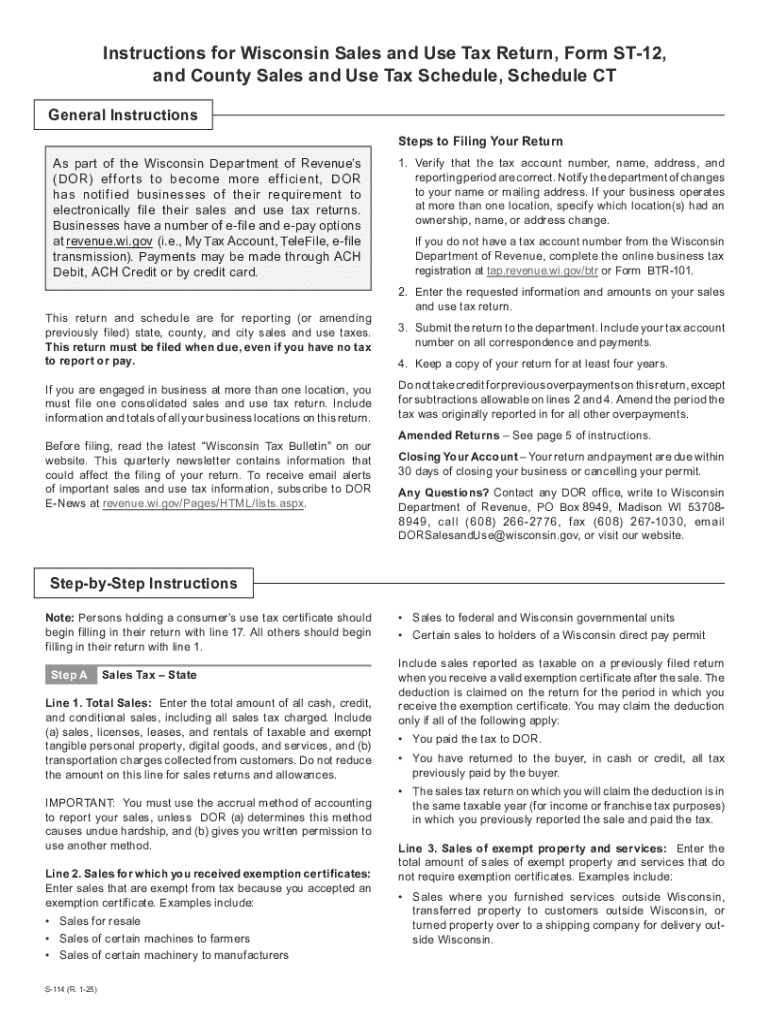
Instructions for Wisconsin Sales and Use Tax Return, Form ST12, and County Sales and Use Tax Schedule, Schedule CT General Instructions Steps to Filing Your ReturnAs part of the Wisconsin Department.

Open form follow the instructions

Easily sign the form with your finger

Send filled & signed form or save
How to fill out the WI DoR S-114 online
Filing the WI DoR S-114 online is an essential step for businesses reporting sales and use tax in Wisconsin. This guide provides clear, step-by-step instructions to help users navigate through each section of the form efficiently.
Follow the steps to complete your WI DoR S-114 online.
- Click ‘Get Form’ button to obtain the form and open it in the editor.
- Verify that the tax account number, name, address, and reporting period are accurate. Notify the department of any changes regarding your name or address.
- Enter the total amount of all cash, credit, and conditional sales on line 1. Ensure this amount includes all sales tax charged.
- On line 2, document sales where you received exemption certificates, such as sales for resale or to governmental units.
- Fill in line 3 with the total amount of sales of exempt property and services that do not require exemption certificates.
- Report returns, allowances, and bad debts on line 4. Include any trade-in allowances or cash discounts applicable.
- Complete Schedule CT for sales to locations subject to county and city taxes. Enter totals as instructed.
- Calculate total sales tax on line 13 by adding the amounts from applicable previous lines.
- On line 15, apply any applicable retailer’s discount based on the amount listed on line 14.
- Subtract line 15 from line 14 to determine net sales tax, which should be recorded on line 16.
- Document purchases subject to use tax on line 17 and complete any calculations for taxes due as outlined.
- Finally, after reviewing your entries, save changes, download, print, or share the completed form as needed.
Ensure accuracy and compliance by completing your WI DoR S-114 online today.
Experience a faster way to fill out and sign forms on the web. Access the most extensive library of templates available.
Related content
Contact any DOR office, write to Wisconsin. Department of Revenue, PO Box 8949, Madison WI...
Withholding Tax Forms ; BTR-101, Application for Business Tax Registration ; BTR-114...
This compilation includes state, District of Columbia, and territory statutes as of...
Get answers to your most pressing questions about US Legal Forms API.
Who is exempt from sales tax in Wisconsin?
Some customers are exempt from paying sales tax under Wisconsin law. Examples include government agencies, some nonprofit organizations, and merchants purchasing goods for resale. Sellers are required to collect a valid exemption or resale certificate from buyers to validate each exempt transaction.
What is the highest taxed county in Wisconsin?
Located west of Milwaukee, Dane County is home to the Wisconsin state capital, Madison. In dollar terms, homeowners in Dane County pay some of the highest property taxes of any county in Wisconsin. The median annual property tax paid by Dane County's homeowners is $6,103, by far the highest in the state.
What is the tax return for Hoa in Wisconsin?
Wisconsin HOA Tax Filing Requirements Filing returns can be done using either Form 1120 or 1120–H. All corporations were generally required to file Form 1120 before the Tax Reform Act of 1976. All HOAs were treated as “for-profit” corporations. Form 1120 was disadvantageous to most HOAs.
Why do I owe sales and use tax in Wisconsin?
If you purchase taxable items from a retailer who does not collect Wisconsin sales tax or bring taxable items into Wisconsin from another state or country, you owe use tax.
What are the exceptions to the underpayment penalty in Wisconsin?
You will not owe underpayment interest if your prior year tax return was for a tax year of 12 full months (or would have been if you had been required to file) and either of the following applies: You had no tax liability for the prior year and you were a Wisconsin resident for all of the prior year, or.
What is the income tax rate in Wisconsin?
Wisconsin has a graduated state individual income tax, with rates ranging from 3.50 percent to 7.65 percent. Wisconsin has a 7.9 percent corporate income tax rate. Wisconsin also has a 5.00 percent state sales tax rate and an average combined state and local sales tax rate of 5.70 percent.
What is the dor tax rate in Wisconsin?
Wisconsin individual income tax rates vary from 3.50% to 7.65%, depending upon marital status and income. Note: Nonresidents and part-year residents must prorate the tax based on the ratio of their Wisconsin income to their federal adjusted gross income. See the Wisconsin Form 1NPR instructions for further details. 2.
What is the Ptet tax rate in Wisconsin?
What is the entity-level tax rate? The net income reportable to Wisconsin is taxed at 7.9% as provided in sec.
Use professional pre-built templates to fill in and sign documents online faster. Get access to thousands of forms.
If you believe that this page should be taken down, please follow our DMCA take down process here.