Loading
Get Ca Ea-116 2020-2026
How it works
-

Open form follow the instructions
-

Easily sign the form with your finger
-

Send filled & signed form or save
How to fill out the CA EA-116 online
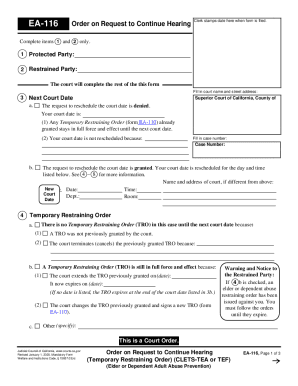
Filling out the CA EA-116 form is an essential step in requesting to continue a hearing regarding a Temporary Restraining Order. This guide provides clear, step-by-step instructions to assist users in completing the form accurately and efficiently through an online platform.
Follow the steps to complete the CA EA-116 form effectively.
- Click ‘Get Form’ button to access the CA EA-116 form and open it for editing.
- Begin by completing items 1 and 2: In item 1, provide the information for the 'Protected Party' and in item 2, the details for the 'Restrained Party'.
- Fill in the 'Court name' and 'street address' for the relevant Superior Court of California.
- Specify the 'Next Court Date' by checking the appropriate option. If the request to reschedule the court date is denied, note the denial. If granted, provide the new date and time.
- Indicate whether there is a Temporary Restraining Order (TRO) in effect. Check the relevant boxes to denote if a TRO was not granted, has been canceled, or is still in effect, and provide the dates accordingly.
- Provide reasons for rescheduling the court date in the section labeled 'Reason Court Date Is Rescheduled'. Ensure to check the applicable reasons as outlined.
- Determine who made the request to reschedule the hearing and fill in the details as required for serving the order to the other party.
- Check the box indicating that the sheriff or marshal will serve this order for free, and ensure to bring all necessary documents.
- Complete the date field and sign the form where indicated by the judicial officer.
- Once the form is filled out, save changes, download the document, print it as needed, or share it with relevant parties.
Complete your CA EA-116 form online for a streamlined submission process.
If a permanent restraining order is not granted, the temporary order will be removed from your record. However, even if the interim order is no longer active, it may still be accessible in certain situations, such as through more comprehensive background checks or court records.