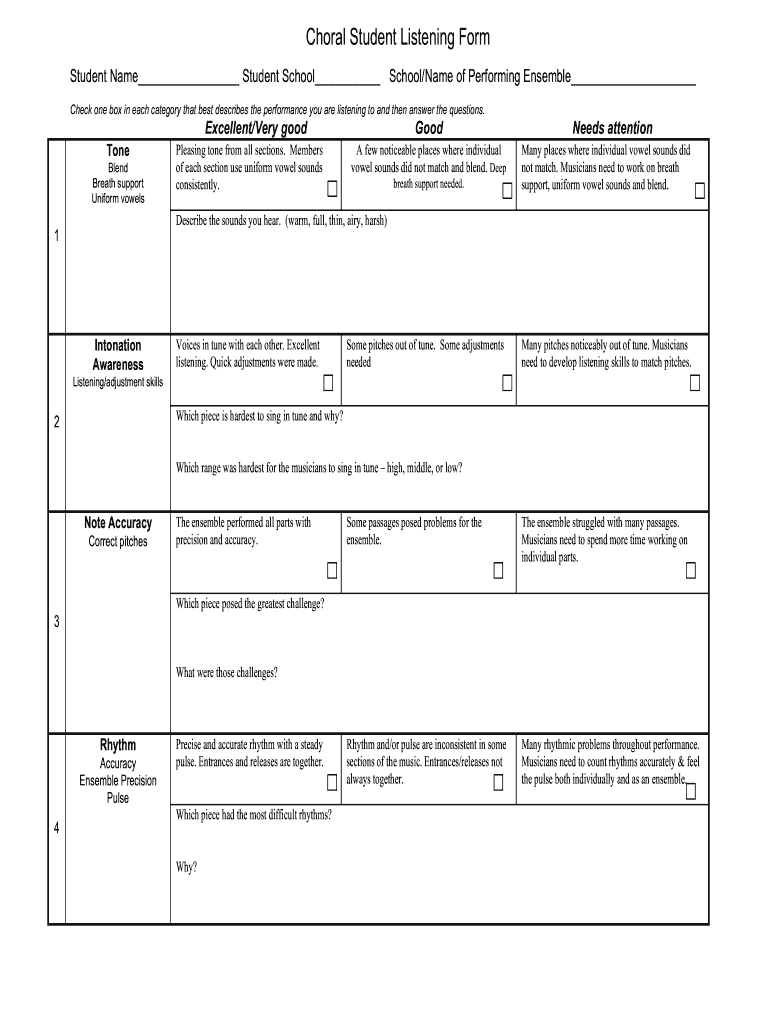
performance you are listening to and then answer the questions. Excellent/Very good Tone Blend Breath support Uniform vowels Pleasing tone from all sections. Members of each section use uniform vowel sounds consistently. Good A few noticeable places where individual vowel sounds did not match and blend. Deep breath support needed. Needs attention Many places where individual vowel sounds did not match. Musicians need to work on breath support, uniform vowel sounds and blend. Describe the s.
Loading

Open form follow the instructions

Easily sign the form with your finger

Send filled & signed form or save
How to fill out the WSMA Choral Student Listening Form online
Filling out the WSMA Choral Student Listening Form online is an essential process for providing structured feedback on choral performances. This guide offers clear, step-by-step instructions to ensure you complete the form accurately and effectively.
Follow the steps to fill out the WSMA Choral Student Listening Form.
- Press the ‘Get Form’ button to access the form and launch it in your preferred online editor.
- Begin by entering the student name and student school in the designated fields at the top of the form. Ensure that the information is accurate and spelled correctly.
- In the section for the performing ensemble, identify the name of the group performing and fill it in correctly to provide context for your feedback.
- For each category related to performance quality, click the box that best reflects your assessment. Categories include tone, intonation, note accuracy, rhythm, balance, musical expression, and attention to the director. Make careful selections based on your observations.
- In the text fields provided, describe the sounds you heard, including characteristics such as warmth, fullness, or harshness. Provide specific feedback for each question to support your assessments.
- Answer the questions related to the ensemble's challenges and strengths. Each question is designed to prompt thoughtful responses that offer insights into the performance.
- Once all information is filled out, review the form for completeness and accuracy to ensure that all required fields are addressed.
- Finally, save your changes, then choose to download, print, or share the completed form as needed to submit your feedback.
Complete your WSMA Choral Student Listening Form online today to provide valuable feedback!
Experience a faster way to fill out and sign forms on the web. Access the most extensive library of templates available.
Related content
Jan 2, 2025 — Music Listening Project. - focused on listening activities with different...
The handbook covers admission, audition, scholarships, degree options, academic integrity...
... student services, plus photographs of. MSOE technical laboratories and student...
Get answers to your most pressing questions about US Legal Forms API.
What are the objectives of choir students learning?
Course Objectives: 1. Students will learn to be confident in their singing voice, and be able to demonstrate proper vocal techniques. 2. Students will be able to read music, including note reading, rhythms, key and time signatures, etc.
What skills do you need to be in a choir?
List of Standard Choral Singing Skills Speak and read English. (We may occasionally do a song in another language, and we'll teach you how.) Match pitches accurately and quickly on demand. ... Sing notes throughout your vocal range. ... Mimic rhythms accurately. ... Steady beat. ... Slow and fast. ... Loud and soft. ... Breathing.
What are the parts of the choir music?
Parts of a Choir Soprano (S): typically sung by higher-voiced, adult females or children. Alto (A): typically sung by lower-voiced, adult females or children and less-typically by males who sing in their falsetto range. Tenor (T): typically sung by higher-voiced, adult males.
What are the choir listening questions?
1) What are your first impressions of the music that you hear? 2) Describe the mood and setting of the song. 3) What images or thoughts are you reminded of? 4) What do you think the text of the song is describing (what is it about)?
What are the 4 groups of choir?
In choral music arrangements each of these voices is represented by a letter—S for soprano, A for alto, T for tenor, and B for bass. Most choral music is arranged SATB, using a voice part from each of the four major classifications.
Use professional pre-built templates to fill in and sign documents online faster. Get access to thousands of forms.
If you believe that this page should be taken down, please follow our DMCA take down process here.