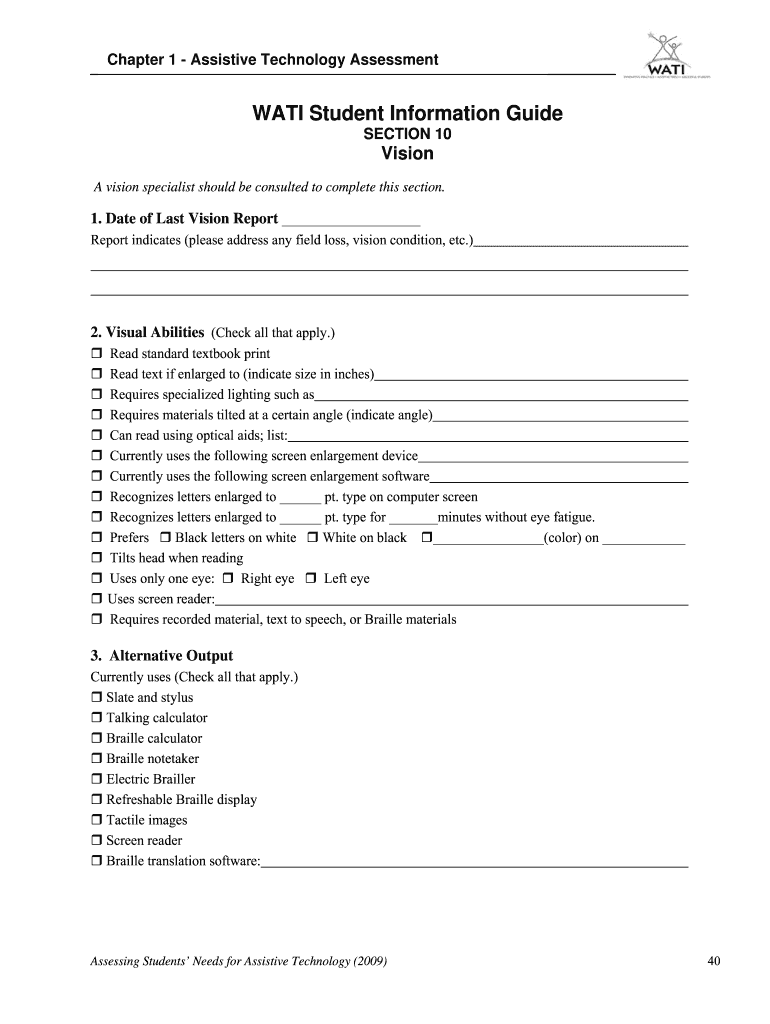
_________ Report indicates (please address any field loss, vision condition, etc.) 2. Visual Abilities (Check all that apply.) Read standard textbook print Read text if enlarged to (indicate size in inches) Requires specialized lighting such as Requires materials tilted at a certain angle (indicate angle) Can read using optical aids; list: Currently uses the following screen enlargement device Currently uses the following screen enlargement software Re.
Loading

Open form follow the instructions

Easily sign the form with your finger

Send filled & signed form or save
How to fill out the WATI Student Information Guide online
The WATI Student Information Guide is an essential document designed to assess the needs of students requiring assistive technology. This guide will provide a clear, step-by-step approach to filling out the form accurately online.
Follow the steps to successfully complete the WATI Student Information Guide.
- Click ‘Get Form’ button to access the WATI Student Information Guide and open it in your preferred online editor.
- Begin filling out Section 10 by consulting with a vision specialist. They will provide insights needed to complete this section accurately.
- Enter the date of the last vision report in the designated field. Ensure that you include any relevant details regarding field loss, vision conditions, or other pertinent information.
- Check all applicable visual abilities from the provided options, including reading ability, specialized lighting needs, and the use of optical aids. Be specific with your responses where indicated.
- In the Alternative Output section, check all current technologies the student uses. This may include tools like a Braille calculator or a screen reader.
- Move on to the level of proficiency section, selecting the option that most closely matches the student's ability to perform tasks independently or with assistance.
- Proceed to the Writing/Handwritten Materials section, checking all relevant capabilities regarding writing and reading. Ensure accuracy in all selections.
- Summarize the student's abilities and concerns related to vision in the provided space, using clear and precise language to convey all necessary information.
- Once all sections are completed, review the entire form for any errors or omissions. Make necessary corrections.
- Finally, save changes to your document. You can choose to download, print, or share the completed WATI Student Information Guide as required.
Start filling out the WATI Student Information Guide online today to ensure accurate assessment and support for the student.
Experience a faster way to fill out and sign forms on the web. Access the most extensive library of templates available.
Related content
WATI Assessment Package. Student Information Guide – Section 4. Communication. Rev...
WATI Assistive Technology Consideration Guide. Student''s Name. School. 1. What task is it...
Sep 1, 1976 — It was introduced at $450.00, but when processor prices went down we...
Get answers to your most pressing questions about US Legal Forms API.
How do you write a student report format?
A student report format should start with basic information like the student's name and class. Next, outline academic performance and behavioral comments in designated sections that make it easy to read. Utilizing the WATI Student Information Guide ensures you follow best practices while creating a comprehensive report.
How to fill a student report card?
To fill a student report card, start by reviewing the student’s evaluations across all subjects. Document their grades based on established criteria and write personalized comments that reflect their performance and behavior. The WATI Student Information Guide offers valuable templates to help simplify this task.
How do I fill out a student report card?
Filling out a student report card involves entering specific data regarding the student's performance and behavior in each subject. Begin with the student's personal details, then provide grades for academics, and include comments on their social skills and work habits. The WATI Student Information Guide provides clear instructions to streamline this process.
What is the WATI assessment?
The WATI assessment is a tool designed to help educators evaluate student needs and strengths, particularly in special education settings. This assessment guides you in developing a tailored educational plan that focuses on the individual student's growth. By using the WATI Student Information Guide, you can apply this assessment to create impactful learning experiences.
What are positive remarks for students behavior?
Positive remarks for student behavior can highlight traits such as cooperation, respect, and enthusiasm. For instance, you might say that a student consistently shows kindness to peers or displays a strong willingness to learn. Using the WATI Student Information Guide can assist you in crafting specific and encouraging feedback.
What do you write in a student report card?
In a student report card, you typically include the student's name, grade level, and the subjects they are being evaluated on. You should write comments that reflect their performance, such as their grades, attendance, and participation. The WATI Student Information Guide can help you understand how to assess each area effectively.
What is WATI assistive technology?
WATI assistive technology encompasses a variety of devices and software tailored to support students with disabilities. It includes tools that assist with communication, mobility, and learning processes. Implementing these technologies can significantly improve educational outcomes for students. To find detailed information on available options, check the WATI Student Information Guide.
What does WATI stand for?
WATI stands for the Wisconsin Assistive Technology Initiative. This initiative focuses on providing resources and support to individuals with disabilities and those who work with them. By promoting the use of assistive technology, WATI aims to enhance accessibility in various settings. For a deeper understanding, refer to the WATI Student Information Guide.
What is the WATI methodology?
The WATI methodology is a systematic approach aimed at assessing the needs of students with disabilities. It focuses on identifying the right assistive tools that promote independence and academic success. By utilizing this methodology, educators can tailor solutions that fit individual requirements. Explore the WATI Student Information Guide to understand how this methodology can be applied in your educational settings.
What are examples of assistive technology?
Assistive technology includes various tools designed to aid individuals with disabilities. Common examples are screen readers, speech recognition software, and adaptive keyboards. These technologies enhance access to information, making it easier for users to engage with the world. The WATI Student Information Guide can help you discover the best options for your needs.
Use professional pre-built templates to fill in and sign documents online faster. Get access to thousands of forms.
If you believe that this page should be taken down, please follow our DMCA take down process here.