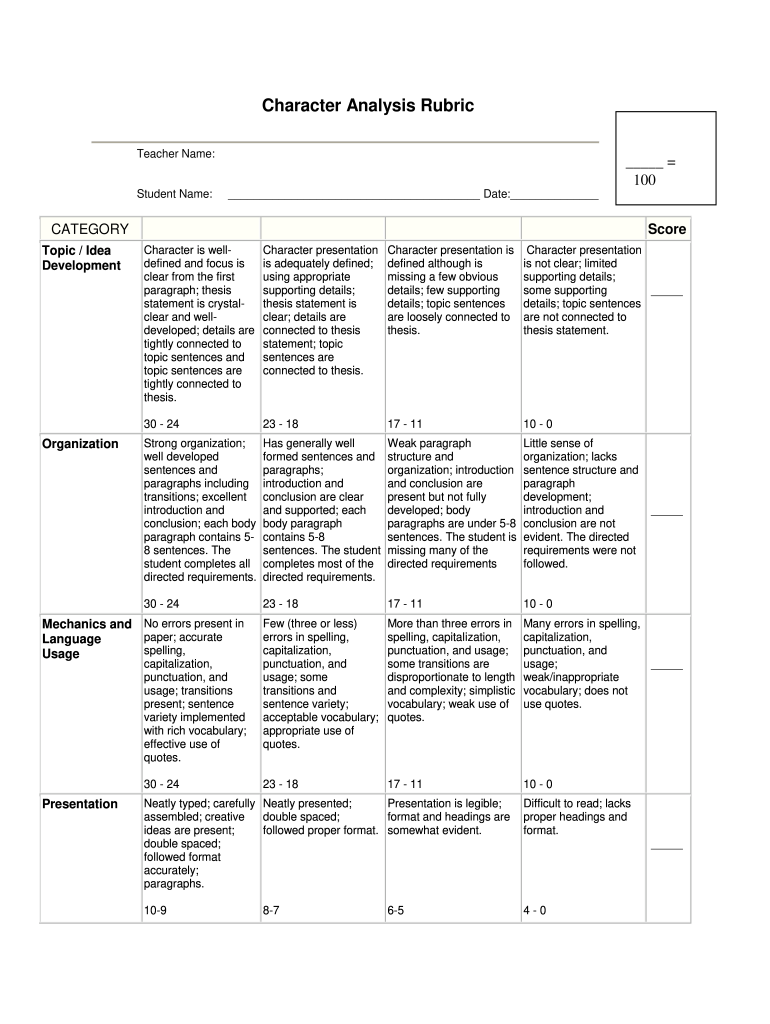
Character Analysis Rubric Teacher Name: Student Name: 100 Date: Score CATEGORY Character presentation is adequately defined; using appropriate supporting details; thesis statement is clear; details.

Open form follow the instructions

Easily sign the form with your finger

Send filled & signed form or save
How to fill out the Rock Academy Character Analysis Rubric online
This guide will assist you in navigating and completing the Rock Academy Character Analysis Rubric online. By following these instructions, you will present a thorough analysis of character elements effectively and efficiently.
Follow the steps to complete your rubric accurately.
- Press the ‘Get Form’ button to access the Rock Academy Character Analysis Rubric and open it for editing.
- Begin by entering the teacher's name in the designated field. Ensure accuracy as this identifies the evaluator.
- Next, input the student's name in the corresponding field to attribute the analysis to the correct individual.
- In the provided area, fill in the date on which you are completing the rubric. This will help track when the analysis was performed.
- Scoring starts with the first category: Topic/Idea Development. Assess the character definition and focus based on the provided criteria, and select the appropriate score.
- Move to the Organization section. Evaluate the structure of the analysis, including the introduction and conclusion. Assign a score reflecting the quality of organization.
- Proceed to the Mechanics and Language Usage category. Review the spelling, punctuation, and vocabulary used within the analysis. Choose a score based on your evaluation.
- Finally, assess the Presentation of the rubric. Consider the legibility and format of the document. Record this score as well.
- Once all fields are completed, you can save your changes. Options to download, print, or share the filled rubric will be available for your convenience.
Complete your Rock Academy Character Analysis Rubric online today!
Experience a faster way to fill out and sign forms on the web. Access the most extensive library of templates available.
Related content
Jun 30, 2025 — Nashville, TN - The Rock Academy is submitting a proposal to establish a...
Implementing this reading list aims to cultivate critical thinking, empathy, and a love...
Analysis of Effects of Determinants and Moderators. Academy of Management Journal...
Get answers to your most pressing questions about US Legal Forms API.
How to do a character analysis for a play?
To do a character analysis for a play, focus on the character's motivations, relationships, and development throughout the script. Using the Rock Academy Character Analysis Rubric, dissect specific scenes to understand how the character interacts with others and drives the plot forward. This comprehensive evaluation aids in creating a nuanced understanding of the character's significance within the play.
What are 5 methods of analysing characters?
Five effective methods of analyzing characters include examining their dialogue, scrutinizing their actions, assessing their relationships, exploring their inner thoughts, and noting their development over time. The Rock Academy Character Analysis Rubric provides a comprehensive framework to systematically apply these methods, ensuring a deep understanding of the character's role and impact. This thorough approach elevates your analysis to the next level.
How do you write a character analysis step by step?
Writing a character analysis step by step begins with choosing your character and studying their actions and motivations in the text. Next, apply the Rock Academy Character Analysis Rubric to complement your observations with structured criteria, ensuring you cover all aspects of the character. Finally, compile your findings into a cohesive analysis, maintaining clarity and focus throughout.
How to write a conclusion for a character analysis?
To write a conclusion for a character analysis, revisit the main traits and insights about the character and summarize how these contribute to the overall narrative. Utilizing the Rock Academy Character Analysis Rubric allows you to create a strong and coherent ending that ties all your points together effectively. This helps reinforce the character's significance in the story.
How to format a character analysis essay?
To format a character analysis essay, start with an introduction that includes a thesis statement about the character. Follow with body paragraphs that outline different aspects of the character, using the Rock Academy Character Analysis Rubric as a guide. Conclude with a summary of your insights, cementing the analysis for your readers.
How do you write a character analysis for a play?
Writing a character analysis for a play involves examining the character's dialogue, actions, and relationships with others. Use the Rock Academy Character Analysis Rubric to focus on how these elements reveal the character's personality traits and motivations. This structured analysis enables you to present a comprehensive picture of the character’s role within the play.
What are the three steps for character analysis?
The three steps for character analysis include selecting the character, gathering information from the text, and interpreting the actions and traits. Utilizing the Rock Academy Character Analysis Rubric can guide you through these steps, ensuring you cover the necessary elements of the character thoroughly. This method helps clarify your analysis and enhances your understanding of the character.
How to write a character analysis example?
To write a character analysis example, begin by selecting a character from a work you’ve studied. Then, use the Rock Academy Character Analysis Rubric to identify key traits, motivations, and actions of the character. This structured approach helps in articulating your insights clearly and ensuring that your example resonates with readers.
How do you format a character analysis?
When formatting a character analysis, begin with an introduction that presents the character and your thesis statement. Follow with body paragraphs that each address specific traits or moments, using evidence from the text. Utilizing the Rock Academy Character Analysis Rubric ensures that your formatting is consistent and covers all necessary components for a strong analysis.
What are the 5 methods of analyzing characters?
Five methods of analyzing characters include examining their dialogue, actions, relationships, motivations, and overall development. Each method offers a different perspective and richer insights. The Rock Academy Character Analysis Rubric can assist in applying these methods effectively, helping you to compile a thorough analysis that reflects the character's complexity.
Use professional pre-built templates to fill in and sign documents online faster. Get access to thousands of forms.
If you believe that this page should be taken down, please follow our DMCA take down process here.