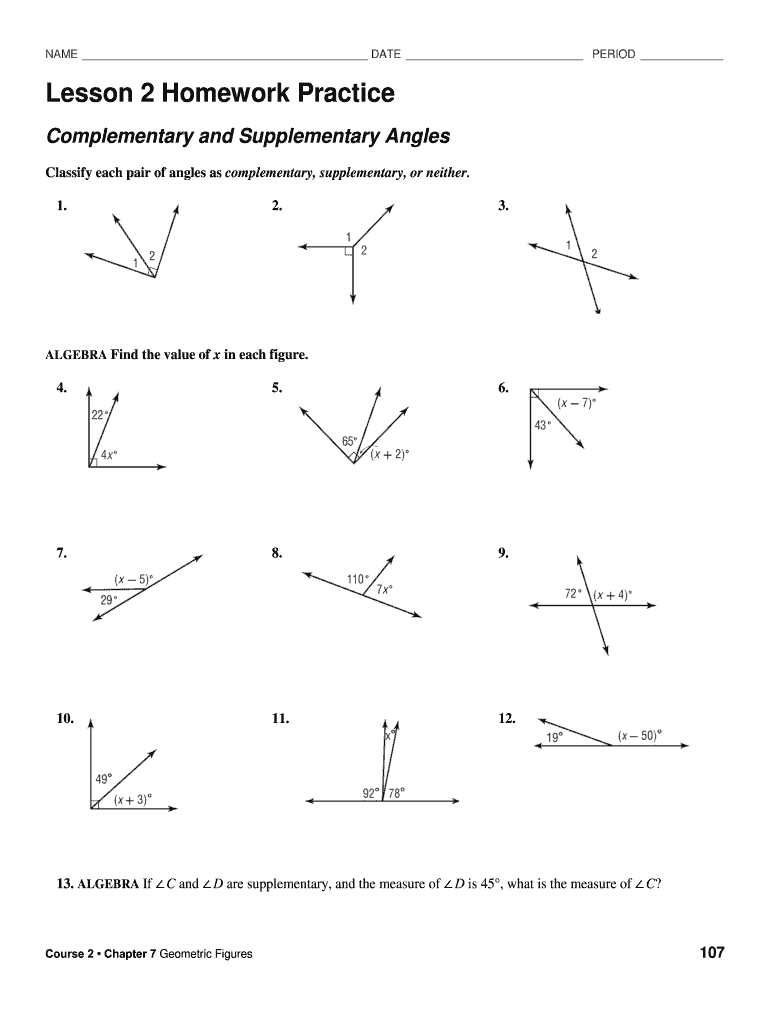
NAME DATE PERIOD Lesson 2 Homework Practice Complementary and Supplementary Angles Classify each pair of angles as complementary supplementary or neither. ALGEBRA Find the value of x in each figure. 13. ALGEBRA If C and D are supplementary and the measure of D is 45 what is the measure of C Course 2 Chapter 7 Geometric Figures. NAME DATE PERIOD Lesson 2 Homework Practice Complementary and Supplementary Angles Classify each pair of angles as complementary supplementary or neither. ALGEBRA Find the value of x in each figure. 13. ALGEBRA If C and D are supplementary and the measure of D is 45 what is the measure of C Course 2 Chapter 7 Geometric Figures. .
Loading

Open form follow the instructions

Easily sign the form with your finger

Send filled & signed form or save
How to fill out the Lesson 2 Homework Practice Complementary and Supplementary Angles online
Completing the Lesson 2 Homework Practice on complementary and supplementary angles is an essential part of understanding geometric relationships. This guide will provide you with clear instructions to successfully fill out the form online.
Follow the steps to effectively complete the homework practice.
- Click ‘Get Form’ button to obtain the form and open it in the editor.
- Begin filling out your name in the provided space labeled 'NAME.' This identifies you as the person completing the assignment.
- Next, enter the current date in the 'DATE' field. This helps in tracking when the assignment was completed.
- Indicate your class period by filling in the 'PERIOD' section. This might refer to the specific time slot of your geometry class.
- Classify each pair of angles by writing 'complementary,' 'supplementary,' or 'neither' in the appropriate sections for questions 1 through 3.
- For the algebra section (questions 4 to 12), carefully analyze each figure to find the value of x. Write your answers clearly in the designated spaces.
- In question 13, solve for the measure of angle C given that angle D is supplementary and measures 45 degrees. Write your answer in the provided area.
- Review all your responses to ensure accuracy and completeness before finalizing.
- Once satisfied with your work, you can save the changes, download, print, or share the completed form as needed.
Complete the Lesson 2 Homework Practice online today to enhance your understanding of angles!
Experience a faster way to fill out and sign forms on the web. Access the most extensive library of templates available.
Related content
Solve problems using properties of supplementary, complementary, and vertical angles. •...
A Kuta worksheet helps students practice identifying and calculating complementary and...
Students can use GarageBand to create enhanced podcasts that explain concepts in math...
Get answers to your most pressing questions about US Legal Forms API.
How to teach complementary and supplementary angles?
When teaching these concepts, start with clear definitions and visual aids, such as diagrams or angle pairs. Engage students by using real-life examples to illustrate supplementary and complementary angles in architecture or art. By incorporating the Lesson 2 Homework Practice Complementary and Supplementary Angles into your curriculum, you can provide hands-on learning experiences that reinforce these important geometric principles.
How do you identify each pair of angles as complementary, supplementary, or neither?
To identify each pair, calculate the sum of their angle measures. If the sum is 90 degrees, the angles are complementary; if it's 180 degrees, they are supplementary. If neither condition is met, the angles are neither complementary nor supplementary. Practicing these identification skills in your Lesson 2 Homework Practice Complementary and Supplementary Angles can greatly improve your confidence.
How do you identify complementary and supplementary angles?
You can identify complementary angles by looking for a pair that adds up to 90 degrees, while supplementary angles add up to 180 degrees. A good strategy is to practice with diagrams, checking the angle measures to categorize them. The Lesson 2 Homework Practice Complementary and Supplementary Angles provides ample opportunities for this identification technique, enhancing your learning experience.
How do you determine complementary?
To determine if two angles are complementary, simply measure their angles and check if their sum equals 90 degrees. If they do, you've successfully identified a pair of complementary angles. This is a fundamental skill in geometry, especially when completing your Lesson 2 Homework Practice Complementary and Supplementary Angles. Use protractors or angle measures to refine your skills.
How to remember the difference between complementary and supplementary?
To remember the difference, you can associate the prefix 'com-' in complementary with 'complete', as they add up to 90 degrees, giving a complete right angle. In contrast, 'sup-' in supplementary can remind you of 'super', indicating a larger sum of 180 degrees. Using these simple mnemonics can help solidify your understanding while you work on your Lesson 2 Homework Practice Complementary and Supplementary Angles.
What are the notes on complementary and supplementary angles?
When studying complementary and supplementary angles, it's important to note that complementary angles combine to 90 degrees, while supplementary angles combine to 180 degrees. These definitions serve as the foundation for recognizing and solving angle-related problems. By mastering these concepts, you'll be better equipped to tackle questions in your Lesson 2 Homework Practice Complementary and Supplementary Angles. Keep these notes handy for quick reference.
What are supplementary angles and how can you use supplementary angles to solve problems?
Supplementary angles are two angles whose measures add up to 180 degrees. Understanding this concept is essential, especially when you encounter problems involving angle measurements. You can use supplementary angles to find missing angles in various geometric shapes, such as triangles and quadrilaterals. For effective practice, check out our Lesson 2 Homework Practice Complementary and Supplementary Angles.
What is the measure of two supplementary angles is 180?
The measure of two supplementary angles always totals 180 degrees, regardless of their individual measurements. For example, one angle could be 120 degrees while the other is 60 degrees. Recognizing this relationship is important in various mathematical contexts, particularly in geometry. Engaging with tools like Lesson 2 Homework Practice Complementary and Supplementary Angles can provide students with the practice needed to master this concept.
Are two angles whose measures total 180, either of the two supplementary angles is said to be the supplement of the other?
Yes, when two angles add up to 180 degrees, each angle is known as the supplement of the other. This characteristic is vital in various mathematical scenarios, including solving equations and geometric proofs. By practicing these relationships through structured exercises, like those found in Lesson 2 Homework Practice Complementary and Supplementary Angles, students can gain a deeper understanding of angle relationships.
Which two angles are said to be supplementary if the sum of their measures is 180 degrees?
Any two angles whose measures total 180 degrees are classified as supplementary angles. This relationship is crucial in solving various geometric problems. You can visualize this by thinking of angles formed by intersecting lines or angles in a triangle. The Lesson 2 Homework Practice Complementary and Supplementary Angles can provide hands-on activities to ensure students grasp this essential concept.
Use professional pre-built templates to fill in and sign documents online faster. Get access to thousands of forms.
If you believe that this page should be taken down, please follow our DMCA take down process here.