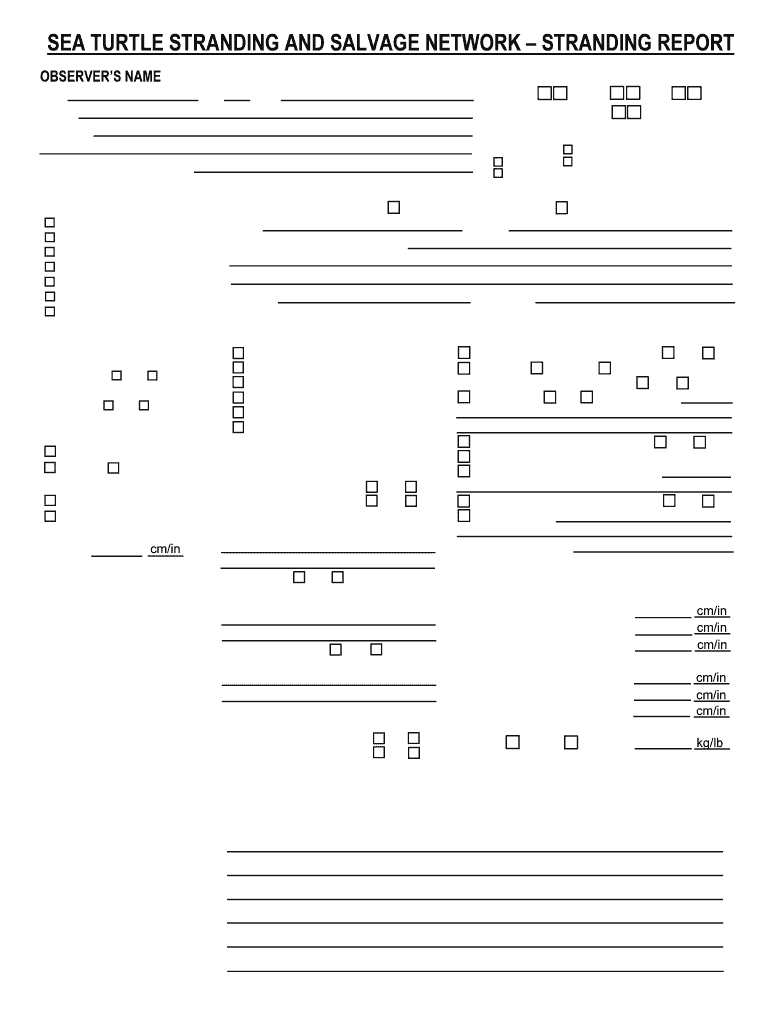
Malities on diagrams at left and describe below (note tar or oil, gear or debris entanglement, propeller damage, epibiota, papillomas, emaciation, etc.). Please note if no wounds or abnormalities were found. If released, note if new tags were applied. PLEASE E-MAIL ELECTRONIC COPY TO STSSNFORM@MYFWC.COM, OR FAX COMPLETED FORM TO (561)743-6228. IF FAXED, ALSO PLEASE USE AN ENVELOPE AND MAIL ORIGINAL FORM TO: FLORIDA STSSN COORDINATOR FLORIDA FISH & WILDLIFE CONSERVATION COMMISSION FISH AND WILD.
Loading

Open form follow the instructions

Easily sign the form with your finger

Send filled & signed form or save
How to fill out the Sea Turtle Stranding and Salvage Network - Stranding Report online
The Sea Turtle Stranding and Salvage Network - Stranding Report is an essential document used for reporting stranding incidents of sea turtles. This guide provides clear, step-by-step instructions on how to complete the form online, ensuring that all necessary information is accurately captured.
Follow the steps to complete the Stranding Report online.
- Press the 'Get Form' button to access the Stranding Report form and open it in the online editor.
- Begin by filling in your details in the 'Observer’s Name' section. Include your first name, middle initial, last name, email address, affiliation, and phone number (with area code).
- In the 'Species' section, select the appropriate sea turtle species from the provided options. If unsure, check 'Unidentified' instead of guessing.
- Record the latitude and longitude of the stranding location. Be sure to select the appropriate condition of the turtle, indicating if it was alive or how decomposed it is.
- Indicate the sex of the turtle by checking the appropriate box. If the sex is indeterminate, use the option for 'Immature, undetermined.'
- Document the stranding date by entering the year and month, as well as the turtle's number for that day.
- Check if there were any flipper tags present at the stranding. If yes, record the tag numbers, locations, and the return address. Also, check if the turtle is alive or has been treated.
- In the 'Final Disposition' section, choose the appropriate option that represents what was done with the turtle after recovery, checking all relevant boxes.
- Provide measurements for the carapace, including straight and curved lengths and widths. Mark any wounds or abnormalities on the diagram provided, and describe them in the text box.
- Once all fields are completed, ensure to save your changes. You may download, print, or share the completed form electronically as needed.
Complete your Sea Turtle Stranding and Salvage Network - Stranding Report online today.
Experience a faster way to fill out and sign forms on the web. Access the most extensive library of templates available.
Related content
Jul 18, 2025 — The Sea Turtle Stranding and Salvage Network was formally established by...
Page 1. SEA TURTLE STRANDING AND SALVAGE NETWORK – STRANDING REPORT. OBSERVER'S NAME /...
Get answers to your most pressing questions about US Legal Forms API.
Is it illegal to save sea turtles?
Saving sea turtles is not illegal, but it requires adherence to specific laws and guidelines. The Sea Turtle Stranding and Salvage Network - Stranding Report can assist you in understanding the regulations in your area. Engaging with local experts ensures that your efforts contribute positively to the conservation of these magnificent creatures.
When should a sea turtle carcass be salvaged?
A sea turtle carcass should be salvaged when it poses a threat to public health or environmental safety. The Sea Turtle Stranding and Salvage Network - Stranding Report advises that timely reporting of carcasses helps in conducting necropsies to study different health factors and causes of death. Salvaging also prevents the carcass from attracting predators or causing pollution.
Is it illegal to save baby sea turtles?
It is not illegal to save baby sea turtles, but you must act responsibly and within legal guidelines. The Sea Turtle Stranding and Salvage Network - Stranding Report provides resources for safely assisting these creatures. If you find a baby turtle in distress, contacting wildlife professionals is the best course of action to ensure its survival.
How do you report a sea turtle?
To report a sea turtle, you can contact your local wildlife agency or the Sea Turtle Stranding and Salvage Network - Stranding Report directly. It’s important to provide detailed information, including the location, condition of the turtle, and any marks or tags. Prompt reporting aids in swift action and supports conservation efforts.
Should you report dead sea turtles?
Yes, reporting dead sea turtles is essential for their conservation. The Sea Turtle Stranding and Salvage Network - Stranding Report encourages individuals to report any deceased turtles to local authorities. This information helps scientists understand the causes of mortality and contribute to protecting living sea turtles.
Are you allowed to help baby turtles?
You can help baby turtles, but it is crucial to follow local regulations when doing so. The Sea Turtle Stranding and Salvage Network - Stranding Report advises contacting trained professionals if you encounter a struggling turtle. Your assistance can be beneficial, but proper protocols must be followed to ensure the turtle receives the best care possible.
Is it illegal to keep a baby turtle?
Keeping a baby turtle in the United States is generally illegal without a special permit. The Sea Turtle Stranding and Salvage Network - Stranding Report emphasizes the importance of wildlife conservation, and keeping a turtle can harm its chance of survival in the wild. Instead of taking a baby turtle home, consider contacting local wildlife officials who can provide guidance.
Are sea turtles endangered or extinct?
Most sea turtles are indeed classified as endangered, highlighting the urgent need for conservation measures. The Sea Turtle Stranding and Salvage Network - Stranding Report provides crucial insights into their populations and the threats they encounter. Although some species are critically endangered, ongoing efforts contribute to their recovery. Awareness is the first step towards preservation.
What is the current status of the sea turtle?
Currently, several sea turtle species are classified as endangered or threatened due to various factors. The Sea Turtle Stranding and Salvage Network - Stranding Report regularly updates this status based on new findings. By staying informed about these classifications, you can better understand the challenges they face. Supporting conservation efforts is crucial in improving their circumstances.
Are sea turtles recovering?
Some sea turtle populations show signs of recovery due to dedicated conservation efforts. The Sea Turtle Stranding and Salvage Network - Stranding Report plays a key role in this success by monitoring turtle health and survival rates. While not all populations are thriving, collective action and continuous monitoring can lead to positive outcomes. Engaging with these efforts can accelerate recovery across different regions.
Use professional pre-built templates to fill in and sign documents online faster. Get access to thousands of forms.
If you believe that this page should be taken down, please follow our DMCA take down process here.