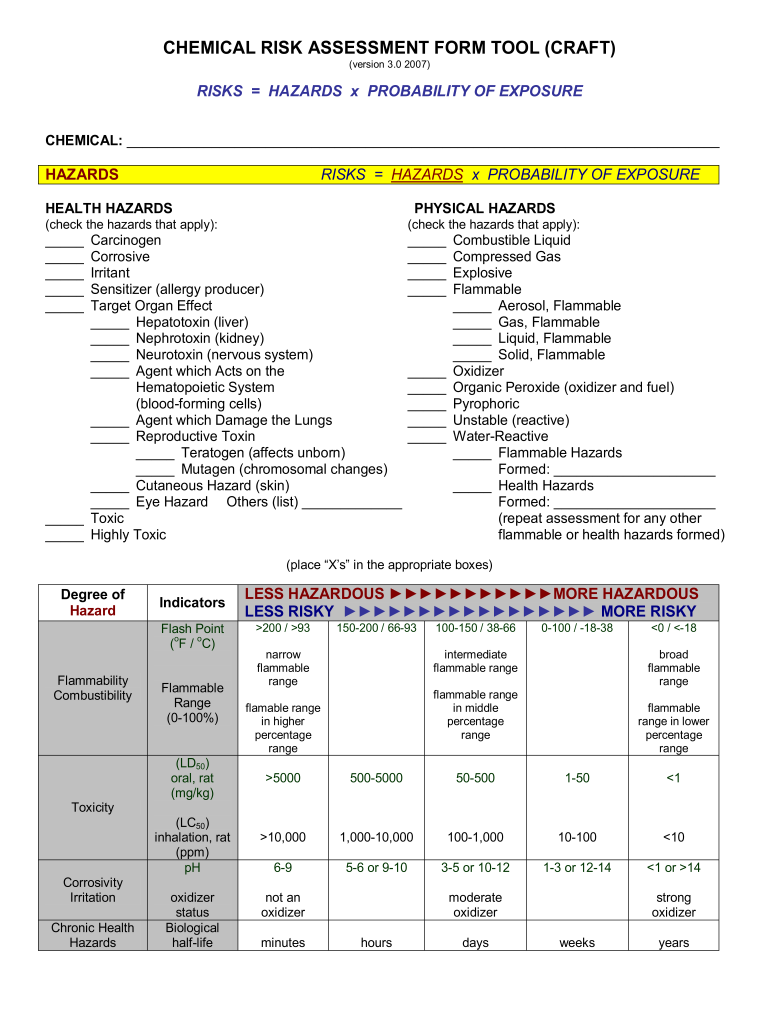
_____________________ HAZARDS RISKS = HAZARDS x PROBABILITY OF EXPOSURE HEALTH HAZARDS PHYSICAL HAZARDS (check the hazards that apply): (check the hazards that apply): _____ Carcinogen _____ Combustible Liquid _____ Corrosive _____ Compressed Gas _____ Irritant _____ Explosive _____ Sensitizer (allergy producer) _____ Flammable _____ Target Organ Effect _____ Aerosol, Flammable _____ Hepatotoxin (liver) .
Loading

Open form follow the instructions

Easily sign the form with your finger

Send filled & signed form or save
How to use or fill out the Chemical Risk Assessment Tool (Craft) online
The Chemical Risk Assessment Tool (Craft) is designed to help users evaluate the risks associated with various chemicals. This guide will provide clear and instructional steps for completing the form online, ensuring a thorough understanding of each component.
Follow the steps to successfully fill out the Chemical Risk Assessment Tool online.
- Click ‘Get Form’ button to obtain the form and open it in the editor.
- Fill in the chemical name in the designated space provided at the top of the form.
- Review the section for health hazards and physical hazards. Place checks in the boxes next to all applicable hazards for the chemical you are assessing.
- Indicate the degree of hazard by assessing indicators such as flash point and toxicity, filling in the relevant fields accordingly.
- Provide details on acute and chronic health effects by checking the relevant symptoms or listing additional effects as required.
- Evaluate potential physical effects such as fire or explosion risks by checking any that apply.
- Assess the probability of exposure by reviewing the indicators and entering checks where relevant, considering routes and quantities.
- After completing all sections, review your inputs for accuracy before saving your changes.
- Finally, save the form as needed. You can choose to download, print, or share the completed document.
Start filling out the Chemical Risk Assessment Tool online today to ensure safety and compliance.
Experience a faster way to fill out and sign forms on the web. Access the most extensive library of templates available.
Related content
by CH Andrade · 2024 · Cited by 4 — CRAFT integrates fragment-based drug discovery...
Chemical inventory records must be maintained as materials enter and leave the lab or...
Jan 15, 2009 — This Handbook is a tool to assist DoD installations with evaluating and...
Get answers to your most pressing questions about US Legal Forms API.
How to do a chemical risk assessment?
To conduct a chemical risk assessment, start by identifying the chemicals used in your activities and their potential hazards. Evaluate the risks to health and safety, and then establish control measures to mitigate those risks. The Chemical Risk Assessment Tool (Craft) provides valuable guidance throughout this process, ensuring that assessments are thorough and effective.
What is the craft risk assessment tool?
The craft risk assessment tool is a specialized resource designed to help users identify and mitigate risks associated with craft activities. It focuses on various hazards that might arise while engaging in any crafting project or event. This tool is an integral part of the Chemical Risk Assessment Tool (Craft) that ensures safety and compliance in creative environments.
How to do risk assessment for a stall?
To perform a risk assessment for a stall, identify any potential dangers, such as equipment and materials used, and assess the likelihood of accidents occurring. Evaluate existing control measures and determine whether they are adequate. The Chemical Risk Assessment Tool (Craft) can assist you in organizing this information systematically, ensuring a comprehensive assessment.
How do you write a basic risk assessment?
Writing a basic risk assessment involves outlining the identified hazards, analyzing the risks associated with those hazards, and detailing control measures to address them. Be sure to document your findings clearly and ensure that your assessment is easy to understand. Utilizing a Chemical Risk Assessment Tool (Craft) can simplify this process and ensure consistency in your assessments.
What are 5 examples of conducting risk assessments?
Examples of conducting risk assessments include evaluating workplace safety prior to a new project, assessing equipment hazards in a manufacturing setting, reviewing safety procedures for food stalls, analyzing risks during outdoor events, and applying the Chemical Risk Assessment Tool (Craft) in various artistic endeavors. Each scenario helps identify and mitigate potential dangers proactively.
How do you create a risk assessment tool?
Creating a risk assessment tool starts with determining the specific needs of your organization or setting. Collect relevant data on the hazards present, then design a framework that allows users to assess risks effectively. The Chemical Risk Assessment Tool (Craft) can serve as an excellent template to help you organize this information and facilitate thorough assessments.
How to do a risk assessment for a craft stall?
To conduct a risk assessment for a craft stall, begin by identifying potential hazards like sharp tools or hot equipment. Next, evaluate the risks associated with each hazard, and then implement measures to minimize those risks. Using a Chemical Risk Assessment Tool (Craft) can streamline this process and provide a structured approach to ensure safety during events.
What are the 5 main steps of a risk assessment?
The five main steps of a risk assessment include identifying hazards, evaluating risks, implementing control measures, recording findings, and reviewing and updating the assessment. By following these steps, users can effectively utilize the Chemical Risk Assessment Tool (Craft) to manage potential issues. Understanding these steps is crucial for ensuring the safety of all involved.
What should I write for risk assessment?
For a risk assessment, focus on detailing the hazards associated with the chemicals you use. Use the Chemical Risk Assessment Tool (Craft) to guide your writing and ensure that you include risks and control strategies. Aim for clarity and actionability, so that readers can understand and implement the necessary safety measures.
How do you fill out a risk assessment form?
When filling out a risk assessment form, start by clearly listing all hazards relevant to the chemical in question. Utilize the Chemical Risk Assessment Tool (Craft) to ensure you consider risks thoroughly. After analyzing the implications of each hazard, suggest proper control measures to mitigate risks effectively.
Use professional pre-built templates to fill in and sign documents online faster. Get access to thousands of forms.
If you believe that this page should be taken down, please follow our DMCA take down process here.