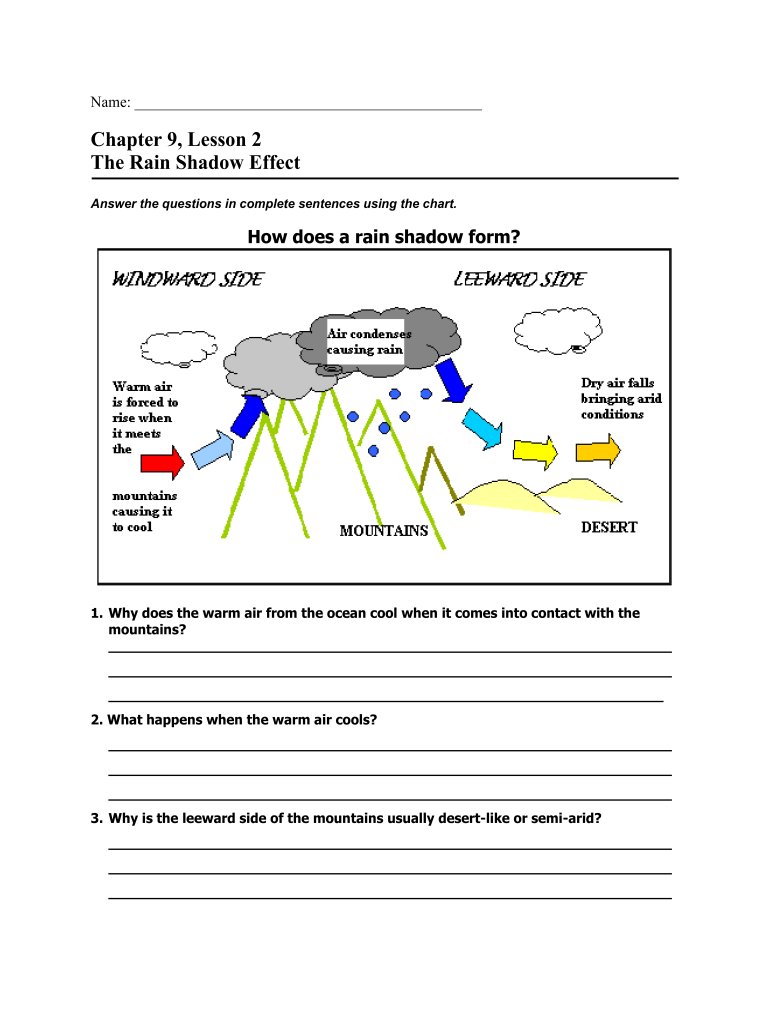
Name Chapter 9 Lesson 2 The Rain Shadow Effect Answer the questions in complete sentences using the chart. How does a rain shadow form 1. Why does the warm air from the ocean cool when it comes into contact with the mountains 2. What happens when the warm air cools 3. Why is the leeward side of the mountains usually desert-like or semi-arid Using the two illustrations place these statements in the correct order. A. Warmer air produces a rain shadow on the opposite side of the mountain* B. Water evaporates from lakes oceans and land. C. As the air continues to rise it cools. D. The cool air condenses causing rain* E* The wind carries the moist air inland. F* Rain falls on the windward side of the mountain* G* As the air reaches the other side of the mountain it sinks and becomes warmer. H. When air reaches a mountain it begins to rise. 1. Answer the following questions in complete sentences. 1. What region in Argentina is considered to be in a rain shadow 2. What mountains cause the rai....

Open form follow the instructions

Easily sign the form with your finger

Send filled & signed form or save
How to fill out the Chapter 9 Lesson 2 The Rain Shadow Effect online
This guide aims to assist you in successfully completing Chapter 9 Lesson 2, focusing on the rain shadow effect. By following the steps outlined below, you will navigate the online form with ease and confidence, ensuring that you provide complete and accurate responses to all questions.
Follow the steps to complete your form efficiently.
- To begin, press the ‘Get Form’ button to acquire the form and open it for editing.
- Once you have opened the form, start by answering the questions in complete sentences in the designated response fields provided. Pay attention to provide thoughtful and detailed answers to each question regarding how a rain shadow forms.
- Proceed to the section where you must arrange the statements based on the illustrations. Carefully analyze the statements provided and drag or input the corresponding numbers to indicate the correct order of events.
- Next, address the additional questions that require complete sentences. Ensure you include specific information such as regions in Argentina known for their rain shadow, as well as the mountains that contribute to this phenomenon.
- Finally, review your entries for clarity and completeness. Once satisfied, you can save your changes, download the document, print it, or share it as needed.
Complete your document online today to enhance your understanding of the rain shadow effect.
Experience a faster way to fill out and sign forms on the web. Access the most extensive library of templates available.
Related content
stances a "rain shadow" effect, an area of decreased precipitation down wind from the area...
Definition of Rain Shadow – A region having little rainfall because it is sheltered from...
Sep 2, 2025 — Flights of Fancy (FOF) is a game mode in which players unlock and collect...
Get answers to your most pressing questions about US Legal Forms API.
Which factor contributes to the rain shadow effect?
The most significant contributing factor to the rain shadow effect is the presence of a mountain range. It acts as a barrier that intercepts moist air moving from the ocean or other water bodies. Other factors, such as the prevailing wind direction and the temperature differences, also play roles, but the mountains are crucial, as detailed in Chapter 9 Lesson 2 The Rain Shadow Effect.
What causes a rain shadow to occur?
A rain shadow occurs primarily due to orographic lift, where moist air is forced to rise over mountains. As the air rises, it cools and loses moisture, resulting in precipitation on one side. Once the air descends on the other side, it has much lower humidity, leading to arid conditions. This process is the core topic of Chapter 9 Lesson 2 The Rain Shadow Effect.
What are the three things required in order for a rain shadow effect to occur?
For the rain shadow effect to take place, three main elements are necessary: a moisture source such as an ocean, a mountain range to block the air, and prevailing winds that carry the moist air. These elements work together to create a stark contrast in precipitation levels across regions, as elaborated in Chapter 9 Lesson 2 The Rain Shadow Effect.
What explains the rain shadow effect?
The rain shadow effect is explained by the interaction of air, mountains, and moisture. As air hits the mountains, it rises and cools, leading to rainfall on one side. The opposite side receives little to no precipitation because the descending air warms and loses moisture. This phenomenon is thoroughly examined in Chapter 9 Lesson 2 The Rain Shadow Effect.
What three things do you need to get a rain shadow effect?
To create a rain shadow effect, you need a moisture source, usually an ocean or large body of water. Secondly, a mountain range must be present to intercept the moist air. Lastly, you require prevailing winds that bring the moisture-laden air towards the mountains, as discussed in Chapter 9 Lesson 2 The Rain Shadow Effect.
How do you use rain shadow effect in a sentence?
You can illustrate the concept of the rain shadow effect by saying, 'The town experienced drought conditions due to the rain shadow effect caused by the adjacent mountain range.' This usage clearly demonstrates how geographical features influence weather patterns, as highlighted in Chapter 9 Lesson 2 The Rain Shadow Effect.
What are the steps of the rain shadow effect?
In Chapter 9 Lesson 2 The Rain Shadow Effect, the process starts when moist air rises over a mountain range. As the air ascends, it cools and condenses, leading to precipitation on the windward side. After crossing the peak, the air descends, warms up, and becomes drier, creating the rain shadow area on the leeward side. This effect significantly impacts local climates and ecosystems.
Which is the best description of the rain shadow effect?
The best description of the rain shadow effect is the transformation of moist air into dry conditions as it moves over a mountain range. The windward side experiences rain, while the leeward side remains arid. This process explains the diverse ecosystems that can exist in close proximity. Chapter 9 Lesson 2 The Rain Shadow Effect thoroughly examines this balance of moisture and dryness.
What is the rain shadow effect in Quizlet?
In Quizlet, the rain shadow effect is usually detailed as a weather phenomenon depicting how geographical features influence local climates. It explains how mountains or hills impact rainfall patterns, creating dry areas on one side. Users can explore various study sets and flashcards for Chapter 9 Lesson 2 The Rain Shadow Effect to better understand this concept. This platform provides valuable learning tools for students and enthusiasts alike.
What produces the rain shadow effect?
The rain shadow effect occurs when moist air rises over mountains. As the air ascends, it cools and loses moisture, leading to precipitation on the windward side. Once the air passes over the peak and descends on the leeward side, it becomes warmer and drier, creating a rain shadow. This phenomenon is discussed in Chapter 9 Lesson 2 The Rain Shadow Effect, highlighting its geographical importance.
Use professional pre-built templates to fill in and sign documents online faster. Get access to thousands of forms.
If you believe that this page should be taken down, please follow our DMCA take down process here.