Loading
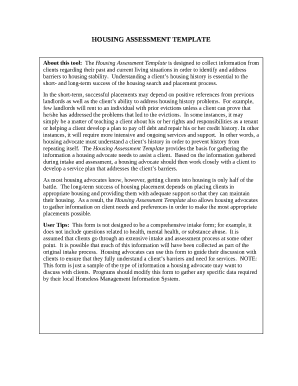
Get Hud Exchange Housing Assessment Template 2017-2026
How it works
-

Open form follow the instructions
-

Easily sign the form with your finger
-

Send filled & signed form or save
How to fill out the HUD Exchange Housing Assessment Template online
The HUD Exchange Housing Assessment Template is a vital tool for gathering essential information on clients' housing situations to identify barriers to stability. This guide provides clear, step-by-step instructions for completing the form online, ensuring a smooth process for users.
Follow the steps to successfully complete the template.
- Press the ‘Get Form’ button to access the Housing Assessment Template and open it in your online editor.
- Begin by entering the client's name, intake date, case number, date of birth, and the name of the housing advocate and case manager, if applicable. Ensure accuracy to facilitate the assessment process.
- Indicate whether the client has worked with a housing search agency by selecting 'Yes' or 'No.' If 'Yes,' provide the name of the agency and contact person, along with their phone numbers.
- In Part 1, review the list of barriers to housing with the client. Mark all barriers that apply, such as eviction history or insufficient income, to guide further discussion.
- For Part 2, document the client's housing history. Check all types of residences the client has lived in and provide the dates and reasons for leaving each type.
- In the Private Housing History section, provide detailed information about the client's previous housing, including whether it was subsidized and the name of the housing authority.
- Part 3 focuses on Financial Stability. Check all applicable sources of income received in the last month, listing the amounts. Record any non-cash benefits the client receives.
- Collect information on the origins of any debts the client may have. Additionally, assess the client's employment status and gather information regarding their identification paperwork.
- In Part 4, document the number of adults and children in the household. Discuss the client’s housing needs and preferences, including desired locations and special requirements.
- Finally, have both the client and housing advocate sign and date the form. This confirms the information provided is accurate and acknowledges the housing advocate's role.
- After completing the form, you can save changes, download, print, or share it as needed.
Complete your HUD Exchange Housing Assessment Template online today to effectively assist clients in their housing search.
Related links form
RESPONSIBILITIES OF THE HEALTH PLAN Consumer Directed Personal Assistance Program Memorandum Of
ATTACHMENT II - NOTICE OF INTENT TO IMPOSE A LIEN ON REAL PROPERTY INSTITUTIONALIZED INDIVIDUAL ADM
LDSS-4882-CH (7/12) - Childsupport Ny
Jim Kinney Scholarship - Illinois Real Estate Education Foundation - Ilreef