Loading
Get Ut Westlake Ffa Veterinary Terminology Notes 2012-2026
How it works
-

Open form follow the instructions
-

Easily sign the form with your finger
-

Send filled & signed form or save
How to fill out the UT Westlake FFA Veterinary Terminology Notes online
This guide provides a clear and supportive approach to completing the UT Westlake FFA Veterinary Terminology Notes online. By following these steps, you will effectively navigate each section of the form and enhance your understanding of veterinary terminology.
Follow the steps to accurately complete the form.
- Click the ‘Get Form’ button to obtain the document and open it in your chosen online editor.
- In the 'Name' field, input your full name. This field identifies you as the form's author.
- Enter your 'Period' in the corresponding field to specify the course or session you are associated with.
- Record the 'Binder Page #' to keep track of where this document is stored in your learning materials.
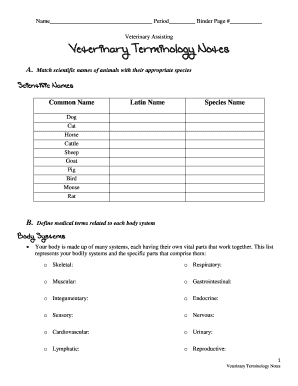
- In section A, match the scientific names with their appropriate species by filling in the 'Latin Name' and 'Species Name' based on your knowledge.
- For section B, define medical terms related to each body system by clearly outlining descriptions in the space provided for skeletal, respiratory, and other body systems.
- In section C, identify prefixes, suffixes, and root words related to medical terms by filling in the practice section with the appropriate terms.
- For section D, decipher directional terminology by writing down the meanings next to each directional term you have learned.
- In section E, list any medical abbreviations you are familiar with and their meanings in the corresponding fields.
- Once you have completed all sections, review the document for accuracy and completeness, then save your changes. You can download, print, or share the form as needed.
Start filling out your UT Westlake FFA Veterinary Terminology Notes online today!
Understanding terminology ensures doctors and technicians have a shared method of communicating, which helps avoid confusion when pinpointing structures and describing locations of lesions. Knowing your directional terms makes things clear and saves time!