Loading
Get Unum Beneficiary Designation Form For El Paso County 2011-2026
How it works
-

Open form follow the instructions
-

Easily sign the form with your finger
-

Send filled & signed form or save
How to fill out the UNUM Beneficiary Designation Form For El Paso County online
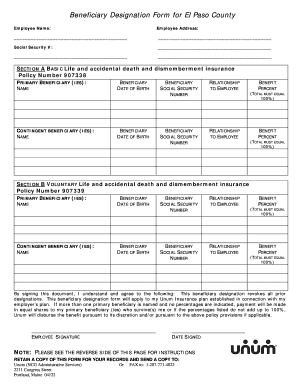
Completing the UNUM Beneficiary Designation Form is an important step in ensuring your beneficiaries are designated according to your wishes. This guide provides a clear, step-by-step approach to filling out the form online, fostering a better understanding of its components.
Follow the steps to complete your form accurately.
- Click ‘Get Form’ button to obtain the form and open it in the editor.
- Begin by entering your full name in the employee name field.
- Fill in your address in the employee address section, being sure to include all relevant details.
- Enter your Social Security number in the designated field.
- In Section A, provide your policy number (907338) and start filling out the primary beneficiary section. Include the name, date of birth, Social Security number, and relationship to you for each primary beneficiary.
- Next, if applicable, list your contingent beneficiaries in the corresponding section, completing the same details as for the primary beneficiaries.
- Ensure that the total percentage for primary beneficiaries equals 100%. Repeat this for contingent beneficiaries in their section as well.
- In Section B, repeat the process for the voluntary life insurance policy number (907339) with primary and contingent beneficiaries.
- Review all entered information for accuracy before proceeding.
- Once all fields are completed, make sure to sign and date the form at the bottom, confirming your agreement.
- After reviewing, you can save the changes, download, print, or share the completed form as needed.
Make sure to complete the UNUM Beneficiary Designation Form online and ensure your beneficiaries are accurately designated.
Your beneficiary can be a person, a charity, a trust, or your estate. Almost any person can be named as a beneficiary, although your state of residence or the provider of your benefits may restrict who you can name as a beneficiary. Make sure you research your state's laws before naming your beneficiary.