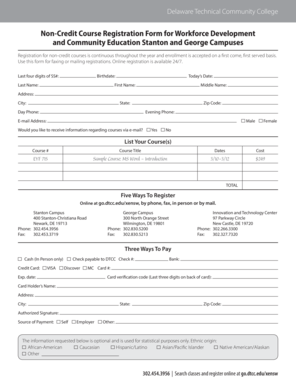
Delaware Technical Community College Noncredit Course Registration Form for Workforce Development and Community Education Stanton and George Campuses Registration for noncredit courses is continuous.

How it works
  • Open form

    Open form follow the instructions

  • Easily sign form

    Easily sign the form with your finger

  • Share form

    Send filled & signed form or save

How to fill out the Delaware Technical Community College Non-Credit Course Registration Form online

Filling out the Delaware Technical Community College Non-Credit Course Registration Form is a straightforward process designed to streamline your enrollment in valuable courses. This guide will walk you through each section of the form, ensuring you are well-equipped to complete it online with ease.

Follow the steps to successfully complete your registration form.

  1. Click ‘Get Form’ button to obtain the form and open it in the editor.
  2. Begin by entering your last four digits of your Social Security number in the designated field.
  3. Provide your birthdate in the requested format to verify your identity.
  4. Fill in your last name, first name, and middle name in the appropriate fields.
  5. Enter your state and zip code to identify your location.
  6. Complete your address, including the city, to ensure proper communication.
  7. Provide your day phone and evening phone numbers for contact purposes.
  8. Include your email address for correspondence and updates regarding your course registration.
  9. Indicate your gender preference by selecting the appropriate option.
  10. Choose whether you would like to receive information regarding courses via email by selecting yes or no.
  11. List the courses you wish to register for by providing the course number, course title, dates, and cost for each.
  12. Fill out the payment section, selecting a payment method and providing the necessary payment details.
  13. Optional: Complete the demographic information for statistical purposes if you choose.
  14. Review all entries for accuracy and completeness before submission.
  15. Once you have completed the form, you can save your changes, download, print, or share the form as needed.

Complete your Delaware Technical Community College Non-Credit Course Registration Form online today!

Get form

Experience a faster way to fill out and sign forms on the web. Access the most extensive library of templates available.

Related content

Delaware Technical Community College (DTCC)

May 1, 2013 — The campus's credit enrollment during the Fall, 2013 semester was 4,199...

Learn more
Non-Credit Course Registration Form for Workforce...

Use this form for faxing or mailing registrations. Online registration is available 24/7...

Learn more
2015

We are a comprehensive regionally accredited university that offers approximately 200...

Learn more
Questions & Answers

Get answers to your most pressing questions about US Legal Forms API.

Contact support

What properties does the Tennessee Residential property Disclosure Act apply?

The Act applies to all sales of residential real property consisting of not less than one dwelling unit, but not more than four dwelling units. The Act applies even if real estate agents are not involved in the sale. The disclosure form required in Tennessee is lengthy, detailed and comprehensive.

What Must You Tell Buyers? Tennessee is what is known as a full disclosure state, meaning that the seller of residential property must disclose all known material defects to the buyer before or at the time an offer is made.

Property sellers are usually required to disclose negative information about a property. It is usually wise to always disclose issues with your home, whether you are legally bound to or not. The seller must follow local, state, and federal laws regarding disclosures when selling their home.

Common exceptions include sales or transfers between co-owners, new construction, purchases from lenders after foreclosure, auction sales, or if the Seller has not lived in the home within the 3 years before the Closing.

As a seller of a property with one to four dwelling units, you in most situations must provide the buyer with a disclosure statement before a purchase contract is signed. (For exemptions, such as for transfers between co-owners or divorcing spouses, see Tenn. Code Ann. § 66-5-209.)

Sellers must report any known defects or malfunctions of structural or mechanical components. Disclosure also includes a list of conditions that affect the home such as environmental hazards, encroachments, flood or drainage problems, or remodeling work done without permits or compliance to building codes.

Some examples of what needs to be disclosed: If there are pests or Japanese knotweed problems either currently or in the past. If your neighbours have an Anti Social Behaviour Order (ASBO) Any structural issues with the property. Any planning permission, whether it was granted, is pending, or was denied.

The Land Contract or Memorandum must state that the buyer is responsible for paying the property taxes. The Land Contract or Memorandum must be selling the property. Option to buy or lease agreements will not qualify for the homestead and mortgage deductions. The Land Contract or Memorandum must be recorded.

The Tennessee Residential Property Disclosure Act states that anyone transferring title to residential real property must provide information about the condition of the property. This completed form constitutes that disclosure by the seller.

Get This Form Now!

Use professional pre-built templates to fill in and sign documents online faster. Get access to thousands of forms.

If you believe that this page should be taken down, please follow our DMCA take down process here.

Get Delaware Technical Community College Non-Credit Course Registration Form