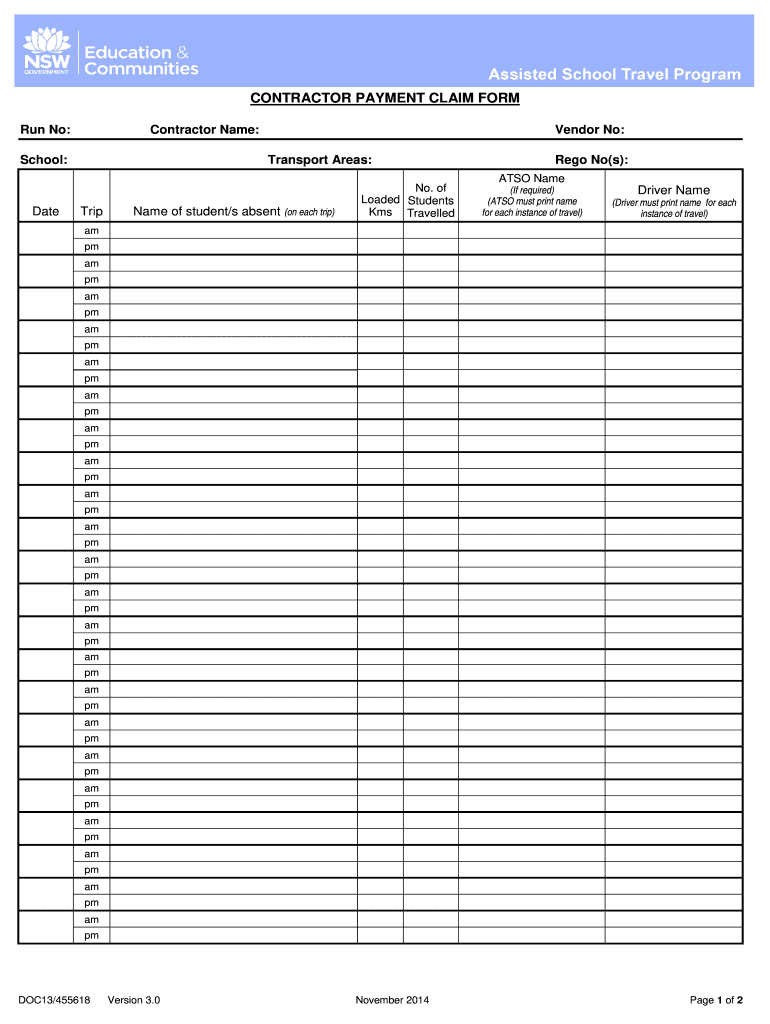
Each trip) No. of Loaded Students Kms Travelled Rego No(s): ATSO Name (If required) (ATSO must print name for each instance of travel) Driver Name (Driver must print name for each instance of travel) am pm am pm am pm am pm am pm am pm am pm am pm am pm am pm am pm am pm am pm am pm am pm am pm am pm am pm am pm am pm am pm am pm DOC13/455618 Version 3.0 November 2014 Page 1 of 2 Run No: Contractor Name: Vendor No: UNFORSEEN VARIATION TO RUN, OTHER THAN ABSENCES Date Name of Stu.
Loading

Open form follow the instructions

Easily sign the form with your finger

Send filled & signed form or save
How to fill out the AU NSW DOC13/455618 online
The AU NSW DOC13/455618 form is essential for submitting contractor payment claims for transportation services offered to schools. This guide provides a clear, step-by-step approach to assist users in completing the form accurately online.
Follow the steps to complete your contractor payment claim form successfully.
- Click ‘Get Form’ button to obtain the document and open it for editing.
- Enter the run number in the designated field to identify the specific transport service.
- Fill in the contractor name, ensuring it matches any official documentation you have.
- Input the school name where the transport service is provided.
- Record the date of the transport service, ensuring it aligns with the claim period.
- Insert your vendor number, which is crucial for processing the payment.
- List all transport areas as designated in your service agreement.
- Document the trip details, including the name of students absent from each trip.
- For each trip, indicate the number of loaded students and the kilometers travelled.
- Provide the registration number(s) of the vehicle(s) used.
- Fill in the ATSO's name and ensure they print their name for each instance of travel if required.
- The driver's name must also be printed for each travel instance; clearly fill this section.
- If there are unforeseen variations to the run, fill in the relevant date, names of students (if applicable), and circumstances or reasons for the variation.
- Signatures must be obtained from the departmental officer, drivers, and ATSOs confirming the details are correct.
- Affirm the certification statement to indicate that all necessary conditions have been met prior to submission.
- Each school involved must apply their stamp, along with the principal's signature and date.
- Review all entries for accuracy, as any errors or omissions may lead to return of your claim.
- Once completed, save changes, download the document, print it, or share it as needed.
Complete your AU NSW DOC13/455618 form online today for a smooth submission process.
Experience a faster way to fill out and sign forms on the web. Access the most extensive library of templates available.
Get answers to your most pressing questions about US Legal Forms API.
What's the cheapest way to insulate walls?
6 Inexpensive Insulating Materials For Interior Walls Radiant Barrier. Stone Wool. Fiberglass Batts. Blown-in Cellulose. Rigid Foam Boards. Spray Foam.
How much does it cost to insulate a house in Canada?
The common price to insulate a normal-sized new construction home can be between $8,000 and $14,000 from top to bottom. For a 1,000 square feet home, the cost can range between $6,000 and $8,000.
How do you insulate a cold wall from the inside?
Internal wall insulation is done by fitting rigid insulation boards to the wall, or by building a stud wall filled in with insulation material such as mineral wool fibre. Internal insulation: Is generally cheaper to install than external wall insulation.
How much does it cost to top up insulation?
Adding more insulation to an attic costs $1 to $4 per square foot professionally installed, depending on the existing insulation, desired R-value, and type. Adding 5 inches of loose-fill insulation yourself costs $200 to $650 to cover 1,000 square feet.
What is the cheapest way to insulate a house?
6 Inexpensive Insulating Materials For Interior Walls Radiant Barrier. Stone Wool. Fiberglass Batts. Blown-in Cellulose. Rigid Foam Boards. Spray Foam.
Is insulation worth the money?
Most people would agree that insulation is not only good for their health, it's also good for their pocket too. Insulation is generally low maintenance and lasts a life time. You lose 35% of heat through your walls if you don't have adequate insulation.
What is the least expensive insulation?
The most common form of home insulation is the “batt and roll” or “blanket” type, which is the least expensive to purchase and install....Its most common material is fiberglass, but if you're looking for an alternative, check out these natural fiber options: Mineral wool. Cotton (recycled denim) Sheep's wool.
How long does insulation take to pay for itself?
While there is no static amount of time to say by which your insulation will have paid for itself, we can roughly estimate that within two years (or just over), your insulation will have paid for itself – and then those savings will continue for years to come.
How long does it take for insulation to pay itself?
Adding attic and wall insulation can pay for itself in just two years based on the typical amount of energy savings you'll experience. In just a couple of years, you can save an average of $1,000 in energy savings.
What type of insulation is most cost effective?
Expanded polystyrene (EPS) is a premier material for protecting homes, foods and sensitive materials because of its cost-effective, efficient insulation qualities. In fact, EPS leads the pack when it comes to R-value per dollar. This ratio of R-value to the total price of manufacturing and installation per sq.
Use professional pre-built templates to fill in and sign documents online faster. Get access to thousands of forms.
If you believe that this page should be taken down, please follow our DMCA take down process here.