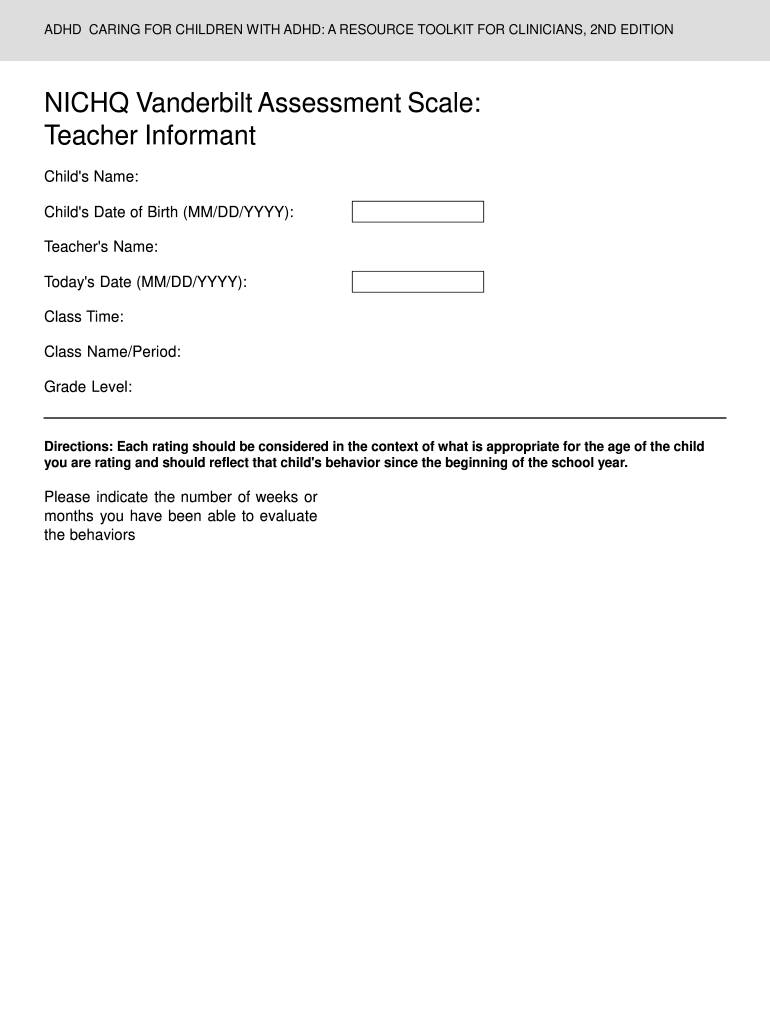
E: Today's Date (MM/DD/YYYY): Class Time: Class Name/Period: Grade Level: Directions: Each rating should be considered in the context of what is appropriate for the age of the child you are rating and should reflect that child's behavior since the beginning of the school year. Please indicate the number of weeks or months you have been able to evaluate the behaviors Symptoms Never 1. Fails to give attention to details or makes careless mistakes with schoolwork 2. Has difficulty sustainin.
Loading

Open form follow the instructions

Easily sign the form with your finger

Send filled & signed form or save
How to fill out the NICHQ Vanderbilt Assessment Scale Teacher Informant online
Completing the NICHQ Vanderbilt Assessment Scale Teacher Informant is crucial for evaluating a child's behavior in an academic setting. This guide will walk you through each step of the online form, ensuring you provide accurate and helpful information.
Follow the steps to effectively complete the assessment scale.
- Click ‘Get Form’ button to access the online version of the NICHQ Vanderbilt Assessment Scale Teacher Informant.
- Begin by filling in the child's name and date of birth in the specified fields. Ensure accuracy, as this information is vital for identifying the specific assessment.
- Enter your name as the teacher, along with today’s date. This allows for tracking and accountability of the assessment process.
- Provide the class time and class name or period details to contextualize the assessment in relation to the student's school environment.
- Indicate the grade level of the child being assessed to align with appropriate behavioral expectations.
- Review the directions regarding symptom ratings, which should reflect behaviors observed since the school year began.
- Fill out the symptoms section by rating how often each behavior has been observed, selecting from options: Never, Occasionally, Often, or Very Often.
- Complete the academic performance section, evaluating the child’s abilities in areas such as reading, mathematics, and written expression, using the provided performance scales.
- Assess classroom behavior performance by rating relationships with peers, following directions, disrupting class, assignment completion, and organizational skills.
- If any additional comments are necessary, provide insights or observations that may aid in understanding the child's behavior.
- Once all sections are completed, save your changes. You may also download, print, or share the assessment as needed.
Complete the NICHQ Vanderbilt Assessment Scale Teacher Informant online to support effective evaluation of students.
Experience a faster way to fill out and sign forms on the web. Access the most extensive library of templates available.
Related content
Directions: Each rating should be considered in the context of what is appropriate for the...
NICHQ Vanderbilt Assessment Scale—TEACHER Informant ... Directions: Each rating should...
Scoring Instructions for NICHQ Vanderbilt Assessment Scales. Parent Assessment Scale...
Get answers to your most pressing questions about US Legal Forms API.
What is the rating scale for ADHD assessment?
A standardized measure called a T-score helps your doctor compare your results. When your T-score is less than 60, it usually means you don't have ADHD. A score higher than 60 may indicate ADHD. And a T-score higher than 70 means your ADHD symptoms are more serious.
Is the Vanderbilt ADHD diagnostic rating scale reliable?
Results: The internal consistency and factor structure of the VADPRS are acceptable and consistent with DSM-IV and other accepted measures of ADHD. Conclusion: The VADPRS is a reliable, cost-effective assessment for ADHD in clinical and research settings.
What is the Vadrs score?
The Vanderbilt ADHD Diagnostic Rating Scale (VADRS) is a psychological assessment tool for attention deficit hyperactivity disorder (ADHD) symptoms and their effects on behavior and academic performance in children ages 6–12.
What is the Vanderbilt ADHD teacher rating scale Vadtrs?
The Vanderbilt ADHD Diagnostic Teacher Rating Scale (VADTRS) is used to help in the diagnostic process of Attention Deficit/Hyperactivity Disorder (ADHD) in children between the ages of 6 and 12....Scoring and Interpretation Predominantly Inattentive Subtype. ... Predominantly Hyperactive/Impulsive Subtype. ... Combined Subtype.
What is a positive Vanderbilt score?
Scoring for Diagnostic Purposes A positive response is a 2 or 3 (often, very often) (you could draw a line straight down the page and count the positive answers in each subsegment). There is a place to record the number of positives in each subsegment.
Who completes the Vanderbilt assessment?
The VAS is a brief scale completed by parents and teachers that assesses ADHD symptoms of inattention and hyperactivity along with conduct disorder, oppositional defiance disorder, anxiety, depression and academic performance (Fields & Hale, 2011).
What Vanderbilt score means ADHD?
To meet criteria for ADHD there must be at least 2 items of the performance set in which the child scores a 4, or 1 item of the performance set in which the child scores a 5; ie, there must be impairment, not just symptoms, to meet diagnostic criteria.
How accurate is Vanderbilt for ADHD?
Diagnostic Accuracy of Tests for Attention-Deficit/Hyperactivity Disorder TestStudiesSpecificity (95% CI)Conners Abbreviated Symptom Questionnaire584% (68% to 93%)Vanderbilt ADHD Diagnostic Parent Rating Scale175% (66% to 83%)Vanderbilt ADHD Diagnostic Teacher Rating Scale184% (78% to 89%)3 more rows • Jun 1, 2019
Use professional pre-built templates to fill in and sign documents online faster. Get access to thousands of forms.
If you believe that this page should be taken down, please follow our DMCA take down process here.