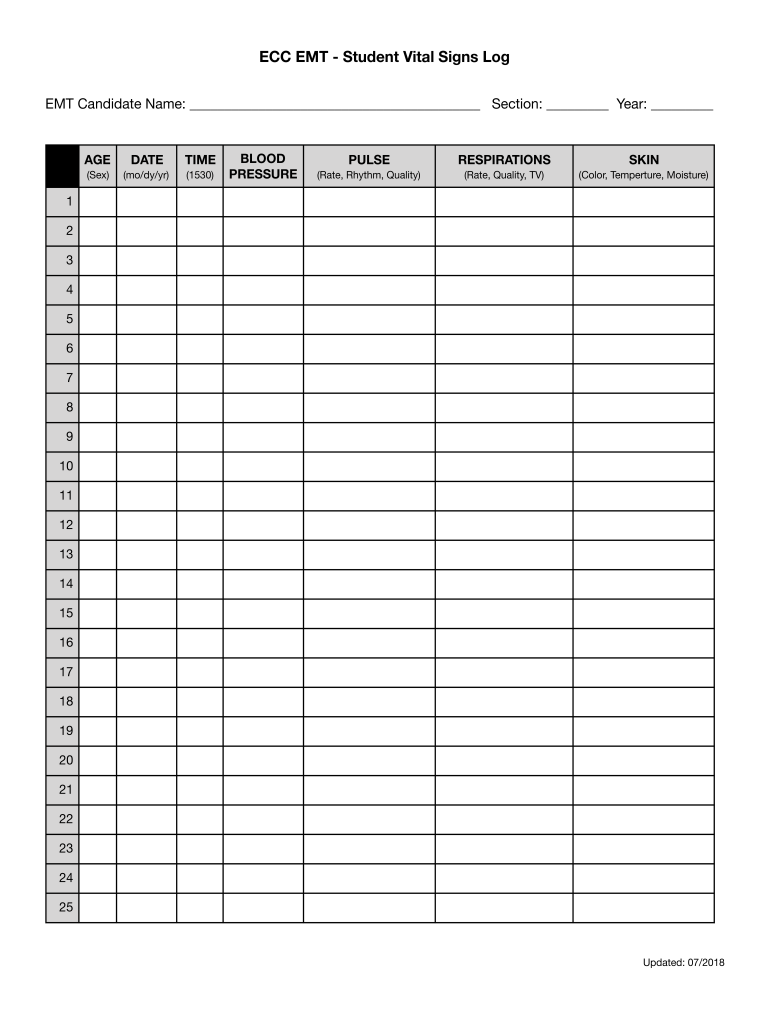
SE RESPIRATIONS SKIN (Rate, Rhythm, Quality) (Rate, Quality, TV) (Color, Temperture, Moisture) 1 2 3 4 5 6 7 8 9 10 11 12 13 14 15 16 17 18 19 20 21 22 23 24 25 Updated: 07/2018.
Loading

Open form follow the instructions

Easily sign the form with your finger

Send filled & signed form or save
How to fill out the VITAL SIGNS LOG online
Filling out the VITAL SIGNS LOG is an essential task for tracking vital health measurements. This guide will help you navigate the online form with detailed, step-by-step instructions customized to meet your needs.
Follow the steps to complete the form accurately and efficiently.
- Press the ‘Get Form’ button to obtain the VITAL SIGNS LOG form and open it in the online editor.
- Begin by entering the EMT candidate's name in the designated field. Ensure you spell the name correctly for clear identification.
- Fill in the section labeled 'Section' to indicate the specific course or division you are part of, followed by the year of study.
- Record the age of the person whose vital signs are being measured in the 'AGE' field.
- Enter the date of the measurement in the format (mo/dy/yr) to ensure proper record-keeping.
- Document the time of the measurement in military format (e.g., 1530 for 3:30 PM).
- Specify the sex of the individual whose vital signs are recorded in the designated field.
- For blood pressure, enter the measurements in the 'BLOOD PRESSURE' section using the appropriate units.
- Next, record the pulse rate in the 'PULSE' section, noting the rhythm and quality as indicated.
- Fill in the 'RESPIRATIONS' section by documenting the rate, quality, and tidal volume for complete records.
- In the 'SKIN' section, evaluate and document the color, temperature, and moisture of the skin to provide a holistic view of the individual's health.
- After recording the vital signs, review each entry to ensure accuracy and completeness.
- Once all information is correctly entered, save your changes to ensure the data is preserved.
- You may choose to download, print, or share the form as needed for your records or to submit to relevant authorities.
Complete your vital signs documentation online today to maintain accurate health records.
Experience a faster way to fill out and sign forms on the web. Access the most extensive library of templates available.
Related content
by A Sapra · 2022 · Cited by 56 — Vital signs are an objective measurement of the...
Vital signs, also known as vital functions, biometric data or biodata, was a term that...
Get answers to your most pressing questions about US Legal Forms API.
How many vital signs do we have?
There are four main vital signs: Body temperature. Blood pressure. Pulse (heart rate).
What are the 5 primary vital signs?
Vital signs measure the body's basic functions. These include your temperature, heart rate, respiratory rate, blood pressure, and oxygen saturation.
How do you log vitals?
The vital signs should be recorded in the following order: Body temperature, Heart rate, Respiration rate, Blood pressure, and Pain (optional).
What is a normal vital signs record?
Normal vital sign ranges for the average healthy adult while resting are: Blood pressure: 90/60 mm Hg to 120/80 mm Hg. Breathing: 12 to 18 breaths per minute. Pulse: 60 to 100 beats per minute.
What are the 7 vital signs?
What Are Vital Signs, and What Can They Tell Us About Our Health? Overview. Heart rate. Respiratory rate. Body temperature. Oxygen saturation. Blood pressure. In children.
What are the six vital signs of life?
The six classic vital signs (blood pressure, pulse, temperature, respiration, height, and weight) are reviewed on an historical basis and on their current use in dentistry.
What are the 5 steps of vital signs?
Vital Signs (Body Temperature, Pulse Rate, Respiration Rate, Blood Pressure) Body temperature. Pulse rate. Respiration rate (rate of breathing) Blood pressure (Blood pressure is not considered a vital sign, but is often measured along with the vital signs.)
What are the 9 vital signs?
Introduction Temperature. Pulse rate. Blood pressure. Respiratory rate. Blood oxygen saturation via pulse oximetry. Vital signs can be influenced by a number of factors. It can vary based on age, time, gender, medication, or a result of the environment.
Use professional pre-built templates to fill in and sign documents online faster. Get access to thousands of forms.
If you believe that this page should be taken down, please follow our DMCA take down process here.