Loading
Get Gizmos Student Exploration: Coastal Winds And Clouds 2015-2026
How it works
-

Open form follow the instructions
-

Easily sign the form with your finger
-

Send filled & signed form or save
How to fill out the Gizmos Student Exploration: Coastal Winds and Clouds online
This guide provides comprehensive instructions on completing the Gizmos Student Exploration: Coastal Winds and Clouds online. Users will learn how to navigate each section and field of the form effectively.
Follow the steps to successfully complete the online form.
- Press the ‘Get Form’ button to access the document and open it in the editor.
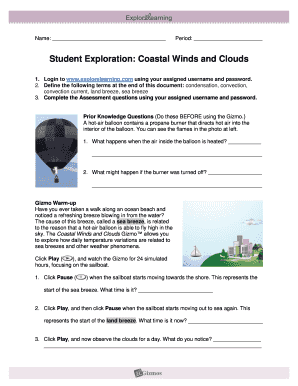
- Log in to www.explorelearning.com using your assigned username and password to begin your exploration.
- Define the key terms listed at the end of the document: condensation, convection, convection current, land breeze, and sea breeze.
- Answer the prior knowledge questions that are presented before starting the Gizmo. Ensure you provide thoughtful responses based on what you know about hot-air balloons and breezes.
- Engage with the Gizmo simulation by clicking 'Play' to observe a 24-hour weather cycle. Record your observations at specific times as instructed.
- Prepare for Activity A by resetting the Gizmo and turning on the Weather probe. Collect data regarding air temperatures and wind conditions at specified times throughout the day.
- Analyze the collected data by comparing air temperatures with the breezes and answering the corresponding questions provided.
- Move on to Activity B, where you will again reset the Gizmo and observe the drifting balloon's behavior over 48 hours. Record your observations and analyze the results.
- Complete the assessment questions at the end by using your username and password for full credit. Ensure all responses are filled in where required.
- Once you have completed the form, save your changes. You may then choose to download, print, or share your completed document as needed.
Begin completing your Gizmos Student Exploration: Coastal Winds and Clouds online today!
Afternoon is the most active time of day for these circulations, as sea breeze penetration reaches a maximum and winds are strongest.