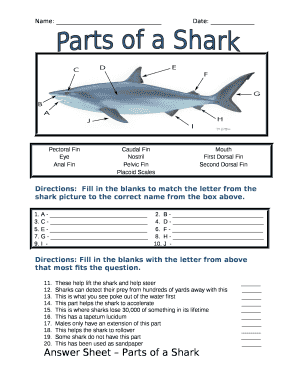
Name: Date: Pectoral Fin Caudal Fin Mouth Eye Nostril First Dorsal Fin Anal Fin Pelvic Fin Second Dorsal FinPlacoid ScalesDirections: Fill in the blanks to match the letter from the shark picture.

How it works
  • Open form

    Open form follow the instructions

  • Easily sign form

    Easily sign the form with your finger

  • Share form

    Send filled & signed form or save

How to fill out the Shark Anatomy - Ocean Of Know online

Filling out the Shark Anatomy - Ocean Of Know form online is an important step in understanding the unique features of sharks. This guide will provide you with clear instructions on how to accurately complete the form and enhance your knowledge of shark anatomy.

Follow the steps to successfully complete the Shark Anatomy form.

  1. Press the ‘Get Form’ button to access the Shark Anatomy - Ocean Of Know form and open it in your preferred editor.
  2. Begin by entering your name in the designated blank space at the top of the form. This identifies you as the person completing the document.
  3. In the section labeled with various shark parts, identify each part listed and match them with the corresponding letters from the shark picture. Fill in the blanks numbered 1 through 10.
  4. Continue to the next section which asks you to relate each shark anatomical feature to the questions provided. Use the letters from the first section to complete blanks 11 through 20.
  5. Review your answers to ensure accuracy. Make sure each part is matched correctly with its corresponding anatomical function.
  6. Once you have completed all sections, you can save the changes, download the document for your records, print it for reference, or share it with others who might benefit from it.

Start completing the Shark Anatomy - Ocean Of Know form online today!

Get form

Experience a faster way to fill out and sign forms on the web. Access the most extensive library of templates available.

Related content

12 Shark Facts That May Surprise You | NOAA...

Jul 17, 2018 — 1. Sharks do not have bones. ... Sharks use their gills to filter oxygen...

Learn more
Sharks | Smithsonian Ocean

Apr 30, 2018 — No matter their size, all sharks have similar anatomy. ... Many shark...

Learn more
Antarctic toothfish

Oct 10, 2020 — The habitat of the Antarctic toothfish is in subzero degree water...

Learn more
Questions & Answers

Get answers to your most pressing questions about US Legal Forms API.

Contact support

What features of a shark's anatomy allow it to survive in the ocean?

Cartilaginous skeleton Sharks, rays, skates, and chimaeras (also know as rat fishes) all have cartilaginous skeletons. Cartilage is less dense than bone, allowing sharks to move quickly through the water without using too much energy.

To help compensate for their tendency to sink, their livers contain large amounts of oil that is less dense than seawater. Pelagic (open water) sharks generally have larger livers, with more and lighter oil, than sharks which live in shallower water or near the ocean bottom.

Spines are included in the shark anatomy as a form of protection. For many sharks and most rays, spines are included in their anatomy to defend them against potential predators.

Many sharks, especially bottom-dwelling species, have paired openings called spiracles located between the eye and the gill slits. Spiracles are used to take in water and ventilate the gills, even while the shark may be feeding or at rest on the bottom.

Most sharks have a muscular, asymmetrical, upturned tail; pointed fins; a pointed snout; and sharp triangular teeth. Sharks have no swim bladder and must swim perpetually to keep from sinking. Most species bear living young.

One way the shark protects itself is its teeth. They teeth protect the shark by biting the enemy and making them swim away. The other way the shark protects itself is with it's head. The head of the hammerhead shark is important because the hammerhead shark can use it to hit the enemy and hurt it.

A shark has fins and a streamlined body that help it swim through water. It has gills, which take in oxygen directly out of the water. Because of its gills, sharks can stay underwater and not have to come to the surface to breathe. Sharks also have a tremendous number of sharp teeth, which make them fierce predators.

On fast swimming sharks, denticles have sharp peaks and small grooves running from front to back, helping water flow over the body more efficiently. The denticles of some sharks even have cross-ridges and pits (like a golf ball) to further increase swimming efficiency.

Get This Form Now!

Use professional pre-built templates to fill in and sign documents online faster. Get access to thousands of forms.

If you believe that this page should be taken down, please follow our DMCA take down process here.

Get Shark Anatomy - Ocean Of Know