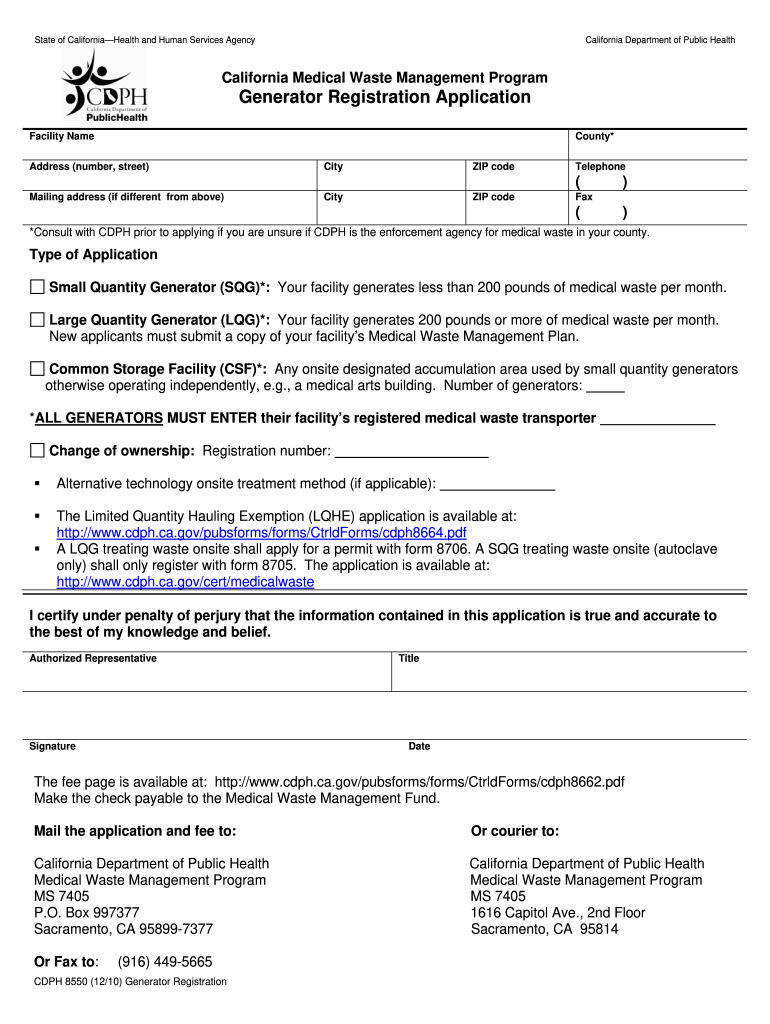
T Program Generator Registration Application Facility Name County* Address (number, street) City ZIP code Mailing address (if different from above) City ZIP code Telephone ( ) Fax ( ) *Consult with CDPH prior to applying if you are unsure if CDPH is the enforcement agency for medical waste in your county. Type of Application Small Quantity Generator (SQG)*: Your facility generates less than 200 pounds of medical waste per month. Large Quantity Generator (LQG)*: Your facility gene.
Loading

Open form follow the instructions

Easily sign the form with your finger

Send filled & signed form or save
How to fill out the CA CDPH 8550 online
Filling out the CA CDPH 8550 form is an essential step for medical waste management generator registration. This guide will help you navigate each section of the form with clarity, ensuring that your application is completed accurately and efficiently.
Follow the steps to successfully complete your application.
- Click ‘Get Form’ button to access the CA CDPH 8550 form online.
- Begin by entering the facility name in the designated field, ensuring it is correctly spelled to avoid processing delays.
- Select your county from the dropdown menu. If unsure about CDPH's enforcement in your county, consult with them prior to submitting your application.
- Provide the full address, including number, street, city, and ZIP code. If your mailing address differs from the physical address, fill in those details in the respective fields.
- Enter the telephone number and fax information; ensure accuracy to facilitate correspondence.
- Indicate the type of application by selecting one of the following options: Small Quantity Generator (SQG), Large Quantity Generator (LQG), or Common Storage Facility (CSF). Each option has specific criteria, so choose accordingly.
- New applicants must attach a copy of their facility’s Medical Waste Management Plan. Ensure this document is ready for submission.
- If applying for a change of ownership, include the registration number associated with the previous owner.
- Complete the section about alternative onsite treatment methods if applicable, providing all required information.
- Review the certification statement carefully. The authorized representative must sign, providing their title and the date.
- Finalize your application by saving changes, and then download or print the form for submission.
- Mail the application and required fee to the California Department of Public Health or fax it to the provided number, as per your preference.
Start your application process today by filling out the CA CDPH 8550 online.
Experience a faster way to fill out and sign forms on the web. Access the most extensive library of templates available.
Related content
CDPH 8550 (8/18). Page 1 of 2. Waste Management Program. Generator Registration...
The Emergency Services Act (Government Code Section 8550, et seq.) authorizes the Governor...
Get answers to your most pressing questions about US Legal Forms API.
Which is not allowed in a regulated medical waste container?
Items such as municipal waste, food waste, and recyclables should never be placed in regulated medical waste containers as outlined by CA CDPH 8550. Mixing these materials can lead to serious legal consequences and health risks. Always ensure that containers are exclusively used for their intended purpose. This practice safeguards both you and your community.
What is not regulated waste?
Not all waste generated in a healthcare setting is regulated. Under CA CDPH 8550, items like paper products and certain office waste do not fall under regulated waste categories. Understanding what constitutes regulated versus non-regulated waste helps maintain compliance and reduces unnecessary disposal costs. Make informed decisions to protect your facility.
What are the rules for pharmaceutical waste in California?
Pharmaceutical waste disposal in California is governed by CA CDPH 8550 regulations. These rules categorize pharmaceutical waste into hazardous and non-hazardous types, each requiring specific disposal methods. Correctly following these rules is essential for compliance and safety. Utilizing services from US Legal Forms can assist you in understanding your responsibilities.
How do you dispose of biohazard waste in California?
To dispose of biohazard waste in California, adhere to procedures mandated by CA CDPH 8550. This includes using designated containers, labeling materials accurately, and following transportation guidelines. Ensuring compliance protects health and the environment. Consider using platforms like US Legal Forms for guidance on the necessary documentation.
What is not suitable for medical waste?
Non-infectious materials, food waste, and recyclable items are not suitable for medical waste disposal as outlined by CA CDPH 8550. Proper classification prevents contamination and protects human health. It is vital to separate these materials correctly. Failing to do so can lead to hazardous situations.
Which of the following items should be disposed of as regulated waste?
Items like sharps, infectious waste, and pathological waste should be disposed of as regulated medical waste under CA CDPH 8550. This classification ensures the safety of individuals and the environment. It is essential to follow proper disposal procedures to minimize risk. Understanding the classifications helps maintain a safe healthcare environment.
What cannot be disposed of in regulated medical waste?
Certain items cannot be disposed of in regulated medical waste according to CA CDPH 8550 guidelines. For example, municipal waste, general office waste, and hazardous waste have different disposal regulations. It is critical to understand these distinctions to ensure compliance. Always check local regulations to avoid fines.
What is the best method to dispose of hospital waste?
The best method to dispose of hospital waste involves following comprehensive regulations, including those found in CA CDPH 8550. Hospitals should use designated containers for different types of waste and work with licensed medical waste disposal companies. This strategy ensures compliance with safety standards and protects both public health and the environment.
What is the medical waste Management Act MWMA in California?
The Medical Waste Management Act (MWMA) in California is a law that regulates medical waste management practices and is essential for compliance with CA CDPH 8550. This act establishes guidelines for the collection, handling, treatment, and disposal of medical waste. Organizations must understand and follow this act to avoid legal issues and ensure community safety.
How should you dispose of biohazard waste?
To dispose of biohazard waste properly, adhere to the protocols outlined in CA CDPH 8550. It's crucial to use clearly labeled containers designed for biohazard waste, ensuring that they are sealed and secure. Engaging a certified waste disposal service also guarantees that your disposal methods comply with established regulations.
Use professional pre-built templates to fill in and sign documents online faster. Get access to thousands of forms.
If you believe that this page should be taken down, please follow our DMCA take down process here.