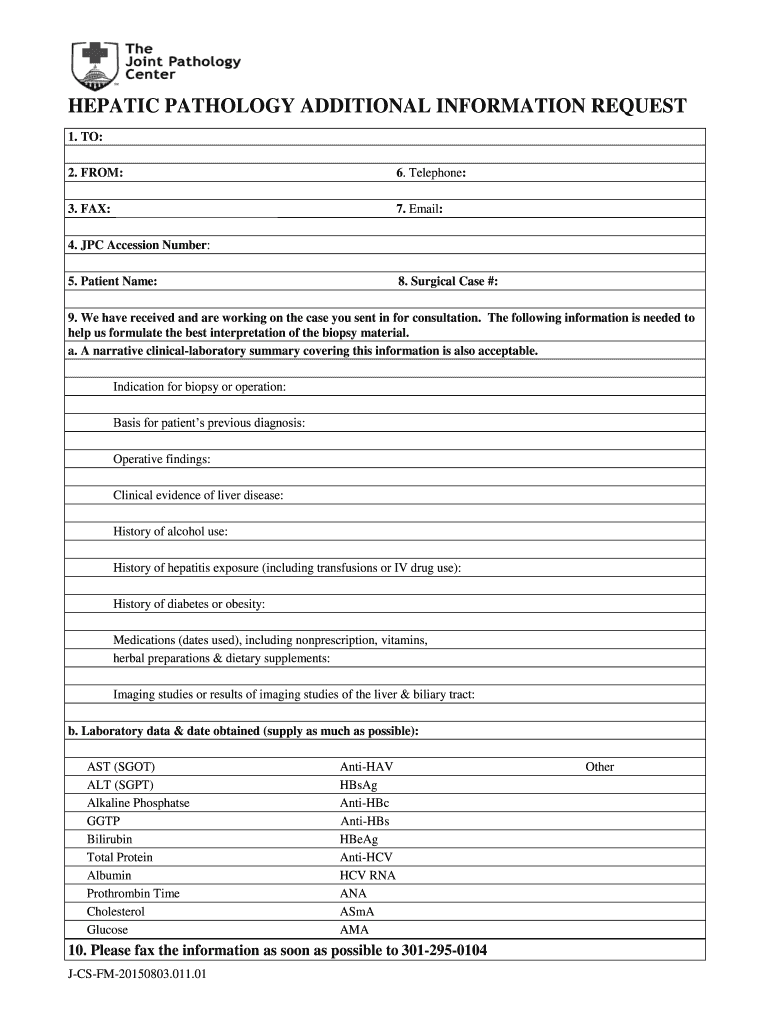
Hepatic pathology additional information request j-cs-fm-20150803.011.01 1. To: 2. From: 6. Telephone: 3.

Open form follow the instructions

Easily sign the form with your finger

Send filled & signed form or save
How to fill out the The Joint Pathology Center Hepatic Pathology Additional Information Request online
Filling out the The Joint Pathology Center Hepatic Pathology Additional Information Request form is an essential step in providing the necessary information for accurate pathology interpretations. This guide will help you navigate the process with clarity and confidence.
Follow the steps to complete the request form online.
- Press the ‘Get Form’ button to access the form and open it in the editor.
- In the 'To:' section, enter the name of the medical facility or recipient to whom the request is addressed.
- In the 'From:' section, provide your name or the name of the person submitting the request.
- Fill out the 'Telephone' field with your contact number for follow-up inquiries.
- Complete the 'FAX' section with the appropriate fax number for submission.
- Input the 'JPC Accession Number' in the designated field, which is crucial for tracking the request.
- In the 'Patient Name' field, enter the full name of the patient associated with the request.
- Fill in the 'Surgical Case #' if applicable, ensuring it corresponds to the patient's case.
- In the narrative section labeled 'Indication for biopsy or operation,' provide a brief description of why the biopsy was performed.
- Supply details in the section for 'Basis for patient’s previous diagnosis' to give context to the pathology request.
- Detail the 'Operative findings' in the field provided, offering insights from any surgical procedures related to the case.
- Provide any available 'Clinical evidence of liver disease', ensuring it's as thorough as possible.
- Include the patient's 'History of alcohol use' if relevant, as it can impact liver health assessments.
- Detail any 'History of hepatitis exposure,' highlighting factors such as transfusions or IV drug use.
- Summarize the 'History of diabetes or obesity', indicating if these conditions are present.
- List any 'Medications' the patient has taken, including nonprescription drugs, vitamins, herbal preparations, and dietary supplements, along with their usage dates.
- If applicable, include any 'Imaging studies or results' relevant to the liver and biliary tract.
- In the 'Laboratory data & date obtained' section, supply the values for the listed tests (AST, ALT, Alkaline Phosphatase, etc.) as well as the relevant dates.
- Conclude by checking that all information is accurate, and know that your ‘Other’ notes can capture any additional relevant details.
- Once completed, save any changes to your form, and consider downloading, printing, or sharing the document as needed.
Begin completing your request form online today to ensure timely processing.
Experience a faster way to fill out and sign forms on the web. Access the most extensive library of templates available.
Related content
This chapter provides basic information about the motivation for and the conduct of the...
INVENTORY - Notify the Vet Path office if you want to move equipment from one office or...
For additional information or assistance with filing a. VAERS report, call:...
Get answers to your most pressing questions about US Legal Forms API.
What is a hepatic pathology?
Hepatic Pathology. This is a case of viral hepatitis C, which in half of cases leads to chronic liver disease. The extent of chronic hepatitis can be graded by the degree of activity (necrosis and inflammation) and staged by the degree of fibrosis.
What is a pathology condition of the liver?
Acute hepatitis, chronic hepatitis, steatohepatitis, and chronic cholestatic injury are all examples of patterns of injury in liver disease. When the pattern is sufficiently distinctive, it can be recognized almost instantly by an experienced pathologist.
Is hepatic disease and liver disease the same thing?
Liver disease, also called hepatic disease, is a general term that refers to any condition affecting your liver. There are many kinds of liver diseases and they can develop for different reasons or causes such as viruses, genetic disorders, or substances such as drugs, alcohol or poisons.
What is the meaning of liver pathology?
The study of Liver diseases is called Liver pathology. Liver diseases can be inherited or caused by a variety of factors that damage the liver, such as viruses and alcohol use. Liver diseases include the following conditions: Cirrhosis, Inflammation or hepatitis.
What are the 4 stages of hepatic disease?
Chronic liver disease progresses in roughly four stages: Hepatitis. Fibrosis. Cirrhosis. Liver failure.
What is considered a hepatic disease?
There are many kinds of liver diseases: Diseases caused by viruses, such as hepatitis A, hepatitis B, and hepatitis C. Diseases caused by drugs, poisons, or too much alcohol. Examples include fatty liver disease and cirrhosis.
Use professional pre-built templates to fill in and sign documents online faster. Get access to thousands of forms.
If you believe that this page should be taken down, please follow our DMCA take down process here.