Loading
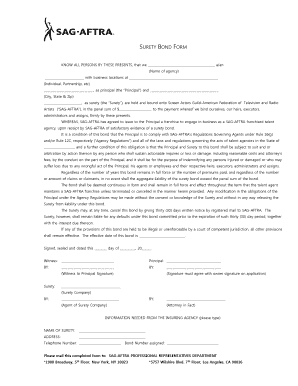
Get Sag-aftra Surety Bond Form 2014-2026
How it works
-

Open form follow the instructions
-

Easily sign the form with your finger
-

Send filled & signed form or save
How to fill out the SAG-AFTRA Surety Bond Form online
Filling out the SAG-AFTRA Surety Bond Form is a crucial step for agencies seeking to operate as SAG-AFTRA franchised talent agencies. This guide provides a straightforward, step-by-step approach to help users complete the form accurately online.
Follow the steps to fill out the SAG-AFTRA Surety Bond Form with ease.
- Click ‘Get Form’ button to obtain the form and open it for editing.
- In the first section, fill in the name of the agency on the line provided. This identifies the entity seeking the surety bond.
- Next, specify the type of agency—Individual, Partnership, etc.—along with the business's physical address in the designated field.
- Enter the city, state, and zip code of the surety in the corresponding section to indicate the surety's location.
- Input the penal sum of the bond in the designated area. This amount represents the financial liability covered by the bond.
- Complete the effective date of the bond, marking the official start of the bond's validity.
- Sign the document where indicated below the 'Principal' section and include a witness signature next to your own.
- Proceed to fill in the surety details, including the surety company's name and signature of the authorized representative.
- In the section labeled 'Information needed from the insuring agency', provide the name and address of the surety, along with the telephone number and bond number.
- After completing all fields, review the form for accuracy, then save changes. You may choose to download, print, or share the completed form as necessary.
Ensure your agency is compliant by completing the SAG-AFTRA Surety Bond Form online today.
Examples of Surety Bonds Includes bid or proposal bonds, performance bonds, payment or labor and material bonds, maintenance bonds and supply bonds. These bonds are required by state or federal law for most public construction projects or by a private developer.