Loading
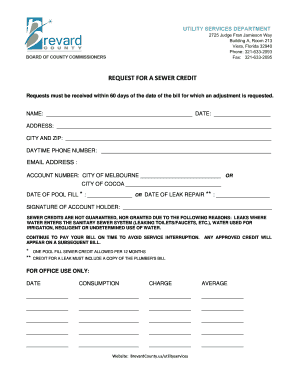
Get Fl Request For A Sewer Credit - Brevard County
How it works
-

Open form follow the instructions
-

Easily sign the form with your finger
-

Send filled & signed form or save
How to fill out the FL Request For A Sewer Credit - Brevard County online
Filing the FL Request For A Sewer Credit is an essential process for users seeking an adjustment on their sewer bills in Brevard County. This guide will provide clear and detailed instructions on how to complete the form online, ensuring a smooth experience for all users.
Follow the steps to complete the request form accurately.
- Click ‘Get Form’ button to access the form and open it in your preferred online editor.
- Begin filling out the form by entering your name in the designated field. Ensure your name is written as it appears on your account to avoid processing delays.
- Provide the date on which you are submitting the request in the specified field.
- Enter your address, including street number and name, in the designated address field. This information is crucial for establishing your account's location.
- Complete the city and zip code fields to ensure accurate identification of your service area.
- Fill in your daytime phone number where you can be reached for any follow-up inquiries regarding your request.
- Input your email address accurately to receive any communication regarding your sewer credit request.
- Locate the account number section and fill in your account number, choosing between the City of Melbourne or City of Cocoa, as applicable.
- Indicate the date of pool fill or date of leak repair, depending on your circumstance, in the appropriate fields.
- Sign the form in the signature field to confirm that the information provided is accurate and that you authorize the request.
- Review your filled form for any errors and ensure all required information is complete before submitting.
- Once satisfied, save changes, download for your records, print, or share the completed form as necessary.
Start your request for a sewer credit online today!
In 2020 Total Trihalomethanes were detected at a level of 17.1, which is below the maximum acceptable limit of 80 ppb. Total Trihalomethanes are a by-product of drinking water disinfection. Copper. In 2020 Copper was detected at a level of 0.17 ppm, which is below the maximum acceptable limit of 1.3 ppm.