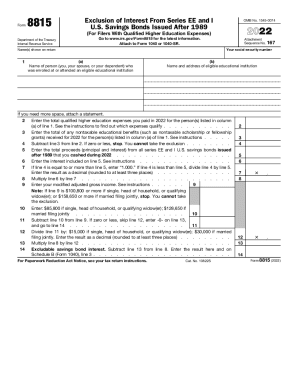
Form8815Exclusion of Interest From Series EE and I U.S. Savings Bonds Issued After 1989OMB No. 154500742022(For Filers With Qualified Higher Education Expenses)Department of the Treasury Internal.
Open form follow the instructions
Easily sign the form with your finger
Send filled & signed form or save
How to fill out the IRS 8815 online
Filing your taxes can be a complex process, but understanding how to fill out specific forms can simplify your experience. This guide provides step-by-step instructions on how to complete the IRS form 8815 online, ensuring you can successfully exclude interest from your U.S. savings bonds.
Follow the steps to fill out the IRS 8815 online with ease.
- Click 'Get Form' button to obtain the form and open it for editing.
- Enter your social security number and the name(s) shown on your return.
- In line 1(a), write the name of the person who attended an eligible educational institution. In line 1(b), provide the name and address of the institution.
- For line 2, list the total qualified higher education expenses for the individual(s) from line 1(a). Ensure you understand which expenses qualify.
- For line 3, enter any nontaxable educational benefits received for the individual(s) in line 1(a).
- Complete line 4 by entering the total proceeds from the series EE and I U.S. savings bonds you cashed during the year.
- On line 5, enter the interest included from line 4.
- For line 6, if applicable, calculate the portion of interest to exclude and enter the result.
- In line 9, enter your modified adjusted gross income and follow any necessary instructions to determine eligibility.
- Finally, review all entries for accuracy, then save changes, download the document, and print or share it as needed.
Complete your documentation online and ensure you're ready for tax season.
Experience a faster way to fill out and sign forms on the web. Access the most extensive library of templates available.
Related content
Jan 18, 2023 — If you cashed series EE or I U.S. savings bonds this year that were...
Jan 20, 2023 — 5329 Additional Taxes on Qualified Plans (Including. IRAs) and Other...
Form 8815 is used to figure the amount of interest you can exclude from your income when...
Get answers to your most pressing questions about US Legal Forms API.
What is IRS Form 8815?
If you cashed series EE or I U.S. savings bonds this year that were issued after 1989, you may be able to exclude from your income part or all of the interest on those bonds. Use Form 8815 to figure the amount of any interest you may exclude.
What happens if you keep a bond past maturity?
You can hold your bond once it reaches maturity, but you won't earn any additional interest. On one hand, you can't spend a savings bond without redeeming it, so the value of your bonds would be considered "safe" from that standpoint.
What is the difference between sole owner and primary owner in TreasuryDirect?
Sole Owner: Only one individual is named as owner. Primary Owner (with Secondary Owner): Two individuals' names are recorded for the security in TreasuryDirect, separated by the word "WITH." For example, "John Smith SSN 123-45-6789 WITH Mary Smith SSN 987-65-4321."
Is there a tax penalty for not cashing in matured savings bonds?
There is no penalty if you simply hold onto the bond after five years. There is value in holding onto most bonds. The longer they mature, the more interest bonds earn.
What happens if you don't cash savings bonds?
Failure to report such interest may lead to a federal tax penalty. You are supposed to pay tax on a U.S. Savings Bond in one of two ways. Most bondholders choose to defer the tax until the bond matures. Once they redeem the bond, they report the interest through a 1099-INT form.
What is the best thing to do with matured savings bonds?
When those bonds mature and stop earning interest, it is time to redeem them. Redeeming bonds is easy - just take them to a local bank or send them to the Bureau of the Fiscal Service.
What is the income limit for 8815?
Use Form 8815 to figure your modified AGI. For 2022, the exclusion begins to phase out at: $77,200 if you file single. $115,750 if you're married filing jointly or a qualifying widow(er)
What is the penalty for not cashing matured savings bonds?
After the one-year mark, you can go ahead and cash in your bond, but you will get hit with a penalty of three months' interest earned on the bond. There is no penalty if you simply hold onto the bond after five years.
Use professional pre-built templates to fill in and sign documents online faster. Get access to thousands of forms.
If you believe that this page should be taken down, please follow our DMCA take down process here.