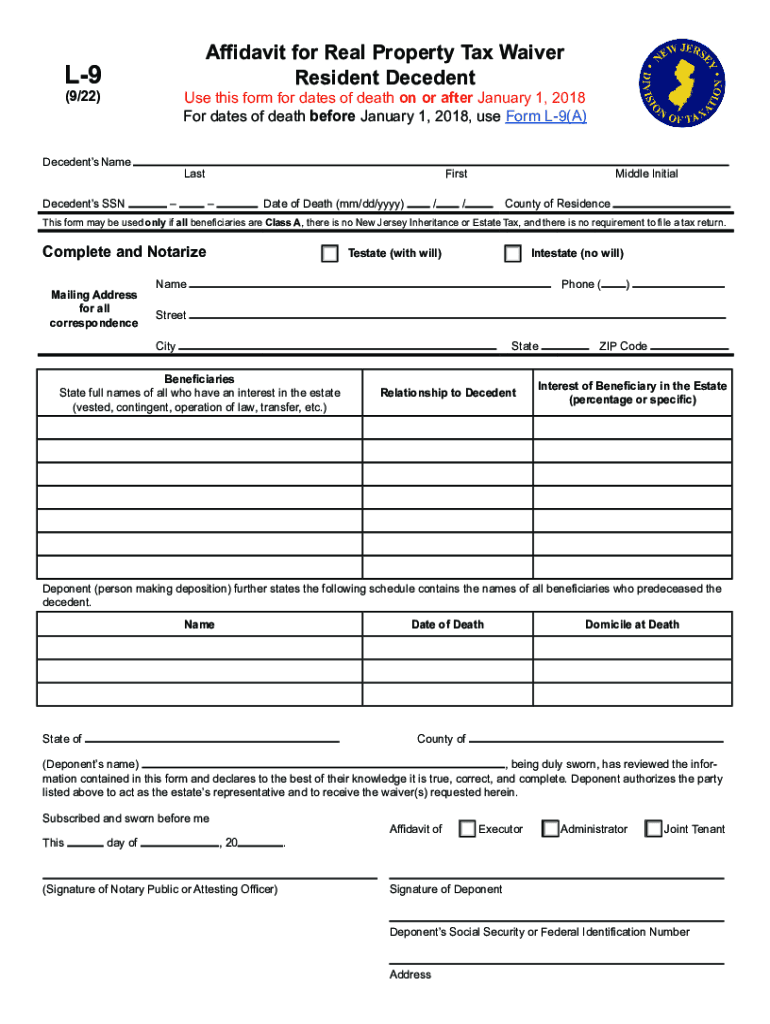
Affidavit for Real Property Tax Waiver Resident DecedentL9 (9/22)Use this form for dates of death on or after January 1, 2018, For dates of death before January 1, 2018, use Form L9(A)Decedents Name.

Open form follow the instructions

Easily sign the form with your finger

Send filled & signed form or save
How to fill out the NJ DoT L-9 online
This guide provides step-by-step instructions for filling out the NJ DoT L-9 form online, ensuring that you have all the necessary information to complete it accurately. The NJ DoT L-9 form is vital for individuals seeking a tax waiver for real property after the death of a resident decedent.
Follow the steps to complete the NJ DoT L-9 form online.
- Click the ‘Get Form’ button to access the L-9 document and prepare it for filling out.
- Begin with the decedent's name and Social Security number. Enter the last name, first name, and middle initial in the respective fields.
- Indicate the county of residence at the time of death in the provided field.
- Select whether the decedent left a will (testate) or did not leave a will (intestate).
- Fill in the mailing address for all correspondence, including the name and phone number of the contact person.
- List all beneficiaries' names who have an interest in the estate, along with their relationship to the decedent and their percentage or specific interest in the estate.
- Include a schedule of beneficiaries who predeceased the decedent, providing their names, dates of death, and states of domicile.
- Have the deponent, the individual making the affidavit, review all provided information and declare its truthfulness. This person's signature is required.
- Complete the real estate description section for each property associated with the decedent by providing county, street address, lot, block, and municipality details.
- Ensure all required documents are attached, including the will, property deed, and death certificate.
- Finalize the form by saving your changes, and utilize options to download, print, or share it as needed.
Complete the NJ DoT L-9 form online now and ensure all necessary documents are properly filed.
Experience a faster way to fill out and sign forms on the web. Access the most extensive library of templates available.
Related content
101.01 INTRODUCTION. The 2007 Standard Specifications for Road and Bridge Construction are...
by N Gucunski · 2008 — As a part of the Pavement Management Systems (PMS) project...
The self- certification process will identify commercial drivers that operate in...
Get answers to your most pressing questions about US Legal Forms API.
Who pays NJ Inheritance Tax?
Who Files the New Jersey Inheritance Tax Return? Unless you fall under a Class A beneficiary, the responsibility falls on the estate's Personal Representative to file the appropriate tax return and pay the tax. Payment accompanies the return.
Who is subject to NJ inheritance tax?
The class that a beneficiary falls into determines whether there is New Jersey Inheritance Tax owed. Class A: includes the decedent's spouse, civil union partner, child(ren), grandchild(ren), great-grandchild(ren), step-children, mother, father or grandparent(s).
Does NJ have an estate or Inheritance Tax?
New Jersey has had an Inheritance Tax since 1892, when a tax was imposed on property transferred from a deceased person to a beneficiary. Inheritance Tax is based on who specifically will receive or has received a decedent's assets, and how much each beneficiary is entitled to receive.
Where do I file my NJ inheritance tax return?
All CHECKS should be made payable to NJ INHERITANCE AND ESTATE TAX and sent to the New Jersey Division of Taxation, Individual Tax Audit Branch, Transfer Inheritance and Estate Tax, 50 Barrack Street, PO Box 249, Trenton, NJ 08695-0249. The return must be filed whenever any tax is due or a waiver is needed.
Do beneficiaries have to pay taxes on inheritance in NJ?
New Jersey has had an Inheritance Tax since 1892, when a tax was imposed on property transferred from a deceased person to a beneficiary. Inheritance Tax is based on who specifically will receive or has received a decedent's assets, and how much each beneficiary is entitled to receive.
Does inheritance have to be reported as income on tax return?
Inheritances are not considered income for federal tax purposes, whether you inherit cash, investments or property. However, any subsequent earnings on the inherited assets are taxable, unless it comes from a tax-free source.
Who must file NJ Inheritance Tax return?
The executor, administrator, or heir-at-law of the estate must file an Inheritance Tax return (if required) within eight (8) months of the date of the decedent's death.
What is NJ Form L 9 for?
Form L-9 is an affidavit executed by the executor, administrator or joint tenant requesting the issuance of a tax waiver for real property located in New Jersey which was held by a resident decedent.
Use professional pre-built templates to fill in and sign documents online faster. Get access to thousands of forms.
If you believe that this page should be taken down, please follow our DMCA take down process here.