We use cookies to improve security, personalize the user experience, enhance our marketing activities (including cooperating with our marketing partners) and for other business use.
Click "here" to read our Cookie Policy. By clicking "Accept" you agree to the use of cookies. Read less
Read more
Accept
Loading
Form preview
  • US Legal Forms
  • Form Library
  • More Forms
  • More Multi-State Forms
  • American Museum Of Natural History Worksheet 1: Questions For Chesapeake Bay Food Web Before

Get American Museum Of Natural History Worksheet 1: Questions For Chesapeake Bay Food Web Before

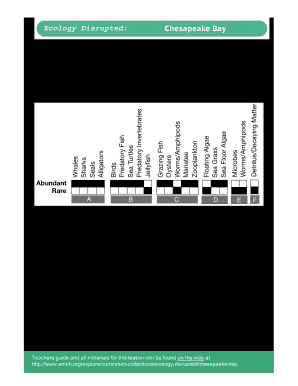
Name Class: Date: Worksheet 1: Questions for Chesapeake Bay Food Web Before Large scale Fishing Detritus/Decaying Matter C Microbes Worms/Amphibious Grazing Fish Oysters Worms/Amphibious Manatee Zooplankton.

How it works

  1. Open form

    Open form follow the instructions

  2. Easily sign form

    Easily sign the form with your finger

  3. Share form

    Send filled & signed form or save

How to fill out the American Museum Of Natural History Worksheet 1: Questions For Chesapeake Bay Food Web Before online

Filling out the American Museum Of Natural History Worksheet 1 is a straightforward process that can help users understand the Chesapeake Bay food web. This guide offers step-by-step instructions to ensure you complete the worksheet effectively.

Follow the steps to successfully complete the worksheet

  1. Press the ‘Get Form’ button to obtain the worksheet and open it in your preferred editing tool.
  2. Fill in your name and class at the top of the worksheet where indicated. Provide the current date in the specified field.
  3. Examine the food web chart presented in the worksheet. Use the provided key to mark the squares indicating the abundance of various species groups, distinguishing between abundant (dark circles) and rare (light circles) species.
  4. Respond to the question regarding the abundance of species by indicating which groups are rare based on your previous markings.
  5. Identify and write down the names of the trophic groups for sections A, B, C, D, and E. Include brief explanations of the interactions among different trophic levels within the ecosystem.
  6. Address question 4A about how worms/amphipods are considered part of two groups. Then, provide an answer for question 4B regarding their more appropriate classification.
  7. Complete question 5 by describing the role of detritus in the food web and categorizing group F appropriately.
  8. For question 6, count and record the number of strong and weak interactions for each species group listed in the chart.
  9. In question 7, categorize the types of producers based on their location in the water, identifying floating producers versus those found on the seabed.
  10. Provide an answer for question 8 by comparing the abundance of floating algae versus seafloor algae.
  11. Create a six-step food chain for question 9 by connecting the species according to their ecological relationships.
  12. In question 10, compare the food chain you've created with one from a terrestrial ecosystem, addressing the differences in length and productivity.
  13. Answer question 11 by detailing what microbes consume and identifying their role within the food web.
  14. Complete questions 12 to 14 by predicting population changes within the food web under various hypothetical scenarios.
  15. Once all questions are answered, review your work for completeness and clarity before saving your changes, downloading, or printing the worksheet.

Begin completing the American Museum Of Natural History Worksheet 1 online today to enhance your understanding of Chesapeake Bay ecosystems.

Get form

Experience a faster way to fill out and sign forms on the web. Access the most extensive library of templates available.
Get form

Related content

Taking a trip with microbes and plankton
by L Safi — The main focus of this class is to work concepts on food webs and ecological...
Learn more
Smithsonian Education – Resource Finder Search
Includes printable handouts for two activities, group discussion questions, and...
Learn more
GLOUCESTER COUNTY SCHOOL BOARD MONTHLY ...
May 8, 2018 — A. Approval of Recommendation for the Expulsion of One (1) Student –...
Learn more

Related links form

Junkers Wrd 11 2b Manual In English 2020 Rule 19(8) 2020 Hb Compliance Login 2020 Figurative Language Worksheets Pdf 2020

Questions & Answers

Get answers to your most pressing questions about US Legal Forms API.

Contact support

Most organisms are rare now. The only abundant organisms are birds, jellyfish, worms/amphipods, floating algae, and microbes. 3.

Are most species abundant or rare? Which species groups are rare? Most species are abundant. The only groups that are rare are jellyfish, worms/amphipods, floating algae, microbes, and detritus.

The first problem is overfishing, since human populations in the eastern coast rely on the Chesapeake Bay for many types of food, most notably crabs, and populations have reached threatened levels due to overfishing. Another major concern in pollution, which limits the growth of most species.

The food chain starts with phytoplankton converting sunlight and nutrients into living tissue. Phytoplankton is then eaten by copepods, which are members of the microscopic animal community called zooplankton. Copepods are eaten by bay anchovies, which are eaten by large fish such as bluefish and striped bass.

The first problem is overfishing, since human populations in the eastern coast rely on the Chesapeake Bay for many types of food, most notably crabs, and populations have reached threatened levels due to overfishing. Another major concern in pollution, which limits the growth of most species.

Nutrient levels have increased dramatically in the Bay in the last 300 years. Between 1883 – 1891, over 1,700,000 metric tons of oysters were removed from the Bay. In 1957, floating algae was 6 times higher than seafloor algae. As the oyster population decreased, the floating algae population increased.

How have humans affected the Chesapeake Bay food web? People have overharvested most of the species in the Chesapeake Bay including whales, sharks, seals, sea turtles, predatory fish, grazing fish, predatory invertebrates, and oysters.

The complexity of the ecosystem has been lost. Also, people have been added to the ecosystem and jellyfish that were once rare are now abundant. Some species might not have any connections at all.

Get This Form Now!

Use professional pre-built templates to fill in and sign documents online faster. Get access to thousands of forms.
Get form
If you believe that this page should be taken down, please follow our DMCA take down processhere.

Industry-leading security and compliance

US Legal Forms protects your data by complying with industry-specific security standards.
  • In businnes since 1997
    25+ years providing professional legal documents.
  • Accredited business
    Guarantees that a business meets BBB accreditation standards in the US and Canada.
  • Secured by Braintree
    Validated Level 1 PCI DSS compliant payment gateway that accepts most major credit and debit card brands from across the globe.
Get American Museum Of Natural History Worksheet 1: Questions For Chesapeake Bay Food Web Before
Get form
Form Packages
Adoption
Bankruptcy
Contractors
Divorce
Home Sales
Employment
Identity Theft
Incorporation
Landlord Tenant
Living Trust
Name Change
Personal Planning
Small Business
Wills & Estates
Packages A-Z
Form Categories
Affidavits
Bankruptcy
Bill of Sale
Corporate - LLC
Divorce
Employment
Identity Theft
Internet Technology
Landlord Tenant
Living Wills
Name Change
Power of Attorney
Real Estate
Small Estates
Wills
All Forms
Forms A-Z
Form Library
Customer Service
Terms of Service
Privacy Notice
Legal Hub
Content Takedown Policy
Bug Bounty Program
About Us
Help Portal
Legal Resources
Blog
Affiliates
Contact Us
Delete My Account
Site Map
Industries
Forms in Spanish
Localized Forms
State-specific Forms
Forms Kit
Legal Guides
Real Estate Handbook
All Guides
Prepared for You
Notarize
Incorporation services
Our Customers
For Consumers
For Small Business
For Attorneys
Our Sites
US Legal Forms
USLegal
FormsPass
pdfFiller
signNow
airSlate WorkFlow
DocHub
Instapage
Social Media
Call us now toll free:
+1 833 426 79 33
As seen in:
  • USA Today logo picture
  • CBC News logo picture
  • LA Times logo picture
  • The Washington Post logo picture
  • AP logo picture
  • Forbes logo picture
© Copyright 1997-2025
airSlate Legal Forms, Inc.
3720 Flowood Dr, Flowood, Mississippi 39232
Form Packages
Adoption
Bankruptcy
Contractors
Divorce
Home Sales
Employment
Identity Theft
Incorporation
Landlord Tenant
Living Trust
Name Change
Personal Planning
Small Business
Wills & Estates
Packages A-Z
Form Categories
Affidavits
Bankruptcy
Bill of Sale
Corporate - LLC
Divorce
Employment
Identity Theft
Internet Technology
Landlord Tenant
Living Wills
Name Change
Power of Attorney
Real Estate
Small Estates
Wills
All Forms
Forms A-Z
Form Library
Customer Service
Terms of Service
Privacy Notice
Legal Hub
Content Takedown Policy
Bug Bounty Program
About Us
Help Portal
Legal Resources
Blog
Affiliates
Contact Us
Delete My Account
Site Map
Industries
Forms in Spanish
Localized Forms
State-specific Forms
Forms Kit
Legal Guides
Real Estate Handbook
All Guides
Prepared for You
Notarize
Incorporation services
Our Customers
For Consumers
For Small Business
For Attorneys
Our Sites
US Legal Forms
USLegal
FormsPass
pdfFiller
signNow
airSlate WorkFlow
DocHub
Instapage
Social Media
Call us now toll free:
+1 833 426 79 33
As seen in:
  • USA Today logo picture
  • CBC News logo picture
  • LA Times logo picture
  • The Washington Post logo picture
  • AP logo picture
  • Forbes logo picture
© Copyright 1997-2025
airSlate Legal Forms, Inc.
3720 Flowood Dr, Flowood, Mississippi 39232