Loading
Form preview
  • US Legal Forms
  • Other Templates
  • Executive Forms
  • Executive Department USDA Forms
  • Usda Sensory Evaluation Form

Get Usda Sensory Evaluation Form

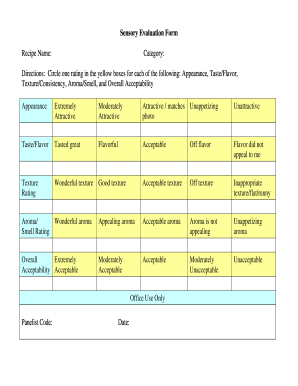
Xture/Consistency, Aroma/Smell, and Overall Acceptability Appearance Extremely Attractive Moderately Attractive Attractive / matches Unappetizing photo Unattractive Taste/Flavor Tasted great Flavorful Acceptable Off flavor Flavor did not appeal to me Texture Rating Wonderful texture Good texture Acceptable texture Off texture Inappropriate texture/flat/runny Aroma/ Wonderful aroma Smell Rating Appealing aroma Acceptable aroma Aroma is not appealing Unappetizing aroma Overall.

How it works

  1. Open form

    Open form follow the instructions

  2. Easily sign form

    Easily sign the form with your finger

  3. Share form

    Send filled & signed form or save

How to fill out the USDA Sensory Evaluation Form online

This guide provides step-by-step instructions for users on how to effectively fill out the USDA Sensory Evaluation Form online. The form is designed to collect sensory feedback on food products, ensuring a comprehensive evaluation process.

Follow the steps to complete the Sensory Evaluation Form effortlessly.

  1. Press the ‘Get Form’ button to access the USDA Sensory Evaluation Form and open it in your preferred editor.
  2. In the first section, enter the recipe name in the designated field to identify the product being evaluated.
  3. Next, choose the category of the recipe from the provided options to classify the product appropriately.
  4. For each aspect of the sensory evaluation—Appearance, Taste/Flavor, Texture/Consistency, Aroma/Smell, and Overall Acceptability—carefully review the criteria listed and circle the rating that best describes the product's qualities.
  5. For 'Appearance', select from options ranging from 'Extremely Attractive' to 'Unattractive'. Take your time to visually assess the product.
  6. For 'Taste/Flavor', determine the overall flavor profile by circling one of the given ratings, with choices from 'Tasted great' to 'Flavor did not appeal to me'.
  7. In the 'Texture' section, indicate your perception of the product's texture by choosing an appropriate rating between 'Wonderful texture' and 'Inappropriate texture'.
  8. Evaluate the 'Aroma/Smell' by selecting a rating from 'Wonderful aroma' to 'Unappetizing aroma'.
  9. Finally, assess the 'Overall Acceptability', selecting from 'Extremely Acceptable' to 'Unacceptable'.
  10. Fill in the 'Panelist Code' and 'Date' in the 'Office Use Only' section for record-keeping purposes.
  11. After completing the form, users can save their changes, download, print, or share the document as needed.

Complete your USDA Sensory Evaluation Form online today and contribute to the assessment process.

Get form

Experience a faster way to fill out and sign forms on the web. Access the most extensive library of templates available.
Get form

Related content

Development and Application of Sensory Testing...
Sensory testing is key to the acceptance and use of products, services, and information...
Learn more
Sensory Evaluations of USDA Select Strip Loin...
by L Reynolds · 2011 · Cited by 2 — One evaluation sheet was completed per trial...
Learn more
Fish and Fishery Products Hazards and Controls...
This section and subsequent sections will help you determine whether those or other...
Learn more

Related links form

Ptc Form 2020 Iti Transcript Hollywood Star Template Editable Vanderbilt Medical Release Form 2020

Questions & Answers

Get answers to your most pressing questions about US Legal Forms API.

Contact support

The six characteristics used in sensory evaluation include appearance, aroma, taste, texture, sound, and aftertaste. These elements help panelists provide a holistic assessment of the product. By leveraging a USDA Sensory Evaluation Form, evaluators can systematically document their findings, promoting consistency and accuracy in sensory assessments.

The 5 sensory analysis focuses on the five senses: sight, smell, taste, touch, and hearing. Each sense contributes valuable information about a product's characteristics. When applying this method, evaluators often use a USDA Sensory Evaluation Form to capture their observations comprehensively, enhancing the reliability of their conclusions.

A classic example of sensory evaluation is taste testing various coffee blends to determine consumer preferences. Participants evaluate the aroma, flavor, and aftertaste using specific criteria outlined in a USDA Sensory Evaluation Form. This approach allows businesses to refine their products based on direct consumer feedback.

The USDA Sensory Evaluation Form is a standardized document designed to facilitate the collection of data during sensory evaluations. It provides clear guidelines for panelists to record their observations systematically. This form is essential for ensuring accurate assessments and is highly regarded in both industry and research settings.

To conduct effective sensory evaluation, you need well-defined objectives, suitable samples, trained panelists, and controlled testing conditions. Each element plays a critical role in achieving reliable results. Utilizing a USDA Sensory Evaluation Form can help streamline the process and maintain consistency across evaluations.

The process of sensory evaluation involves several key stages, including sample selection, panelist training, and sensory testing. Panelists assess attributes such as taste, smell, and texture in a structured environment. Completed assessments are recorded on a USDA Sensory Evaluation Form, ensuring accuracy and consistency in the data collected.

The steps of sensory evaluation begin with defining the objective of the evaluation, followed by the preparation of samples. Next, trained panelists or consumers evaluate the samples using systematic methods. Finally, the results are analyzed and interpreted, often utilizing a USDA Sensory Evaluation Form to collect data effectively.

A sensory assessment typically includes various sensory attributes such as taste, aroma, texture, and appearance. It involves systematic testing and recording of these attributes using established methods. Utilizing the USDA Sensory Evaluation Form helps consolidate observations and ensures thorough documentation of findings.

Conducting sensory evaluation requires specific items such as samples to test, trained panelists, and a suitable testing environment. It is also vital to have a well-structured approach, often documented using a USDA Sensory Evaluation Form, to facilitate accurate data collection and analysis.

To set up a sensory analysis test, start by defining your goals and selecting appropriate sensory attributes. Prepare a sample set that is representative of the products being evaluated. Finally, recruit trained panelists and guide them on the use of tools like the USDA Sensory Evaluation Form to record their observations accurately.

Get This Form Now!

Use professional pre-built templates to fill in and sign documents online faster. Get access to thousands of forms.
Get form
If you believe that this page should be taken down, please follow our DMCA take down processhere.
Get USDA Sensory Evaluation Form
Get form
  • Adoption
  • Bankruptcy
  • Contractors
  • Divorce
  • Home Sales
  • Employment
  • Identity Theft
  • Incorporation
  • Landlord Tenant
  • Living Trust
  • Name Change
  • Personal Planning
  • Small Business
  • Wills & Estates
  • Packages A-Z
  • Affidavits
  • Bankruptcy
  • Bill of Sale
  • Corporate - LLC
  • Divorce
  • Employment
  • Identity Theft
  • Internet Technology
  • Landlord Tenant
  • Living Wills
  • Name Change
  • Power of Attorney
  • Real Estate
  • Small Estates
  • Wills
  • All Forms
  • Forms A-Z
  • Other Templates
  • Legal Hub
  • About Us
  • Help Portal
  • Legal Resources
  • Blog
  • Affiliates
  • Contact Us
  • Delete My Account
  • Site Map
  • Industries
  • Forms in Spanish
  • Localized Forms
  • State-specific Forms
  • Forms Kit
  • Real Estate Handbook
  • All Guides
  • Notarize
  • Incorporation services
  • For Consumers
  • For Small Business
  • For Attorneys
  • USLegal
  • FormsPass
  • pdfFiller
  • signNow
  • altaFlow
  • DocHub
  • Instapage
Form Packages
  • Adoption
  • Bankruptcy
  • Contractors
  • Divorce
  • Home Sales
  • Employment
  • Identity Theft
  • Incorporation
  • Landlord Tenant
  • Living Trust
  • Name Change
  • Personal Planning
  • Small Business
  • Wills & Estates
  • Packages A-Z
Form Categories
  • Affidavits
  • Bankruptcy
  • Bill of Sale
  • Corporate - LLC
  • Divorce
  • Employment
  • Identity Theft
  • Internet Technology
  • Landlord Tenant
  • Living Wills
  • Name Change
  • Power of Attorney
  • Real Estate
  • Small Estates
  • Wills
  • All Forms
  • Forms A-Z
  • Other Templates
Customer Service
  • Legal Hub
  • About Us
  • Help Portal
  • Legal Resources
  • Blog
  • Affiliates
  • Contact Us
  • Delete My Account
  • Site Map
  • Industries
  • Forms in Spanish
  • Localized Forms
  • State-specific Forms
  • Forms Kit
Legal Guides
  • Real Estate Handbook
  • All Guides
Prepared for you
  • Notarize
  • Incorporation services
Our Customers
  • For Consumers
  • For Small Business
  • For Attorneys
Our Sites
  • USLegal
  • FormsPass
  • pdfFiller
  • signNow
  • altaFlow
  • DocHub
  • Instapage
Social Media
Call us now toll free:
+1 833 426 79 33
As seen in:
© Copyright 1999-2026 airSlate Legal Forms, Inc. 17 Station Street, Suite 303, Brookline, MA 02445
  • Your Privacy Choices
  • Terms of Service
  • Privacy Notice
  • Content Takedown Policy
  • Bug Bounty Program