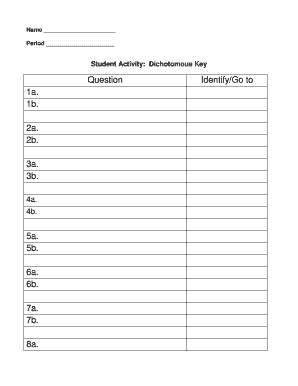
Open form follow the instructions
Easily sign the form with your finger
Send filled & signed form or save
How to fill out the Student Activity Dichotomous Key - Utahlake online
This guide provides clear and supportive instructions on how to complete the Student Activity Dichotomous Key - Utahlake online. Whether you are familiar with digital forms or new to them, the following steps will help you navigate each section effectively.
Follow the steps to fill out the form accurately
- Press the ‘Get Form’ button to download the form and open it in your document editor.
- Begin by entering your name in the designated 'Name' field. This identifies who is completing the activity.
- Fill in the 'Period' field with the appropriate class period to indicate when the activity is being completed.
- For the 'Student Activity: Dichotomous Key' section, follow the questions (1a, 1b, 2a, etc.) and observe the characteristics of the species you are classifying.
- Use the classification pathways provided for both fish and birds to identify species based on observed traits.
- Make sure to accurately record your observations and pathways used to classify each species in the designated areas.
- Once you have completed the key, review all the filled sections for accuracy.
- Finally, save your changes, and choose to download, print, or share your completed form as needed.
Start filling out your document online today!
Experience a faster way to fill out and sign forms on the web. Access the most extensive library of templates available.
Related content
Jun 4, 2012 — Students will be able to use bird picture cards and follow a dichotomous...
This activity will help students recognize that animals have specialized adaptations that...
Get answers to your most pressing questions about US Legal Forms API.
What are the 4 rules of writing a dichotomous key?
Keys are made following these basic rules: • Observing the physical characteristics of objects to be identified by using the key. Identify the most general trait that can be used to divide the organisms into categories. identified. Follow the teacher instructions to complete the key.
What are some examples of dichotomous key?
Dichotomous keys are based on observations, so the instructor should encourage students to use observable characteristics, rather than behaviors. For example, if the picture depicts an owl, accept the observation “they have eyes that face toward the front.” Do not accept the observation “they hunt at night.”
What is an example of a dichotomous key in real life?
Dichotomous keys are based on observations, so the instructor should encourage students to use observable characteristics, rather than behaviors. For example, if the picture depicts an owl, accept the observation “they have eyes that face toward the front.” Do not accept the observation “they hunt at night.”
How do you use a dichotomous key step by step?
0:22 2:37 Using Dichotomous Keys - YouTube YouTube Start of suggested clip End of suggested clip So we write hornbill for a we've identified the first one. We can continue like this for the rest ofMoreSo we write hornbill for a we've identified the first one. We can continue like this for the rest of them if we want to identify B.
What are 3 things a dichotomous key can identify?
A dichotomous key is a tool that can be used to identify organisms or objects in the natural world, such as plants, animals, or rocks. The key consists of a series of paired statements or clues about features or characteristics, providing a stepwise guide toward identifying each entity.
What are 5 examples of dichotomous key?
Example Dichotomous Key Example objects to identify: apple tree, water-lily, fir tree, dandelion, astroturf, seaweed. Dichotomous keys may be simple or complex depending on what is being identified.
What are 2 types of dichotomous keys?
Types of Dichotomous Key: Nested Style. This is when the next identification question appears nested under the answer leading up to it. ... Linked Dichotomous Key: In this kind, questions are written in a listed form, each answer leads to a different question on a different line. Branching Tree.
What is an example of how a dichotomous key can be useful?
Dichotomous keys are most commonly used to identify plant and animal species based on their characteristics. However, they can also be used to identify minerals – and, in theory, any type of object that can be identified by a known set of observed characteristics.
How do you write a dichotomous key activity?
How to Make a Dichotomous Key Step 1: List down the characteristics. ... Step 2: Organize the characteristics in order. ... Step 3: Divide the specimens. ... Step 4: Divide the specimen even further. ... Step 5: Draw a dichotomous key diagram. ... Step 6: Test it out. ... Dichotomous key for animals. ... Dichotomous key for insects.
Use professional pre-built templates to fill in and sign documents online faster. Get access to thousands of forms.
If you believe that this page should be taken down, please follow our DMCA take down process here.