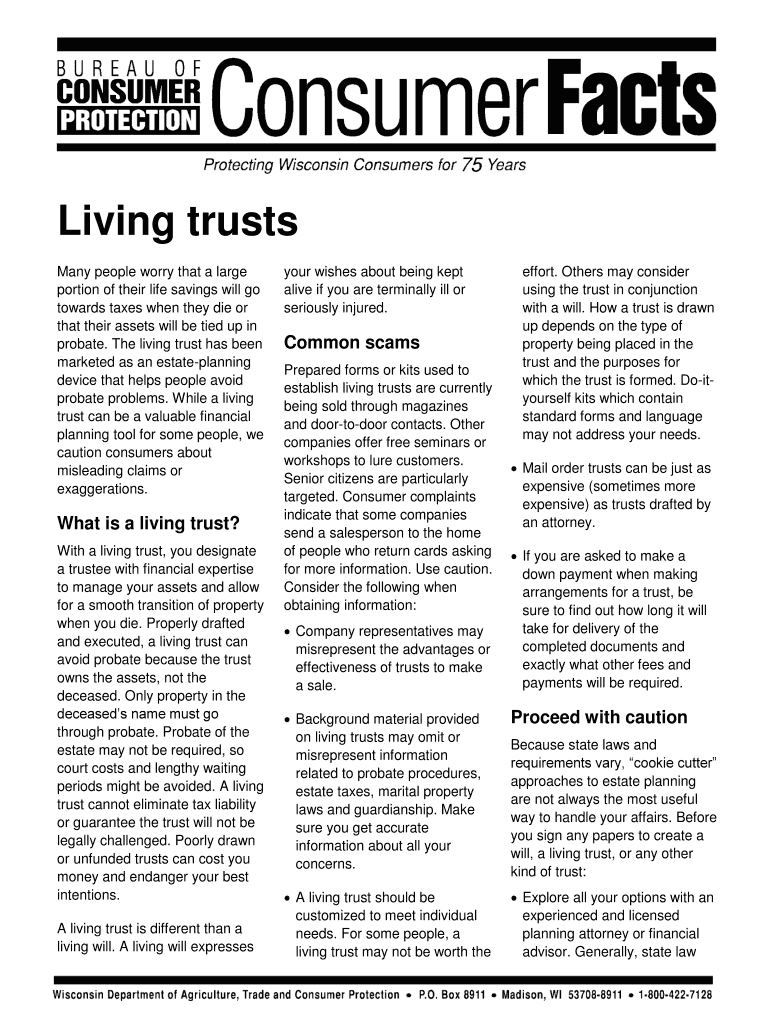
Living trusts Many people worry that a large portion of their life savings will go towards taxes when they die or that their assets will be tied up in probate. The living trust has been marketed as.
Loading

Open form follow the instructions

Easily sign the form with your finger

Send filled & signed form or save
How to fill out the WI Consumer Facts Living Trusts online
Creating a living trust can be a crucial step in effective estate planning. In this guide, we will walk you through how to fill out the WI Consumer Facts Living Trusts form online, ensuring you have a clear understanding of each component to make the process smooth and manageable.
Follow the steps to complete the WI Consumer Facts Living Trusts form online.
- Click the ‘Get Form’ button to access the WI Consumer Facts Living Trusts form. This action will allow you to retrieve the form and open it in the editing interface.
- Familiarize yourself with the introduction section of the form, which outlines the benefits and limitations of living trusts. Ensure you grasp the key points about how living trusts can help avoid probate and the importance of proper execution.
- Fill in your personal information in the designated fields. This typically includes your full name, contact information, and any relevant details about your assets. Be precise and double-check for accuracy.
- Designate a trustee by entering their name in the appropriate field. This person should have financial expertise and be someone you trust to manage your assets effectively.
- Specify the assets you wish to include in the living trust. Clearly list all the property and financial accounts you are transferring into the trust.
- Review your entries to ensure all information is complete and accurate. This is an important step to avoid any issues in the future.
- Once all fields are filled and you are satisfied with the information provided, you can save your changes. You will then have options to download, print, or share the completed form as necessary.
Start your estate planning today by filling out the WI Consumer Facts Living Trusts form online.
Experience a faster way to fill out and sign forms on the web. Access the most extensive library of templates available.
Related content
June 2014. 701.0102 Scope. This chapter applies to express, charitable or noncharitable...
ETF administers retirement, insurance and other benefit programs for state and local...
OCI has contracted with Prometric to develop, evaluate, maintain and revise insurance...
Get answers to your most pressing questions about US Legal Forms API.
What type of trust is best?
An irrevocable trust offers your assets the most protection from creditors and lawsuits. Assets in an irrevocable trust aren't considered personal property. This means they're not included when the IRS values your estate to determine if taxes are owed.
What are the rules for trusts in Wisconsin?
In Wisconsin, a trust is revocable unless it specifically states it is irrevocable in the trust document. Usually a living revocable trust becomes irrevocable (not open to changes) when you die. A trust involves three parties: The settlor or grantor is you, the person who creates the trust.
What does Dave Ramsey say about living trusts?
Do I Need a Living Trust? While there's not a one-size-fits-all answer, the vast majority of people can get by without using a living trust. Dave Ramsey says, “A simple will is perfect for 95% of the population.” In other words, unless you have a really big estate, a simple will works just fine.
What are the disadvantages of trust?
Disadvantages of a Trust include that: the structure is complex. the Trust can be expensive to establish and maintain. problems can be encountered when borrowing due to additional complexities of loan structures. the powers of trustees are restricted by the trust deed.
What are the 3 types of trust?
To help you get started on understanding the options available, here's an overview the three primary classes of trusts. Revocable Trusts. Irrevocable Trusts. Testamentary Trusts.
What is the downside of a living trust?
One of the primary disadvantages to using a trust is the cost necessary to establish it. It's generally more expensive to prepare a living trust than a will. You must create new deeds and other documents to transfer ownership of your assets into the trust after you form it.
How does a living trust work in Wisconsin?
A Wisconsin living trust holds ownership of your assets while you continue to use and control them during your lifetime. After your death, the trust assets are distributed to the beneficiaries you have chosen.
Are trusts worth it?
Trusts are a great way to reduce, and in some cases eliminate, hefty Estate taxes. Essentially, by transferring assets into Trusts you can reduce your overall taxable Estate. Though there are various types of Trusts to choose from, they almost all take tax planning into account.
Use professional pre-built templates to fill in and sign documents online faster. Get access to thousands of forms.
If you believe that this page should be taken down, please follow our DMCA take down process here.