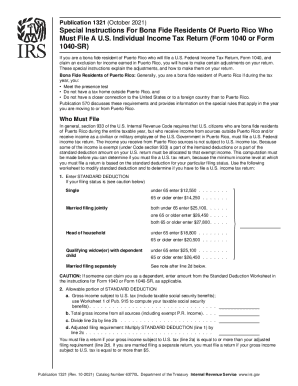
Publication 1321 (October 2021)Special Instructions For Bona Fide Residents Of Puerto Rico Who Must File A U.S. Individual Income Tax Return (Form 1040 or Form 1040SR) If you are a bona fide resident.

How it works
  • Open form

    Open form follow the instructions

  • Easily sign form

    Easily sign the form with your finger

  • Share form

    Send filled & signed form or save

How to fill out the IRS Publication 1321 online

Filling out the IRS Publication 1321 is crucial for bona fide residents of Puerto Rico who need to file a U.S. Individual Income Tax Return. This guide provides a step-by-step approach to help users navigate the online form with ease and confidence, ensuring that all required adjustments are accurately made.

Follow the steps to successfully complete your IRS Publication 1321 online.

  1. Click ‘Get Form’ button to obtain the form and open it in the editor.
  2. Read the introductory information carefully. Make sure you understand the requirements for being a bona fide resident of Puerto Rico.
  3. Fill out the required personal information in the designated fields. This includes your name, address, and Social Security number.
  4. Review the section concerning who must file. Ensure you meet the criteria outlined for filing based on your income sources.
  5. Complete the worksheet for determining the standard deduction, entering your filing status and necessary figures from the provided income sources.
  6. Ensure to properly allocate the allowable portion of your standard deduction based on your gross income subject to U.S. tax.
  7. Fill out the deductions section. Remember that deductions related to exempt Puerto Rico income are not deductible on your Federal return.
  8. Follow the instructions for computing any itemized deductions, if applicable, ensuring that deductions are apportioned correctly.
  9. When you have completed all necessary sections, save your changes. You can then opt to download, print, or share the filled form according to your needs.

Start filling out your IRS Publication 1321 online today to ensure accurate filing and take advantage of your tax benefits.

Get form

Experience a faster way to fill out and sign forms on the web. Access the most extensive library of templates available.

Related content

Publication 1321 (Rev. 10-2021) - IRS

Publication 1321 (October 2021) ... Publication 570 discusses these requirements and...

Learn more
Publication 1321 (Rev. 9-2007)

Possessions, and IRS Form 8898, Statement for Individuals who Begin or End Bona Fide...

Learn more
2016 Instruction 1040 - IRS

Dec 15, 2016 — For the latest information about developments related to Form 1040 and...

Learn more
Questions & Answers

Get answers to your most pressing questions about US Legal Forms API.

Contact support

What are the tax benefits of moving to Puerto Rico?

One of the greatest of many Puerto Rico tax benefits is the Act 60 Investor Resident Individual Tax Incentive (formerly Act 22), which allows you to pay 0% federal or Puerto Rico capital gains tax on all capital gains incurred during the time that you qualify as a bona fide Puerto Rico resident living in Puerto Rico.

The expatriation rules do not apply to U.S. citizens who relocate to Puerto Rico because the relocation by itself does not require any renunciation of U.S. citizenship. Therefore, if an individual relocates to Puerto Rico, the move does not result in an expatriation tax.

Earned income tax credit 2023 The earned income tax credit is adjusted to account for inflation each year. For the 2023 tax year (taxes filed in 2024), the earned income tax credit will run from $600 to $7,430, depending on filing status and number of children.

Individuals who are bona fide residents of Puerto Rico are eligible for a possession-source income exclusion, and therefore not subject to U.S. income tax on work or business income sourced from within the territory.

If you are age 65 or older, your standard deduction increases by $1,700 if you file as single or head of household. If you are legally blind, your standard deduction increases by $1,700 as well. If you are married filing jointly and you OR your spouse is 65 or older, your standard deduction increases by $1,350.

While the Commonwealth government has its own tax laws, Puerto Rico residents are also required to pay US federal taxes, but most residents do not have to pay the federal personal income tax.

The U.S. tax code (Section 933) allows a bona fide resident of Puerto Rico to exclude Puerto Rico-source income from his or her U.S. gross income for U.S. tax purposes.

Note: If you are a resident of Puerto Rico, you can file Form 1040 (PR) instead of Form 1040-SS. Form 1040 (PR) is the Spanish-language equivalent of Form 1040-SS. These forms must be filed with the U.S. Internal Revenue Service at the address shown in the instructions for Form 1040 (PR) and Form 1040-SS.

Get This Form Now!

Use professional pre-built templates to fill in and sign documents online faster. Get access to thousands of forms.

If you believe that this page should be taken down, please follow our DMCA take down process here.

Get IRS Publication 1321