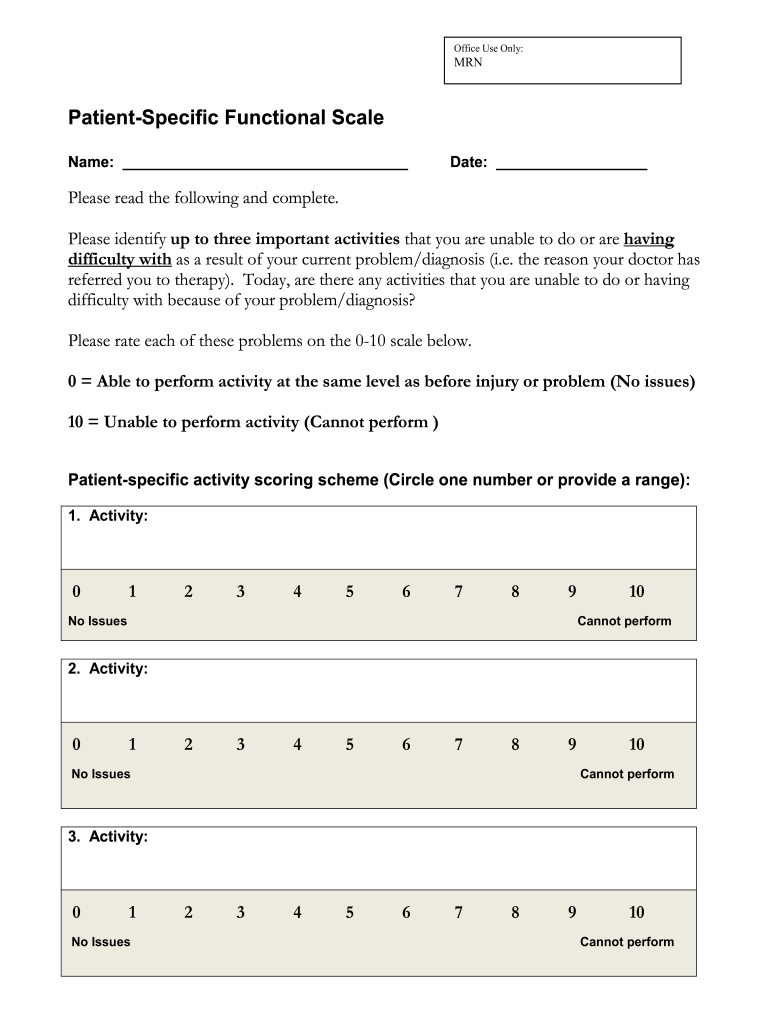
Tivities that you are unable to do or are having difficulty with as a result of your current problem/diagnosis (i.e. the reason your doctor has referred you to therapy). Today, are there any activities that you are unable to do or having difficulty with because of your problem/diagnosis? Please rate each of these problems on the 0-10 scale below. 0 = Able to perform activity at the same level as before injury or problem (No issues) 10 = Unable to perform activity (Cannot perform ) Patient-specif.
Loading

Open form follow the instructions

Easily sign the form with your finger

Send filled & signed form or save
How to fill out the MSU Rehabilitation Patient-Specific Functional Scale online
Filling out the MSU Rehabilitation Patient-Specific Functional Scale is an essential step in assessing your functional abilities and challenges. This online guide will walk you through each section of the form to ensure you accurately express your needs and experiences.
Follow the steps to successfully complete the form.
- Press the ‘Get Form’ button to obtain the document and open it in your preferred online editor.
- Begin by filling in your name in the designated field. This personalizes your submission and allows for proper identification.
- Enter the current date in the specified section. This helps track when the assessment is being completed.
- Read the instructions carefully. Identify up to three important activities that you are currently unable to do or find challenging due to your problem or diagnosis.
- For each of the three activities, provide a brief description in the provided spaces, detailing the nature of the challenges you face.
- Next, rate each activity using the 0-10 scale provided. Circle the number that best reflects your ability to perform each activity, where 0 means no issues and 10 means you cannot perform the activity at all.
- Make sure to double-check all entries for accuracy and completeness.
- Once satisfied with your responses, you can save the changes, download a copy, print it, or share it as needed.
Complete your document online today for a smoother rehabilitation process.
Experience a faster way to fill out and sign forms on the web. Access the most extensive library of templates available.
Related content
by PL van Hulst · 2025 · Cited by 1 — Mobile stroke units (MSUs) have the potential to...
• Functional scale designed to evaluate patients at moderate to severe stages of...
This works by boosting the patient's immune function while suppressing the autoreactive...
Get answers to your most pressing questions about US Legal Forms API.
How to calculate personality test score?
To calculate a personality test score, first, complete the test according to the provided instructions. The scoring typically involves tallying points based on responses to various statements. While cognitive assessments like the MSU Rehabilitation Patient-Specific Functional Scale focus on physical function, understanding personality can also play a role in comprehensive patient care.
What is a functional assessment scale?
A functional assessment scale is a tool designed to evaluate a person's ability to perform specific tasks in daily life. The MSU Rehabilitation Patient-Specific Functional Scale is one such tool, focusing on individualized tasks that matter most to the patient. These scales are vital in guiding treatment and monitoring progress over time.
How to score a PSFS?
Scoring a PSFS requires patients to evaluate specific functional tasks based on their experience. Each task receives a score reflecting the degree of difficulty faced. The overall score from the MSU Rehabilitation Patient-Specific Functional Scale helps healthcare providers create targeted rehabilitation plans tailored to each patient's needs.
How to calculate PSFS score?
To calculate the PSFS score, a patient identifies specific activities they find challenging. They then rate their ability to perform these activities on a scale, typically from 0 to 10. The MSU Rehabilitation Patient-Specific Functional Scale collects these ratings, allowing healthcare practitioners to assess the patient's unique functional status.
What is the MCID for PSFS?
The MCID, or Minimal Clinically Important Difference, for the Patient-Specific Functional Scale varies across studies but generally represents a small change in score that is meaningful to the patient. Understanding the MCID for the MSU Rehabilitation Patient-Specific Functional Scale can help healthcare providers interpret improvements or declines in a patient’s functional ability.
How to calculate APC score?
Calculating the APC score involves assessing patient progress through various measures. Start by determining baseline measurements, then evaluate current performance against those benchmarks. The MSU Rehabilitation Patient-Specific Functional Scale can provide a structured approach to track these changes over time.
What is the full form of PSFS?
The full form of PSFS is Patient-Specific Functional Scale. This scale is widely used in the field of rehabilitation to assess a patient's functional abilities concerning specific tasks that are important to them. The MSU Rehabilitation Patient-Specific Functional Scale takes this concept further by focusing on particular patient needs and activities.
How to calculate mean scale score?
To calculate the mean scale score for the MSU Rehabilitation Patient-Specific Functional Scale, first, sum all the individual item scores. Then, divide this total by the number of items assessed. This process provides a clear average score that reflects the patient's overall functional ability.
What is the functional scale for upper limb?
The functional scale for the upper limb assesses various movements and capabilities necessary for everyday tasks. The MSU Rehabilitation Patient-Specific Functional Scale allows patients to choose activities most relevant to them, thus tailoring their rehabilitation experience. This individualized approach enhances patient engagement and offers precise insights into upper limb function improvement. By utilizing the PSFS, healthcare providers can design more effective and focused recovery plans.
What is the MCID for Penn shoulder score?
The MCID for the Penn Shoulder Score can differ based on various studies but is an essential metric to consider in rehabilitation. For the MSU Rehabilitation Patient-Specific Functional Scale, knowing the MCID helps clinicians identify meaningful changes in a patient’s shoulder function. By monitoring this score, patients and healthcare providers can pinpoint effective interventions and adapt treatment plans. This ultimately leads to improved recovery outcomes for individuals suffering from shoulder issues.
Use professional pre-built templates to fill in and sign documents online faster. Get access to thousands of forms.
If you believe that this page should be taken down, please follow our DMCA take down process here.