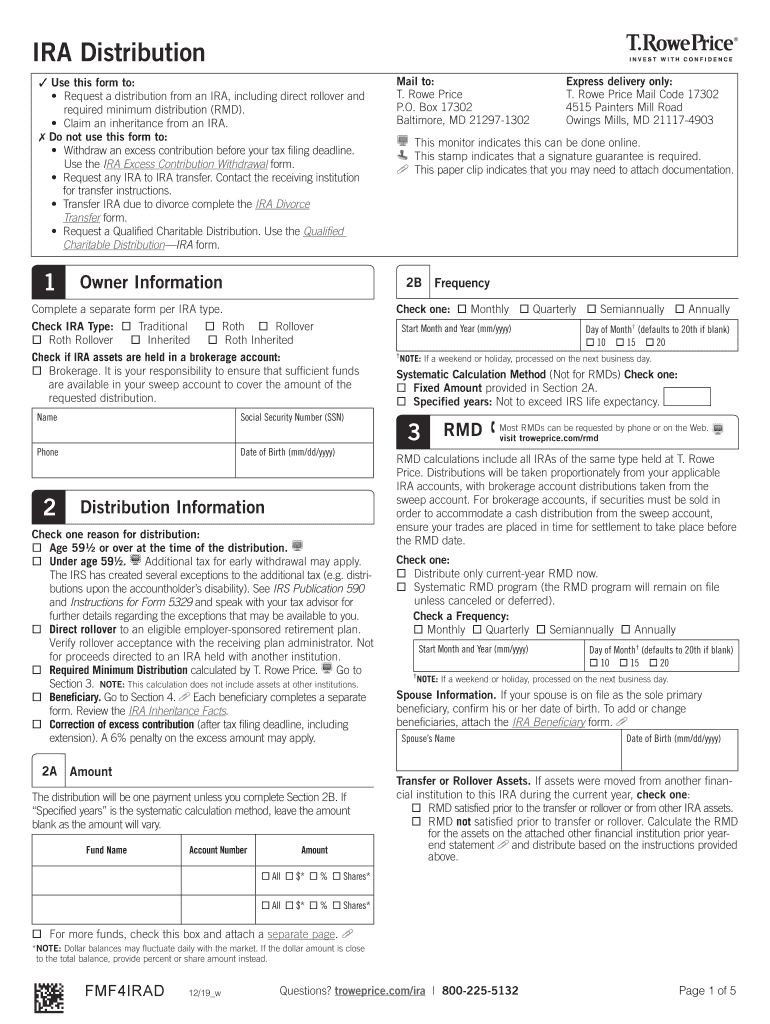
IRA Distribution Use this form to: Request a distribution from an IRA, including direct rollover and required minimum distribution (RMD). Claim an inheritance from an IRA. Do not use this form to:.
Loading

Open form follow the instructions

Easily sign the form with your finger

Send filled & signed form or save
How to fill out the Fmf4irad online
The Fmf4irad form is essential for requesting distributions from an Individual Retirement Account (IRA). This guide provides clear, step-by-step instructions to help users navigate through the online form efficiently.
Follow the steps to complete the Fmf4irad form online.
- Press the ‘Get Form’ button to access the IRA distribution form and open it for completion.
- Enter your personal information including your name, Social Security Number (SSN), phone number, and date of birth, ensuring all details are accurate.
- In the distribution information section, select the reason for the distribution. Options include being over age 59½, under age 59½, a direct rollover, or a required minimum distribution (RMD).
- Complete the amount section, detailing the distribution amount or leaving it blank if you are using specified years for calculation.
- In the owner information section, indicate the type of IRA (Traditional, Roth, Rollover, etc.) and provide account details as requested.
- If you are a beneficiary, complete section 4 with the necessary beneficiary information and the relationship to the IRA owner.
- Review the payment options, determining how you prefer to receive your funds, such as through electronic funds transfer or a mailed check.
- Sign the form to certify your information is accurate. If necessary, obtain a Medallion signature guarantee from your financial institution.
- Once you have completed all sections, save your changes, then download, print, or share the form as needed.
Complete your IRA distribution requests easily by filling out the Fmf4irad form online today.
Experience a faster way to fill out and sign forms on the web. Access the most extensive library of templates available.
Related content
Jul 16, 2021 — Since 2015, the U.S. Department of State provided Iraq with $1.25 billion...
Aug 1, 2019 — and begun work on USRA IRAD projects (see separate section). ... retrieved...
Get answers to your most pressing questions about US Legal Forms API.
What is the 10-year rule for inherited IRA 2023?
SECURE 1.0' s 10-year rule takes you through the end of 2030. As explained in IRS Publication 590-B, under the 10-year rule, “if the owner died in 2021, the beneficiary would have to fully distribute the IRA by December 31, 2031.”
What is the new 10 year rule for inherited IRA?
Generally, a designated beneficiary is required to liquidate the account by the end of the 10th year following the year of death of the IRA owner (this is known as the 10-year rule).
When did the 10-year inherited IRA rule change?
It comes with several changes for inherited IRAs. First, if an IRA account holder dies on or after January 1, 2020, and you inherit their IRA, you'll now generally have 10 years after the account holder's death to withdraw all the money. Otherwise, you'll face a 50% penalty on any money remaining in the account.
Do you have to report fair market value of IRA on tax return?
The IRS requires owners of all retirement plans—self-directed or not—to report the fair market value (FMV) of assets held in their account(s) at the end of each year.
What is the 5 year rule for backdoor Roth IRAs?
The 5-year rule on Roth conversions requires you to wait five years before withdrawing any converted balances — contributions or earnings — regardless of your age. If you take money out before the five years is up, you'll have to pay a 10% penalty when you file your tax return.
What is the 10-year rule strategy for inherited IRA?
You can transfer assets into an inherited IRA in your name and choose to take distributions over 10 years. You must liquidate the account by Dec. 31 of the year that is 10 years after the original owner's death.
Does a Roth conversion count as an RMD IRS?
Remember, if you're already over 73, you will have to take an RMD for the current tax year before you can convert to a Roth IRA—that is, Roth conversions do not satisfy the RMD requirement, although you can use all or part of the RMD to pay the taxes due from the conversion.
How do I avoid paying taxes on an inherited IRA?
Funds withdrawn from an inherited Roth IRA are generally tax-free if they are considered qualified distributions. That means the funds have been in the account for at least five years, including the time the original owner of the account was alive.
Use professional pre-built templates to fill in and sign documents online faster. Get access to thousands of forms.
If you believe that this page should be taken down, please follow our DMCA take down process here.