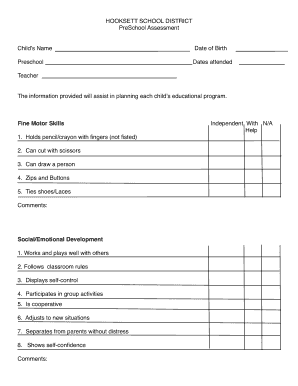
N planning each child’s educational program. ! ! ! ! ! ! ! ! ! ! ! ! ! ! ! ! ! Fine Motor Skills! ! ! ! ! ! ! ! ! ! ! ! ! ! 1. Holds pencil/crayon with fingers (not fisted) ! ! ! ! ! ! 2. Can cut with scissors 3. Can draw a person 4. Zips and Buttons 5. Ties shoes/Laces Comments: Social/Emotional Development 1. Works and plays well with others 2. Follows classroom rules 3. Displays self-control 4. Participates in group activities 5. Is cooperative 6. Adjusts to new situations 7. Separate.
Open form follow the instructions
Easily sign the form with your finger
Send filled & signed form or save
How to fill out the Hooksett PreSchool Assessment online
Completing the Hooksett PreSchool Assessment online can help streamline your child’s educational planning. This guide provides detailed instructions to assist you in filling out the form accurately and efficiently.
Follow the steps to complete the assessment form.
- Press the 'Get Form' button to retrieve the Hooksett PreSchool Assessment and open it in your preferred document handler.
- Enter your child’s name in the designated field. Ensure that both the first and last name are spelled accurately.
- Input your child's date of birth in the format requested. This information helps the school understand your child's developmental stage.
- Provide the dates your child attended preschool. Use distinct dates to reflect each attendance period accurately.
- In the section for fine motor skills, evaluate your child’s abilities based on the provided tasks. Mark whether they exhibit each skill and add comments where necessary.
- Proceed to the social/emotional development section and assess your child's social skills. Check off the applicable statements and provide comments if needed.
- Continue to the intellectual development portion. Evaluate various skills such as name recognition and counting abilities. Mark as appropriate and add comments.
- In the language development section, assess your child's clarity of speech and vocabulary. Indicate levels of independence or need for assistance.
- Evaluate your child’s work habits using the criterion provided. Circle the appropriate responses and ensure to comment on any additional observations.
- In the final sections, describe any interests or activities your child enjoys and any additional information that could aid in meeting their needs.
- Complete the form by filling in your information as the person completing the form, including your position if applicable.
- After ensuring all sections of the form are filled out completely, save your changes. You may download, print, or share the assessment as necessary.
Complete the Hooksett PreSchool Assessment online today to support your child's educational journey.
Experience a faster way to fill out and sign forms on the web. Access the most extensive library of templates available.
Related content
Oct 25, 2024 — For Preschool students evaluations could include POMS,. ESS assessments...
Through the institutional assessment test students will be guided to take either a full...
Get answers to your most pressing questions about US Legal Forms API.
How to write a preschool assessment report?
To write a preschool assessment report, begin with an introduction that outlines the purpose of the assessment. Follow this with detailed findings, including insights on the child's cognitive, social, emotional, and physical development. Conclude the report with constructive recommendations for future learning. This structured approach is essential to the standards set by the Hooksett PreSchool Assessment.
How do you write a preschool assessment?
Writing a preschool assessment involves observing and recording a child's behaviors and skills during various activities. Look for specific examples that showcase both strengths and areas needing support, ensuring you capture the child's overall development. Tailoring your observations to align with the objectives of the Hooksett PreSchool Assessment will enhance the assessment's relevance.
What is a positive comment for a preschool report card?
A positive comment for a preschool report card could highlight a child's enthusiasm for learning and their interactions with peers. You might say, 'Sarah shows great curiosity during activities and demonstrates a wonderful ability to collaborate with her classmates.' Such affirmations are effective in the context of the Hooksett PreSchool Assessment, showcasing both academic and social growth.
How do you write a preschool assessment report?
To write a preschool assessment report, start by summarizing the assessment results in a clear and concise manner. Include sections that detail the child's developmental milestones, strengths, and suggestions for future learning. Use direct quotes from observations when possible to support your findings. Ensuring your report is meaningful aligns with the standard of the Hooksett PreSchool Assessment.
What is the preschool assessment process?
The preschool assessment process typically involves several stages, beginning with initial observations to gather information about the child's abilities. After that, formal assessments may be conducted to measure specific skills. Following this, educators analyze the data collected to identify the child's learning needs and strengths. This thorough process is essential for successful planning in the Hooksett PreSchool Assessment framework.
What to write on a preschool assessment?
When composing a preschool assessment, focus on a child's developmental milestones, strengths, and areas for improvement. Be clear and specific, detailing observations regarding a child's social skills, language development, and cognitive abilities. Including examples of the child's work or interactions can enhance the assessment. This approach aligns with the principles of the Hooksett PreSchool Assessment.
What is an example of a formal assessment in preschool?
A formal assessment example in preschool is the Developmental Indicators for the Assessment of Learning, known as DIAL. This assessment tool measures children's cognitive, motor, language, and social skills. Implementing tools like the DIAL can effectively contribute to the Hooksett PreSchool Assessment. Such assessments provide crucial insights into a child's development and readiness for further education.
What are the four main types of assessment tools used in a preschool classroom?
In a preschool classroom, you can typically find observational assessments, standardized tests, performance assessments, and portfolios. Observational assessments allow teachers to track children’s behaviors and interactions informally. In contrast, standardized tests provide a structured way to measure children's skills against a benchmark. Performance assessments and portfolios help showcase a child's progress through collected work and projects.
How do you complete an assessment?
Completing an assessment involves systematically gathering data about a child’s skills and development using a variety of methods, including observations and standardized testing tools. For a Hooksett PreSchool Assessment, take the time to observe the child in various settings and situations, then compile your findings to generate a comprehensive report. This process allows you to accurately reflect the child's progress and identify areas needing attention.
How to write an assessment form?
When writing an assessment form for a preschool assessment, ensure that it includes relevant sections for developmental milestones, observations, and overall conclusions. Structure the form clearly with headings for each area of assessment, and use straightforward language to make it accessible for parents and caregivers. Incorporate the findings from your assessments to make the document informative and actionable.
Use professional pre-built templates to fill in and sign documents online faster. Get access to thousands of forms.
If you believe that this page should be taken down, please follow our DMCA take down process here.