Loading
Form preview
  • US Legal Forms
  • Form Library
  • More Forms
  • More Multi-State Forms
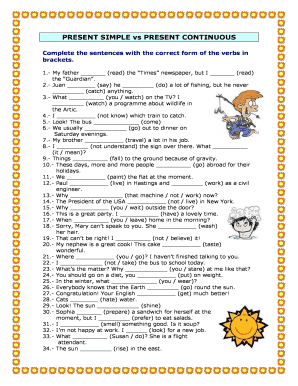
  • Present Simple Vs Present Continuous Exercises 2020

Get Present Simple Vs Present Continuous Exercises 2020-2026

How it works

  1. Open form

    Open form follow the instructions

  2. Easily sign form

    Easily sign the form with your finger

  3. Share form

    Send filled & signed form or save

How to fill out the Present Simple Vs Present Continuous Exercises online

This guide provides clear and comprehensive instructions on how to complete the Present Simple Vs Present Continuous Exercises online. By following these steps, users will be able to fill out the exercises efficiently and accurately.

Follow the steps to complete the exercises with ease.

  1. Click the ‘Get Form’ button to open the Present Simple Vs Present Continuous Exercises in your preferred editor.
  2. Read each sentence carefully. Identify the verb in brackets and determine whether to use the present simple or present continuous tense based on the context of the sentence.
  3. In the corresponding blank, type the correct form of the verb you identified in the previous step.
  4. Once you complete all the sentences, review your answers to ensure that they are accurate and reflect the correct tense.
  5. Make any necessary adjustments to your responses if needed.
  6. After finalizing your answers, you can save changes to your document, download a copy for your records, print it, or share it with others as needed.

Start filling out the Present Simple Vs Present Continuous Exercises online today!

Get form

Experience a faster way to fill out and sign forms on the web. Access the most extensive library of templates available.
Get form

Related content

Present Simple Present Continuous Questions
This article will delve into the nuances of these tenses, their structures, and how to...
Learn more
The Simple Present vs the Present Continuous...
Underline all of the present. Continuous verbs. Example: My sister visits me on Monday...
Learn more
English/Grammar/Tenses
Aug 27, 2025 — The simple present is used when quickly conveying on-site situations...
Learn more

Related links form

Investment Direction - Pivotal Select #693SEL - Equitable Life Of ... Prior Authorization Request And Notification Form - UHA Sinclair Sap Appeal Form Dc 87 Affidavit Of Judgment Debtor Form

Questions & Answers

Get answers to your most pressing questions about US Legal Forms API.

Contact support

An example of five sentences in present perfect continuous is 'I have been studying English for three years,' 'She has been working at the company since January,' 'They have been traveling all summer,' 'He has been learning to play the guitar,' and 'We have been practicing our presentation.' This tense describes actions that started in the past and continue to the present. For clarity, learning the differences between tenses through Present Simple Vs Present Continuous Exercises is beneficial.

The five basic rules for present continuous tense are: begin with the correct auxiliary verb (am, is, are), modify the main verb by adding 'ing,' use it to describe current ongoing actions, apply it for future planned events, and recognize its use in temporary contexts. Familiarity with these principles enhances clarity in communication. Present Simple Vs Present Continuous Exercises can aid in understanding these rules.

Examples of present continuous include: 'I am studying for my exam,' 'She is cooking dinner right now,' 'They are playing soccer in the park,' 'He is reading an interesting book,' and 'We are watching a movie together.' These sentences reflect ongoing actions capturing attention. To improve at forming such sentences, consider doing Present Simple Vs Present Continuous Exercises.

The five basic rules for present continuous include: using the correct form of 'to be' (am, is, are), adding 'ing' to the main verb, using this structure for ongoing actions, utilizing it for planned future events, and employing it for temporary situations. These rules guide learners in constructing sentences accurately. Practicing with Present Simple Vs Present Continuous Exercises reinforces these foundational elements.

The rules for present continuous involve using the auxiliary verb 'to be' combined with the present participle of a verb, typically ending in -ing. This structure indicates actions currently in progress or ongoing situations. Additionally, the present continuous often describes future arrangements. To practice this, engaging in Present Simple Vs Present Continuous Exercises can help clarify these rules.

The present simple act shows routine or general truths, while the present continuous act involves actions occurring at the moment of speaking. For example, 'He plays soccer' denotes a regular activity, whereas 'He is playing soccer' describes an action currently in progress. Familiarity with Present Simple Vs Present Continuous Exercises will help distinguish these differences.

To report present continuous tense, you need to convey ongoing actions. For example, you would say, 'She is running.' When transforming this into reported speech, it becomes 'She said she was running.' Practicing this with Present Simple Vs Present Continuous Exercises will help solidify your understanding of these verb forms.

The formula for constructing present simple is straightforward: subject + base form of the verb + (s/es for third person). For present continuous, it’s subject + 'is/am/are' + verb ending in '-ing.' Understanding these formulas is essential, and employing Present Simple Vs Present Continuous Exercises can help reinforce this knowledge through practical application. Regular practice encourages fluency and confidence in using both tenses.

To effectively separate present simple from present continuous, focus on action indicators. Present simple signals routine, while present continuous highlights ongoing action. Utilize clearly labeled Present Simple Vs Present Continuous Exercises to help distinguish between these forms. Consistent practice will empower students to identify and use each tense correctly.

To know when to use present simple or present continuous, consider the context of the action. Use present simple for habits and facts, and choose present continuous for activities that are currently happening. Observing the context and utilizing Present Simple Vs Present Continuous Exercises can aid in developing this intuition. Encouraging practice will help solidify these distinctions in your students’ minds.

Get This Form Now!

Use professional pre-built templates to fill in and sign documents online faster. Get access to thousands of forms.
Get form
If you believe that this page should be taken down, please follow our DMCA take down processhere.

Industry-leading security and compliance

US Legal Forms protects your data by complying with industry-specific security standards.
  • In businnes since 1997
    25+ years providing professional legal documents.
  • Accredited business
    Guarantees that a business meets BBB accreditation standards in the US and Canada.
  • Secured by Braintree
    Validated Level 1 PCI DSS compliant payment gateway that accepts most major credit and debit card brands from across the globe.
Get Present Simple Vs Present Continuous Exercises
Get form
  • Adoption
  • Bankruptcy
  • Contractors
  • Divorce
  • Home Sales
  • Employment
  • Identity Theft
  • Incorporation
  • Landlord Tenant
  • Living Trust
  • Name Change
  • Personal Planning
  • Small Business
  • Wills & Estates
  • Packages A-Z
  • Affidavits
  • Bankruptcy
  • Bill of Sale
  • Corporate - LLC
  • Divorce
  • Employment
  • Identity Theft
  • Internet Technology
  • Landlord Tenant
  • Living Wills
  • Name Change
  • Power of Attorney
  • Real Estate
  • Small Estates
  • Wills
  • All Forms
  • Forms A-Z
  • Form Library
  • Legal Hub
  • About Us
  • Help Portal
  • Legal Resources
  • Blog
  • Affiliates
  • Contact Us
  • Delete My Account
  • Site Map
  • Industries
  • Forms in Spanish
  • Localized Forms
  • State-specific Forms
  • Forms Kit
  • Real Estate Handbook
  • All Guides
  • Notarize
  • Incorporation services
  • For Consumers
  • For Small Business
  • For Attorneys
  • USLegal
  • FormsPass
  • pdfFiller
  • signNow
  • altaFlow
  • DocHub
  • Instapage
Form Packages
  • Adoption
  • Bankruptcy
  • Contractors
  • Divorce
  • Home Sales
  • Employment
  • Identity Theft
  • Incorporation
  • Landlord Tenant
  • Living Trust
  • Name Change
  • Personal Planning
  • Small Business
  • Wills & Estates
  • Packages A-Z
Form Categories
  • Affidavits
  • Bankruptcy
  • Bill of Sale
  • Corporate - LLC
  • Divorce
  • Employment
  • Identity Theft
  • Internet Technology
  • Landlord Tenant
  • Living Wills
  • Name Change
  • Power of Attorney
  • Real Estate
  • Small Estates
  • Wills
  • All Forms
  • Forms A-Z
  • Form Library
Customer Service
  • Legal Hub
  • About Us
  • Help Portal
  • Legal Resources
  • Blog
  • Affiliates
  • Contact Us
  • Delete My Account
  • Site Map
  • Industries
  • Forms in Spanish
  • Localized Forms
  • State-specific Forms
  • Forms Kit
Legal Guides
  • Real Estate Handbook
  • All Guides
Prepared for you
  • Notarize
  • Incorporation services
Our Customers
  • For Consumers
  • For Small Business
  • For Attorneys
Our Sites
  • USLegal
  • FormsPass
  • pdfFiller
  • signNow
  • altaFlow
  • DocHub
  • Instapage
Social Media
Call us now toll free:
+1 833 426 79 33
As seen in:
© Copyright 1999-2026 airSlate Legal Forms, Inc. 3720 Flowood Dr, Flowood, Mississippi 39232
  • Your Privacy Choices
  • Terms of Service
  • Privacy Notice
  • Content Takedown Policy
  • Bug Bounty Program