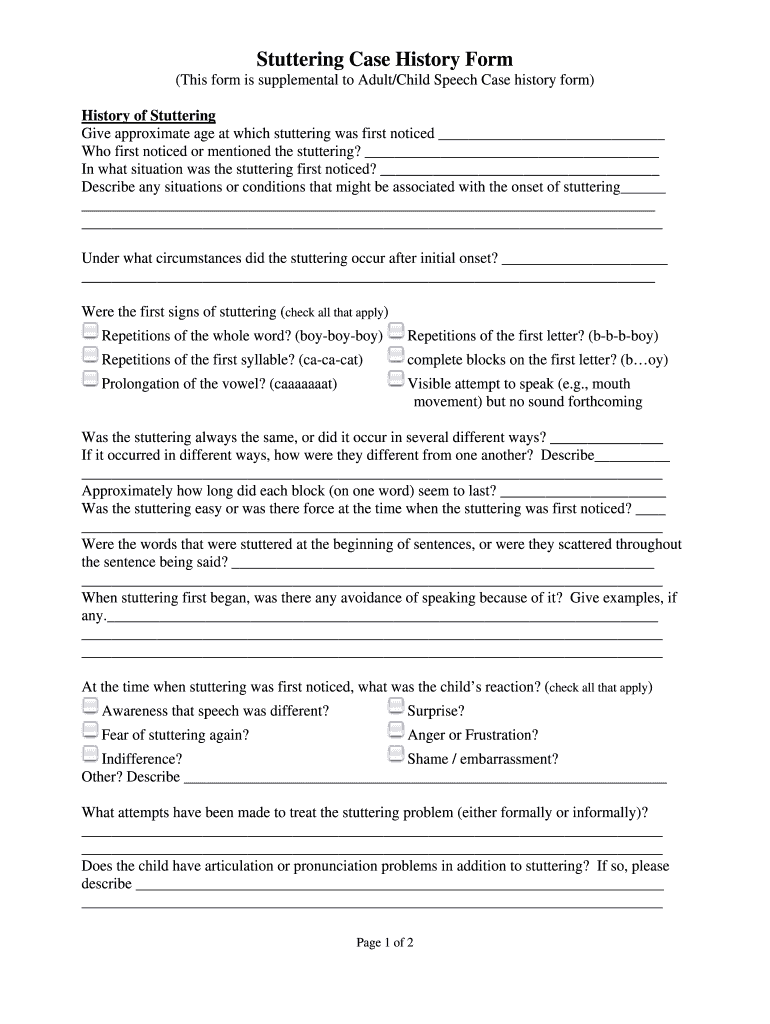
_____________ Who first noticed or mentioned the stuttering? _______________________________________ In what situation was the stuttering first noticed? _____________________________________ Describe any situations or conditions that might be associated with the onset of stuttering______ ____________________________________________________________________________ _____________________________________________________________________________ Under what circumstances did the stuttering occur after .
Loading

Open form follow the instructions

Easily sign the form with your finger

Send filled & signed form or save
How to fill out the Stuttering Case History Form online
Filling out the Stuttering Case History Form online is an important step in understanding stuttering and its impact on communication. This guide will walk you through each component of the form, ensuring you provide accurate and comprehensive information.
Follow the steps to complete the form effortlessly.
- Click ‘Get Form’ button to obtain the form and open it in your preferred digital editing tool.
- Begin with the 'History of Stuttering' section. Provide the approximate age at which stuttering was first observed and indicate who initially mentioned or noticed it. Be clear about the specific situation where stuttering was first noted.
- Describe any potential situations or conditions associated with the onset of stuttering. Detail the circumstances under which stuttering occurred after the initial observation.
- In the 'First signs of stuttering' section, check all observations that apply, including repetitions of whole words, letters, syllables, and any blocks or prolongations.
- Indicate whether the stuttering presented itself consistently or in varied forms. If it appeared differently, describe those variations in detail.
- Estimate the duration of each block or stuttered word and discuss whether the stuttering was experienced as easy or forceful at the onset.
- Explain if the stuttered words were predominantly at the beginning of sentences or scattered throughout.
- Reflect on any avoidance of speaking at the onset of stuttering; provide examples if applicable, and note the individual's reaction to the stuttering at that time.
- In the 'Development of Stuttering' section, check any changes observed in stuttering symptoms over time, and describe them where necessary.
- Document any periods when stuttering disappeared or increased, along with potential explanations for these fluctuations.
- Indicate particularly challenging situations and list any scenarios that never cause difficulty.
- Answer the yes/no questions related to stuttering experiences, ensuring to address each aspect thoroughly.
- Consider how stuttering affects daily life, social interactions, and academic success, circling 'Yes' or 'No' as appropriate.
- Finally, save your changes, and ensure to download, print, or share the completed form as needed.
Complete the Stuttering Case History Form online today to better understand your or your child's stuttering.
Experience a faster way to fill out and sign forms on the web. Access the most extensive library of templates available.
Related content
Sep 9, 2021 — From the case history you know that there is a family history of...
Since the onset of stuttering, has there been any change in stuttering symptoms? Check...
by L Lamport · 2017 · Cited by 38 — This paper explains rules for adding history...
Get answers to your most pressing questions about US Legal Forms API.
What is the difference between stammering and stuttering?
Stammering and stuttering are often used interchangeably, but some distinctions exist. Stammering typically refers to the speech disruption that includes repetitions and hesitations. In contrast, stuttering may encompass a broader range of speech difficulties. Understanding these terms can be crucial when filling out the Stuttering Case History Form.
Does stutter count as a disability?
Yes, a stutter may count as a disability under certain conditions. It is important to evaluate its impact on communication and social interactions. Completing the Stuttering Case History Form thoroughly can help in assessing whether your stutter meets the criteria for a disability.
How to show stuttering in a transcript?
To show stuttering in a transcript, use symbols or annotations that indicate pauses and repetitions. This presentation allows readers to understand the dynamics of speech. The Stuttering Case History Form can support this by detailing specific instances and patterns of your stuttering.
Can you get disability for having a stutter?
Having a stutter can qualify you for disability benefits in certain cases. The key is to demonstrate how it restricts your daily activities. Utilize the Stuttering Case History Form to compile your experiences, which can be pivotal for your disability application.
How to administer the TOCs?
Administering the Terms of Consent (TOCs) involves clearly explaining the process to the participant. Ensure that they understand what information you will collect and how it will be used, especially regarding their stuttering. Use the Stuttering Case History Form to gather necessary consent for data collection.
Does stuttering qualify as a disability?
Yes, stuttering can qualify as a disability under various regulations. The assessment depends on how it significantly impacts daily life and communication. It's essential to document your experience comprehensively on the Stuttering Case History Form to support any disability claims.
How do you format stuttering?
To format stuttering effectively, focus on presenting the speech in a clear manner. Use phonetic notations or indicators to represent stutters in transcripts. This method creates an accurate portrayal of how stuttering affects communication, ensuring that the Stuttering Case History Form provides relevant insights.
What was the cause of stuttering in ancient times?
In ancient times, people attributed stuttering to various factors, including divine punishment or psychological distress. They believed that emotional or moral failings could lead to speech issues. Today, we understand stuttering’s nuances better, and a Stuttering Case History Form can help you reflect on these historical perceptions. It can facilitate a discussion with speech therapists about the factors that may affect your speech.
What is the history of stuttering?
The history of stuttering spans across different cultures and ages, with many notable figures, including Shakespeare and Benjamin Franklin, known to have stuttered. Throughout history, various theories have emerged to explain its causes, from psychological to physiological perspectives. A thorough understanding can aid in treatment approaches, and a Stuttering Case History Form serves as a great resource. It allows professionals to trace individual histories and customize interventions.
Where does stuttering originate?
Research suggests that stuttering originates from a combination of genetic, neurological, and environmental factors. Individuals may inherit a predisposition to stutter, with various triggers in their environment. If you or someone you know stutters, completing a Stuttering Case History Form can provide valuable information for therapy. This form captures essential past experiences that may have influenced the development of stuttering.
Use professional pre-built templates to fill in and sign documents online faster. Get access to thousands of forms.
If you believe that this page should be taken down, please follow our DMCA take down process here.