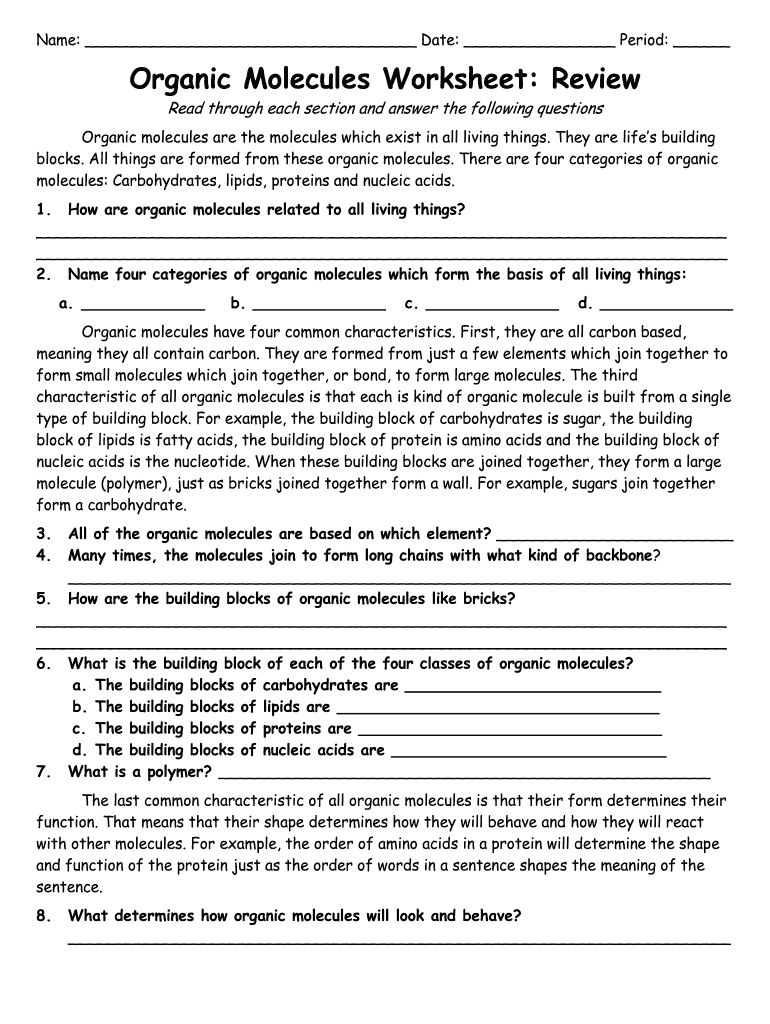
S are the molecules which exist in all living things. They are life‟s building blocks. All things are formed from these organic molecules. There are four categories of organic molecules: Carbohydrates, lipids, proteins and nucleic acids. 1. How are organic molecules related to all living things? _________________________________________________________________________ _________________________________________________________________________ 2. Name four categories of organic molecules which fo.
Loading

Open form follow the instructions

Easily sign the form with your finger

Send filled & signed form or save
How to use or fill out the Organic Molecules Worksheet: Review online
This guide provides a step-by-step approach to completing the Organic Molecules Worksheet: Review. By following these instructions, users can effectively engage with the material related to organic molecules and their significance in living organisms.
Follow the steps to successfully complete the worksheet.
- Press the ‘Get Form’ button to access the Organic Molecules Worksheet: Review and open it in the editor.
- Begin by filling in the personal information at the top of the form, including your name, the date, and the period for which you are submitting the worksheet.
- Read through each question carefully. Start by responding to the question about how organic molecules relate to all living things, using complete sentences to express your thoughts.
- List the four categories of organic molecules in the designated spaces. You may want to review your class materials to ensure accuracy.
- Proceed to the section on organic molecules' characteristics. Answer the questions using the information provided in the worksheet to describe these characteristics thoroughly.
- As you complete the carbohydrate section, make sure to define monosaccharides, disaccharides, and polysaccharides, and provide examples where asked.
- In the lipids section, identify the building blocks and provide examples. Describe the structure of fatty acids as required.
- Continue to the proteins section, ensuring you describe their functions and the nature of amino acids as building blocks.
- Finally, tackle the nucleic acids section, detailing the components and differences between DNA and RNA, as well as their respective roles.
- After completing the worksheet, review your answers to ensure clarity and completeness. Save your changes, and you may download, print, or share the completed form as needed.
Start filling out the Organic Molecules Worksheet: Review online today to enhance your understanding of organic molecules!
Experience a faster way to fill out and sign forms on the web. Access the most extensive library of templates available.
Related content
This review delves into key concepts such as the structure, function, and classification...
Chapter 3: Introduction to Organic Molecules and Functional Groups. 13. (3.21) Identify...
by RC Borden · 2008 · Cited by 5 — This worksheet has a button to select the method to...
Get answers to your most pressing questions about US Legal Forms API.
What are the 4 molecular building blocks?
Each strand of DNA is made of four types of molecules, also called bases, attached to a sugar-phosphate backbone. The four bases are adenine (A), guanine (G), cytosine (C), and thymine (T).
What are the 4 types of organic molecules and what are their building blocks?
There are four main classes, as described below: Carbohydrates. Carbohydrates are comprised of the elements carbon (C), hydrogen (H), and oxygen (O). ... Proteins. Proteins are comprised of amino acids. ... Lipids. A wide variety of biomolecules including fats, oils, waxes and steroid hormones. ... Nucleic Acids.
What are the building blocks of organic molecules?
Common elemental building blocks of biological molecules: Carbon, Oxygen, Hydrogen, Nitrogen and Phosphorus.
What are the 4 organic molecules and their building blocks?
The Four Macromolecules. All life is composed mainly of the four macromolecule building blocks: carbohydrates, lipids, proteins, and nucleic acids. The interactions of different polymers of these basic molecule types make up the majority of life's structure and function.
How are the building blocks of organic molecules like bricks 6 what is the building block of each of the four classes of organic molecules?
What is the building block of each of the four classes of organic molecules? For example, the building block of carbohydrates is sugar, the building block of lipids is fatty acids, the building block of protein is amino acids and the building block of nucleic acids is the nucleotide.
What is the building blocks of organic molecules like bricks?
Bricks are laid and cemented together as building blocks of a house or a building. Essentially, bricks are smaller parts of a whole. The same goes for the building blocks of organic molecules, which are the atoms of carbon, oxygen, nitrogen and hydrogen.
How many building blocks of organic molecules are like bricks?
There are four categories of organic molecules: Carbohydrates, lipids, proteins and nucleic acids.
How do you test for organic molecules?
Organic molecules contain carbon and hydrogen. Substances that contain carbon will burn and blacken. To test a substance for carbon, place the substance in a test tube and hold it over a flame for a few moments. If the substance blackens then it contains carbon and is an organic molecule.
What are the 4 organic molecules and their functions?
The broad functions of the 4 organic macromolecules are: Proteins - Molecular Machines. Nucleic Acids - Information Repositories. Lipids - Waterproof Membranes. Carbohydrates - Stored Energy.
Are lipids organic molecules why or why not worksheet answers?
Q1 Answer Yes, lipids are organic molecules. Lipids are another type of organic molecule. Remember that organic means they contain carbo…
Use professional pre-built templates to fill in and sign documents online faster. Get access to thousands of forms.
If you believe that this page should be taken down, please follow our DMCA take down process here.