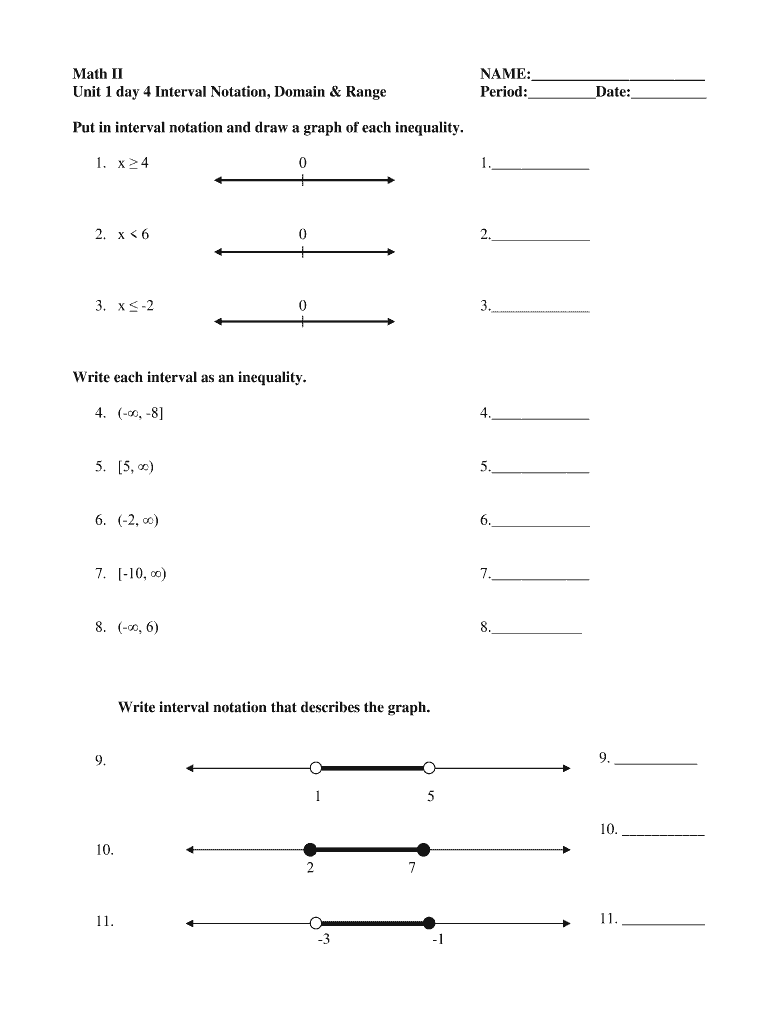
Math II Unit 1 day 4 Interval Notation, Domain & Range NAME: Period: Date: Put in interval notation and draw a graph of each inequality. 1. x 4 0 1. 2. x 6 0 2. 3. x 2 0 3. Write each interval.

Open form follow the instructions

Easily sign the form with your finger

Send filled & signed form or save
How to fill out the Math II Unit 1 Day 4 Interval Notation Domain & Range online
This guide provides step-by-step instructions on how to fill out the Math II Unit 1 Day 4 Interval Notation Domain & Range form online. Whether you are familiar with interval notation or new to the concept, this guide is structured to support your needs.
Follow the steps to successfully complete the form.
- Click the ‘Get Form’ button to access the form and open it in your preferred editor.
- Begin by filling in your name, period, and date at the top of the form. Ensure that all information is accurate and legible.
- For each inequality listed, write the corresponding interval notation and then sketch a graph in the provided space. For example, for 'x ≥ 4,' the interval notation would be [4, ∞).
- Continue to the section where you are required to convert the provided intervals into inequalities. Be careful to accurately represent the intervals using proper inequality notation.
- For the next part, describe the graphs in interval notation. Make sure to visualize the graphs to correctly interpret their boundaries.
- In the domain and range section, find and write the domain and range for each graph using interval notation format. Pay attention to open and closed intervals.
- If necessary, sketch a function that meets the specified domain and range requirements in the given area.
- Finally, review your completed form for accuracy. Once satisfied, you can save your changes, download the form, print it, or share it as needed.
Complete the Math II Unit 1 Day 4 Interval Notation Domain & Range form online today for a clear understanding of interval notation and its application.
Experience a faster way to fill out and sign forms on the web. Access the most extensive library of templates available.
Related content
An essential skill practiced in many domain and range worksheets is expressing the domain...
Determine the domain of each of the following functions. Where possible, state the domain...
Xmath is a mathematical analysis, visualization, and scripting package that is one of the...
Get answers to your most pressing questions about US Legal Forms API.
What is the domain of 3, 6, 5, 7, 7, 7, 8, 9?
To find the domain of the set {3, 6, 5, 7, 7, 7, 8, 9}, list the unique values which results in {3, 5, 6, 7, 8, 9}. The domain thus captures all unique input values in Math II Unit 1 Day 4 Interval Notation Domain & Range. This understanding aids in mapping functions accurately and efficiently.
How do I write in interval notation?
When writing in interval notation, use brackets for inclusive endpoints and parentheses ( ) for exclusive endpoints. For instance, the interval 3, 7) includes 3 but excludes 7, illustrating the desired range in Math II Unit 1 Day 4 Interval Notation Domain & Range. By practicing this format, you will become proficient in expressing various mathematical intervals.
What is the domain and range calculator?
A domain and range calculator is a tool that helps you determine the domain and range of a given function quickly and efficiently. By inputting your function, you can obtain results that enhance your understanding of Math II Unit 1 Day 4 Interval Notation Domain & Range. Using such tools can significantly streamline your math studies and improve accuracy.
What does the interval (-∞, ∞) indicate?
The interval (-∞, ∞) indicates that the function includes all real numbers without restriction. This representation is vital in Math II Unit 1 Day 4 Interval Notation Domain & Range when dealing with functions that do not have defined limits. Understanding this concept allows you to analyze curves and functions without bounds.
How do I write domain and range in interval notation?
To write domain and range in interval notation, you express the set of values using parentheses and brackets. For example, an interval like (2, 5 indicates that 2 is not included, but 5 is part of the range. Mastering this method is fundamental in Math II Unit 1 Day 4 Interval Notation Domain & Range, as it provides a clear and concise way to represent intervals.
What is the domain and range?
The domain is the complete set of possible values that x can take in a function, while the range comprises all the values that the function can produce. When studying Math II Unit 1 Day 4 Interval Notation Domain & Range, it becomes essential to identify these sets to understand function behavior. This knowledge supports a foundation for more complex mathematics involving various functions.
What is the domain and range in ck12?
In CK-12, the domain refers to the set of all possible input values for a function, while the range refers to the set of all possible output values. Understanding these concepts is crucial when studying Math II Unit 1 Day 4 Interval Notation Domain & Range, as they help you effectively analyze functions. CK-12 provides interactive tools that can aid in grasping these mathematical concepts.
What is the formula for interval notation?
The formula for interval notation typically involves indicating the lower and upper bounds of a set of values. Use parentheses for values that are not included and brackets for those that are included. By applying this structure, you can effectively convey the range of values in Math II Unit 1 Day 4 Interval Notation Domain & Range. This concise representation helps in understanding mathematical relationships.
How to find the domain and range in interval notation?
To express domain and range in interval notation, first determine the minimum and maximum bounds of valid inputs and outputs. Use brackets for inclusive limits and parentheses for exclusive limits. This method effectively summarizes the range of values for the Math II Unit 1 Day 4 Interval Notation Domain & Range and presents a clear visual representation for easier understanding.
How to find domain and range?
Finding domain and range starts with understanding the function itself. Look at the input values for domain and the output values for range by attempting different x-values. This method allows you to see which numbers work with the function. As you navigate through Math II Unit 1 Day 4 Interval Notation Domain & Range, follow these steps to ensure you're capturing all necessary values.
Use professional pre-built templates to fill in and sign documents online faster. Get access to thousands of forms.
If you believe that this page should be taken down, please follow our DMCA take down process here.