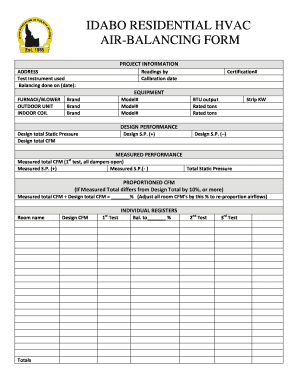
IDABO RESIDENTIAL HVAC AIRBALANCING FORM PROJECTINFORMATION ADDRESS TestInstrumentused Balancingdoneon(date): Readingsby Calibrationdate Certification# EQUIPMENT FURNACE/BLOWER Brand OUTDOORUNIT Brand.
Open form follow the instructions
Easily sign the form with your finger
Send filled & signed form or save
How to fill out the Idabo Residential HVAC Air-Balancing Form online
Completing the Idabo Residential HVAC Air-Balancing Form online is a straightforward process that allows for accurate documentation of HVAC system performance. This guide provides step-by-step instructions to ensure clarity and efficiency when filling out the form.
Follow the steps to complete the form accurately.
- Click ‘Get Form’ button to obtain the form and open it in the editor.
- Enter the project information, including the address, the test instrument used, the date the balancing was done, the person conducting the readings, and the calibration date.
- In the equipment section, fill out the details for the furnace/blower, outdoor unit, and indoor coil. Include the brand and model numbers, as well as the BTU output and rated tons for each piece of equipment.
- Complete the design performance section by indicating the design total static pressure and design CFM, as well as the positive and negative static pressures.
- Record the measured performance results by noting the measured total CFM during the first test with all dampers open, the measured positive static pressure, the measured negative static pressure, and the total static pressure.
- If the measured total CFM differs from the design total by 10% or more, calculate the proportioned CFM by dividing the measured total CFM by the design total CFM and adjust all room CFMs accordingly.
- Fill in the room names and their respective CFM values in the individual registers section, noting the design CFM for each room.
- Conduct the first and second tests, recording the results in their designated sections, and note the balancing percentage for each.
- Once all fields are complete, review the information for accuracy. Users can then save changes, download, print, or share the form as needed.
Start filling out your Idabo Residential HVAC Air-Balancing Form online today for streamlined documentation.
Experience a faster way to fill out and sign forms on the web. Access the most extensive library of templates available.
Related content
Residential Deck Guide (PDF) · Residential HVAC Air-Balancing Form (PDF) · Residential...
Start your HVAC/R Technician career with this course, which prepares you for the...
Summary: "Provides guidance for using ANSI/ASHRAE/IESNA Standard 90.1-1999, Energy...
Get answers to your most pressing questions about US Legal Forms API.
How often should an HVAC system be balanced?
It is advisable to balance your HVAC system every 1 to 2 years, or whenever significant changes occur in your building, such as new construction or alterations. Regular balancing improves indoor air quality and energy efficiency. Using the Idabo Residential HVAC Air-Balancing Form allows you to keep informed records of each balancing session, helping you track performance over time.
What is required to keep the air balanced in a building?
To maintain balanced air in a building, regular checks and adjustments are necessary for your HVAC system. This includes inspecting ducts, filters, and airflow measurements. By using the Idabo Residential HVAC Air-Balancing Form, you can effectively document these changes, ensuring your system runs smoothly and efficiently.
What is the air balance report for HVAC?
The air balance report for HVAC assesses the distribution of air among the rooms in a building. This assessment helps ensure that each area receives the correct amount of airflow. With the Idabo Residential HVAC Air-Balancing Form, you have the tools needed to accurately evaluate and adjust airflow for consistent comfort and reduced energy costs.
What is an HVAC balance report?
An HVAC balance report provides a detailed analysis of airflow throughout your heating, ventilation, and air conditioning system. This report identifies imbalances that can affect comfort and energy efficiency. Utilizing the Idabo Residential HVAC Air-Balancing Form, homeowners can gain insights into how to optimize their system for better performance.
Is air balancing a code requirement?
In many areas, air balancing may be a code requirement, particularly in commercial buildings. Local building codes often stipulate that HVAC systems must perform efficiently and effectively, which includes proper air distribution. It is wise to consult the Idabo Residential HVAC Air-Balancing Form to ensure compliance and enhance your system's performance.
Is air balancing necessary?
Yes, air balancing is necessary for maintaining a comfortable and efficient environment. It helps in resolving issues related to uneven temperatures and energy inefficiency within your space. Implementing air balancing can reduce energy costs and improve indoor air quality. The Idabo Residential HVAC Air-Balancing Form plays a vital role in achieving these benefits.
Is air balancing required?
Air balancing is often required for optimal HVAC system performance. It ensures that air is evenly distributed throughout your building, providing comfort and efficiency. Without it, you may experience hot or cold spots in various rooms. The Idabo Residential HVAC Air-Balancing Form can help guide you through this important process.
How to do air balancing in HVAC?
Air balancing in HVAC is done by measuring the airflow in different areas of a space, then adjusting the duct system to equalize the airflow. Begin with a thorough assessment using tools like an anemometer, and document your findings using the Idabo Residential HVAC Air-Balancing Form for future reference. Consistent adjustments based on your measurements can lead to improved comfort and energy efficiency.
How to balance a ventilation system?
Balancing a ventilation system involves adjusting the airflow rates in each duct to meet the desired levels. Start by measuring the airflow with appropriate tools and then make necessary adjustments to dampers and vents. Implementing the Idabo Residential HVAC Air-Balancing Form will help keep your adjustments organized and ensure consistent results.
How do you calculate air balance in HVAC?
To calculate air balance in HVAC, measure the airflow in each room and compare it to the system's design specifications. Sum the total airflow and identify discrepancies in each area. The Idabo Residential HVAC Air-Balancing Form can be a valuable tool to organize your calculations and findings systematically.
Use professional pre-built templates to fill in and sign documents online faster. Get access to thousands of forms.
If you believe that this page should be taken down, please follow our DMCA take down process here.