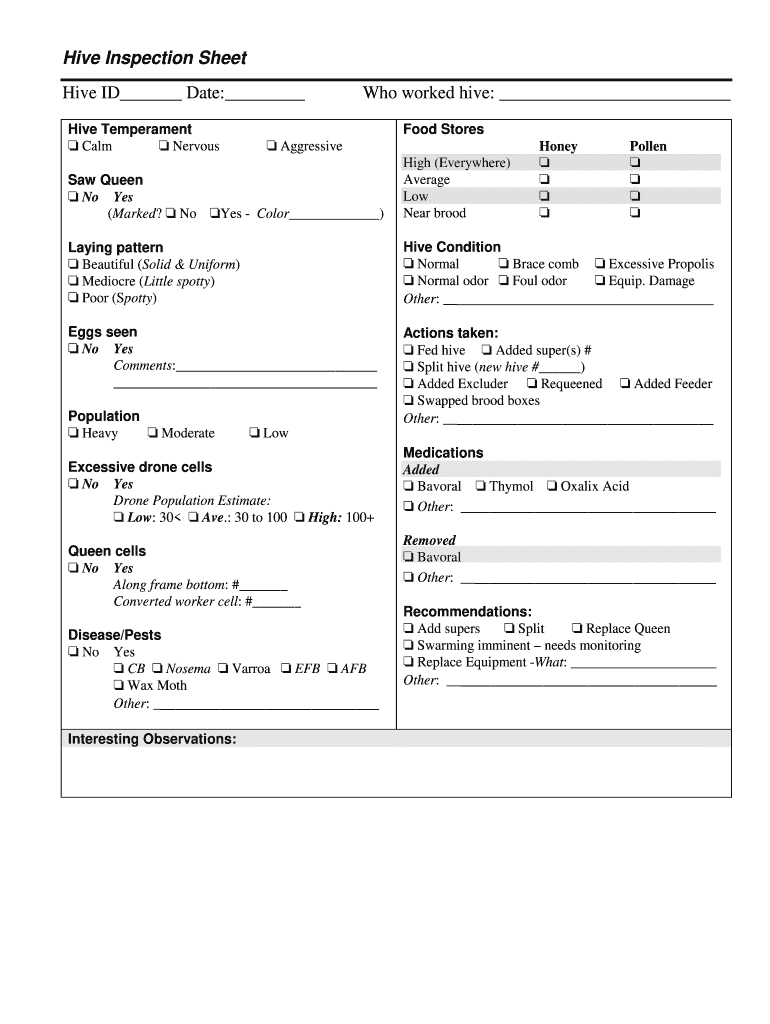
Hive Inspection Sheet Hive ID Date: Hive Temperament t Calm t Nervous Who worked hive: Food Stores t Aggressive Honey t t t t Pollen t t t t Saw Queen t No Yes (Marked? t No tYes Color ) High (Everywhere).

Open form follow the instructions

Easily sign the form with your finger

Send filled & signed form or save
How to use or fill out the Darwen Beekeepers Hive Inspection Sheet online
This guide provides a clear and comprehensive approach to filling out the Darwen Beekeepers Hive Inspection Sheet online. By following these detailed steps, users can effectively document crucial information regarding hive inspections, ensuring a consistent and thorough record for beekeeping practices.
Follow the steps to accurately complete the hive inspection sheet online.
- Press the ‘Get Form’ button to access the hive inspection sheet and open it in the designated online interface.
- In the 'Hive ID' section, enter a unique identifier for the hive you are inspecting.
- Fill in the date of the inspection in the 'Date' field.
- In the 'Hive Temperament' section, mark the appropriate box that describes the behavior of the bees (Calm, Nervous, or Aggressive).
- Indicate who worked the hive by entering the name in the 'Who worked hive' field.
- For 'Food Stores', specify the amount of honey and pollen available by checking the corresponding boxes.
- Record whether the queen was seen. Mark 'No' or 'Yes', and if applicable, indicate if she is marked and her color.
- Assess the laying pattern and select one option (Beautiful, Mediocre, Poor) based on your observations.
- Evaluate the hive condition and select all applicable conditions in the 'Hive Condition' section.
- Note whether eggs were seen in the hive and add any additional comments for clarity.
- Document the actions taken during the inspection by marking relevant options in 'Actions taken'.
- Assess the population of the hive by selecting Heavy, Moderate, or Low in the 'Population' section.
- Indicate if there are excessive drone cells or queen cells and estimate their quantities.
- Identify any diseases or pests by marking the appropriate boxes if applicable.
- In the 'Interesting Observations' section, enter any notable findings observed during the inspection.
- Record any medications added or removed and specify their names.
- Finally, note down any recommendations for the hive such as adding supers or replacing equipment.
- Once completed, save your changes, download the document, print it, or share it as needed.
Take the next step in managing your beekeeping records by filling out the Darwen Beekeepers Hive Inspection Sheet online today.
Experience a faster way to fill out and sign forms on the web. Access the most extensive library of templates available.
Related content
The Intellectual Foundations of Political Economy, Das Kapital by Karl Marx, Part IV...
Get answers to your most pressing questions about US Legal Forms API.
What is the 7 10 rule in beekeeping?
The 7 10 rule in beekeeping suggests that you should inspect your colony every 7 days during the busy season and every 10 days if the colony is experiencing less activity. This rule helps maintain a healthy colony and ensures timely intervention for any issues. By adhering to this guideline, you can improve hive management significantly. The Darwen Beekeepers Hive Inspection Sheet is an excellent tool to support this schedule.
When not to do a hive inspection?
Avoid inspecting a hive during extreme weather conditions, such as heavy rain, high winds, or when temperatures are below 50 degrees Fahrenheit. These conditions can stress the bees and make them more defensive. It's essential to prioritize the well-being of your bees for optimal hive success. The Darwen Beekeepers Hive Inspection Sheet can help you plan your inspections better.
How to do your first hive inspection?
To do your first hive inspection, start by gathering your necessary tools, such as a smoker and protective gear. Carefully approach the hive and lightly smoke the entrance to calm the bees. Open the hive slowly and observe the overall condition of the frames. Taking notes using the Darwen Beekeepers Hive Inspection Sheet can help you remember your findings for future inspections.
How often should a beehive be inspected?
You should inspect a beehive every 7 to 10 days during the active season, which typically runs from spring through fall. This frequency allows you to promptly identify any issues like pests or diseases. Consistent inspections promote hive health and productivity. The Darwen Beekeepers Hive Inspection Sheet can assist you in keeping a record of your inspections.
What temperature should a bee hive be inspected?
A bee hive should be inspected ideally when the outside temperature is between 70 and 80 degrees Fahrenheit. This temperature helps ensure that bees are active and cooperative, allowing for a thorough inspection. Moreover, as bees are less active at cooler temperatures, working within this range is beneficial. The Darwen Beekeepers Hive Inspection Sheet can help you track optimal inspection times.
What is apiary inspection?
Apiary inspection is the process of examining multiple hives to assess their health and productivity. It involves checking for signs of diseases, pests, and overall hive conditions. Regular apiary inspections help beekeepers maintain strong colonies and improve honey production. Utilizing the Darwen Beekeepers Hive Inspection Sheet can streamline this process.
What temperature should you inspect a hive?
You should inspect a hive when the temperature is between 60 and 80 degrees Fahrenheit. This range ensures that bees are active and more likely to respond positively to your presence. A cooler temperature can make bees less active, while a higher temperature might lead to aggressive behavior. Thus, the Darwen Beekeepers Hive Inspection Sheet is useful for scheduling your inspections.
How to get beekeepers hive acnh?
To obtain a beekeepers hive in Animal Crossing: New Horizons (ACNH), you need to craft it using the right DIY recipe. Collect materials from your island like wood and honeycomb, then use your crafting station to create the hive. While this is a virtual world, don’t forget the real-world knowledge from the Darwen Beekeepers Hive Inspection Sheet to enhance your actual beekeeping skills!
What is the 7/10 rule in beekeeping?
The 7/10 rule in beekeeping suggests that you should inspect your hive regularly, approximately every 7 to 10 days. This guideline helps beekeepers manage their hives effectively, ensuring they are monitoring for signs of weakness or issues. Consistent checks can lead to a healthier, more productive colony. Reference the Darwen Beekeepers Hive Inspection Sheet to stay on track with your inspections.
How often do beehives need to be checked?
Bees are active creatures, so checking your hive regularly is essential. A good rule of thumb is to inspect your beehive every 7 to 10 days during the active season. This allows you to monitor your bees' health, prevent potential issues, and ensure they stay productive. The Darwen Beekeepers Hive Inspection Sheet can help you track your inspections effectively.
Use professional pre-built templates to fill in and sign documents online faster. Get access to thousands of forms.
If you believe that this page should be taken down, please follow our DMCA take down process here.