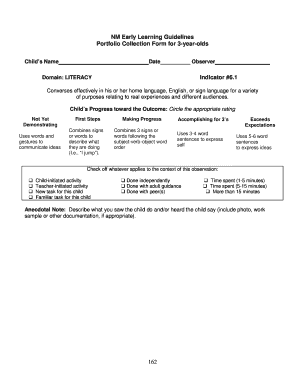
NM Early Learning Guidelines Portfolio Collection Form for 3yearolds Childs Name Date Observer Indicator #6.1 Domain: LITERACY Converses effectively in his or her home language, English, or sign language.
Open form follow the instructions
Easily sign the form with your finger
Send filled & signed form or save
How to fill out the NM Early Learning Guidelines Portfolio Collection Form for 3 online
The NM Early Learning Guidelines Portfolio Collection Form for 3 is an essential tool for documenting a child's developmental progress in various learning domains. This guide provides clear, step-by-step instructions on how to complete the form online, ensuring that users can navigate the process smoothly.
Follow the steps to complete the form accurately and efficiently.
- Click the ‘Get Form’ button to obtain the form and open it in your preferred editing tool.
- Begin by filling in the child's name and the date. Ensure this information is accurate, as it is critical for tracking development over time.
- In the 'Domain' section, select the relevant developmental domain (e.g., Literacy, Numeracy) from the provided options.
- For each observed indicator, indicate the child's progress by circling the appropriate rating. Review each description carefully to choose the rating that best reflects the child's abilities.
- Check all applicable contexts of the observation, such as whether the activity was child-initiated or teacher-initiated.
- Record the time spent on each task, selecting an option that accurately describes the observation duration.
- Provide an anecdotal note in the designated section. Describe specific actions or language used by the child, and attach any relevant documentation, such as photos or work samples.
- Once all sections are completed, review the information for accuracy before saving your changes.
- Download or print the completed form if necessary. Alternatively, share it with relevant stakeholders as required.
Complete your NM Early Learning Guidelines Portfolio Collection Form for 3 online today for an efficient documentation process.
Experience a faster way to fill out and sign forms on the web. Access the most extensive library of templates available.
Related content
The Iowa Early Learning Standards - 3rd edition provides a common understanding for what...
The Child Development Center utilizes the NM Early Learning Guidelines and the...
15.1.3. Dynamic Bending Light. 62. 15.2. Full Adaptive Front Lighting “Full AFS”...
Get answers to your most pressing questions about US Legal Forms API.
What is the relationship between observation and assessment?
Assessment is an ongoing process which provides information about development over time. Observation, watching a child in order to learn about her, is a part of assessment.
How to use observation and assessment in early childhood education?
The cycle is as follows: Instruct. Observe. Observe children in various situations. Document, Reflect. Record while observing or as soon as possible. Analyze, Evaluate. Study the data with assessment tools. ... Summarize, Plan, and Communicate. This informs a child's specific needs and future curriculum. Instruct.
Why is observation and assessment important in early childhood?
Observation is a way to connect with children, to discover their connections to others and to their environment. Children who feel cared for, safe, and secure interact with others and engage in their world to learn. They are more likely to gain skills, and to do better as they enter school.
How do observations support assessment of children's progress?
Observation helps us assess children's progress; we can find out about the specific care and learning needs of each child. We can then plan next steps in children's development and learning. To find out about a child we need to observe them in a way that is valuable to the child and makes best use of our time.
How do observations and the NM early learning guidelines work together to support assessment?
The New Mexico Early Learning Guidelines can be used in a criterion-referenced assessment process. Educators determine children's performance related to the indicators through observation that is supported through anecdotal documentation as well as work sampling.
Use professional pre-built templates to fill in and sign documents online faster. Get access to thousands of forms.
If you believe that this page should be taken down, please follow our DMCA take down process here.