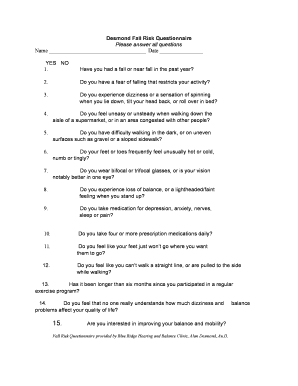
Desmond Fall Risk Questionnaire Please answer all questions Name Date YES NO 1. Have you had a fall or near fall in the past year? 2. Do you have a fear of falling that restricts your activity? 3.
Open form follow the instructions
Easily sign the form with your finger
Send filled & signed form or save
How to fill out the Desmond Fall Risk Questionnaire online
The Desmond Fall Risk Questionnaire is an essential tool designed to evaluate individuals' risk of falling. This guide provides a step-by-step approach to accurately complete the questionnaire online, ensuring you can assess your fall risk effectively.
Follow the steps to fill out the Desmond Fall Risk Questionnaire
- Press the ‘Get Form’ button to access the Desmond Fall Risk Questionnaire and open it in your preferred online editor.
- Begin by entering your personal information in the designated fields, including your name and the date at the top of the form.
- Proceed to answer each question carefully. You will encounter a series of yes/no questions regarding your experiences and feelings about falling. It is crucial to respond honestly, as this will help in assessing your risk accurately.
- Complete the questions sequentially, taking your time to understand what each one asks. If any question is unclear, consider seeking clarification to ensure that you are providing the most accurate responses.
- Once you have answered all the questions, review your responses to confirm all sections are completed. It's important to check for any missed questions or omissions.
- After confirming your answers, save your changes to the form. You may have options to download, print, or share the completed questionnaire as needed.
Complete the Desmond Fall Risk Questionnaire online today to better understand your fall risk and improve your safety.
Experience a faster way to fill out and sign forms on the web. Access the most extensive library of templates available.
Related content
by MC Lohman · 2017 · Cited by 43 — The adapted STEADI clinical fall risk screening...
by SK Bok · 2013 · Cited by 70 — System; in which data were collected in a...
Fall prevention includes any action taken to help reduce the number of accidental falls...
Get answers to your most pressing questions about US Legal Forms API.
What is a normal fall risk score?
Score 0–125. 0–20 No risk or low risk; ≥25 Medium risk; ≥45, 50–55 High risk.
How is fall risk calculated?
You'll start in a chair, stand up, and then walk for about 10 feet at your regular pace. Then you'll sit down again. Your health care provider will check how long it takes you to do this. If it takes you 12 seconds or more, it may mean you are at higher risk for a fall.
What is the most commonly used fall risk assessment tool?
The most commonly used fall risk assessment tools were the Morse Fall Scale and the Performance-Oriented Mobility Scale.
How do you calculate fall risk score?
You'll start in a chair, stand up, and then walk for about 10 feet at your regular pace. Then you'll sit down again. Your health care provider will check how long it takes you to do this. If it takes you 12 seconds or more, it may mean you are at higher risk for a fall.
What is the fall risk awareness questionnaire?
The FRAQ is a 22-item questionnaire that assesses the knowledge of risk factors (medical, environmental, pharmacologic, physical) for falling, as well as demographics, medical, and fall history, and risk factors.
What are the 2 validated fall screening tools?
The tools used the most were the Falls Efficacy Scale International and the Activities-specific Balance Confidence Scale with 15 and 6 studies respectively.
What is a fall risk score of 35?
A patient who scores under 25 points is considered to be at low risk of falling, a patient who scores between 25–45 points is considered to be at moderate risk of falling, and a patient who scores higher than 45 points is considered to be at high risk of falling.
What is a fall risk score of 20?
Score 20 if the patient has an impaired gait. ➢ Difficulty rising from chair (needs to use arms; several attempts to rise. ➢ Head down; watches ground while walking. ➢ Cannot walk without assist; grabs at furniture or whatever available.
Use professional pre-built templates to fill in and sign documents online faster. Get access to thousands of forms.
If you believe that this page should be taken down, please follow our DMCA take down process here.