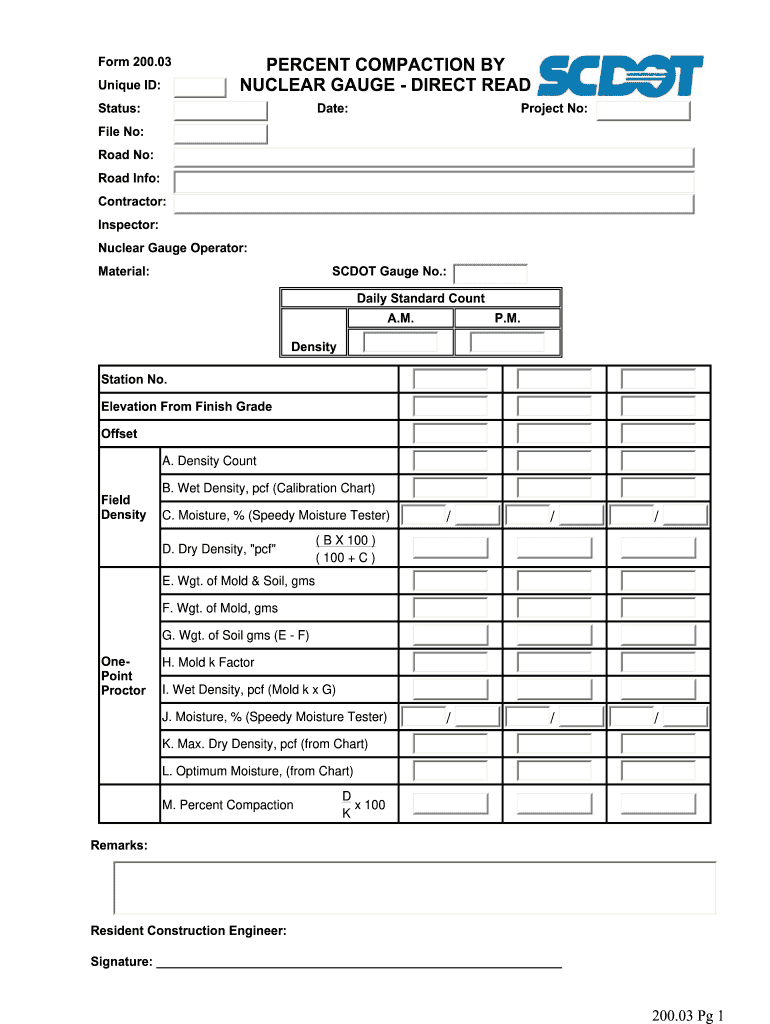
CDOT Gauge No.: Daily Standard Count A.M. P.M. Density Station No. Elevation From Finish Grade Offset A. Density Count Field Density B. Wet Density, pcf (Calibration Chart) C. Moisture, % (Speedy Moisture Tester) D. Dry Density, "pcf" / / / / / / ( B X 100 ) ( 100 + C ) E. Wgt. of Mold & Soil, gms F. Wgt. of Mold, gms G. Wgt. of Soil gms (E - F) OnePoint Proctor H. Mold k Factor I. Wet Density, pcf (Mold k x G) J. Moisture, % (Speedy Moisture Tester) K. Max. Dry Density, pcf (from.
Loading

Open form follow the instructions

Easily sign the form with your finger

Send filled & signed form or save
How to fill out the SC SCDOT Form 200.03 online
Filling out the SC SCDOT Form 200.03 is essential for documenting percent compaction by nuclear gauge during construction projects. This guide provides clear, step-by-step instructions on how to complete the form accurately while submitting it online.
Follow the steps to complete the form effectively.
- Click ‘Get Form’ button to access the form and open it in your chosen online editor.
- Begin by entering the project number in the designated field. This number helps to identify the specific project associated with the compaction measurements.
- Enter the date relevant to the measurements being recorded. Ensure that this date reflects when the gauging work was conducted.
- Fill in the file number associated with this documentation, if applicable, to maintain proper records.
- Input the road number and any additional road information that may be necessary for context.
- In the contractor field, provide the name of the contractor overseeing the project. This is important for accountability.
- Record the inspector name in the relevant section, ensuring the person responsible for the readings is documented.
- List the nuclear gauge operator's name to clarify who operated the equipment during measurements.
- Detail the material being tested in the appropriate field, as this can affect the compaction results.
- Input the SCDOT gauge number. This is crucial for tracking which equipment was used during measuring.
- Fill in the daily standard counts for both the A.M. and P.M. sections, as these are key metrics for verification.
- Complete the density and station number fields carefully, along with elevation and offset information.
- Proceed to fill out the density calculations and measurements as specified in the form, including the weights and densities as indicated.
- Make sure to double-check each entry for accuracy before concluding.
- After finishing, you can save your changes, download the completed form, print it out, or share it as needed.
Start completing your SC SCDOT Form 200.03 online today for efficient project management.
Experience a faster way to fill out and sign forms on the web. Access the most extensive library of templates available.
Related content
29 Sep 2020 — The South Carolina Department of Transportation (SCDOT) has developed this...
Jan 11, 2019 — As outlined in section 106.3.10 of the SCDOT. Construction Manual, at the...
At Columbia, I-126 crosses the confluence of the Broad and Saluda, which together form the...
Get answers to your most pressing questions about US Legal Forms API.
What is field density of soil?
Soil field density test measures relative density of soil which has been compacted using compacting equipment and the result of this test is expressed in %. This relative density is measured by comparing maximum dry density obtained from field test with maximum dry density of laboratory test as a standard reference.
How do you calculate the density of soil?
In bulk density calculation, divide the soil's mass by its volume using the appropriate units. To calculate the bulk density of soil in the real world, obtain a soil sample with a known volume, then dry the sample in the oven and measure its mass, dividing the dry mass by the volume to get the bulk density.
How do you calculate field dry density of soil?
Dry density is calculated by dividing the weight of the wet soil by its water content in percent. The percent compaction for the field density test is calculated by dividing the dry density of the soil by the maximum dry density from the proctor test.
What is the formula for calculating maximum dry density?
Calculate the dry density using the following equation: Dry Density (pcf) = Wet Density (pcf) – Moisture Content (pcf). 9.1. Report the moisture content of the soil to the nearest 0.1 percent and the moisture content of aggregate base materials to the nearest 0.1 pound per cubic foot.
How do you calculate field dry density?
Calculate the dry density using the following equation: Dry Density (pcf) = Wet Density (pcf) – Moisture Content (pcf). 9.1. Report the moisture content of the soil to the nearest 0.1 percent and the moisture content of aggregate base materials to the nearest 0.1 pound per cubic foot.
Why is FDD test needed?
The dry density of the compacted soil or pavement material is a common measure of the amount of the compaction achieved during the construction. Therefore field density test is importance as a field control test for the compaction of soil or any other pavement layer.
What is maximum dry density of soil?
Soil compaction The CDG soil was compacted in layers (65–105 mm in thickness for each layer) to a dry density of 95% of the maximum dry density (ρd max = 1.802 Mg/m3), that is, γ d = 1.712 Mg/m3. The soil mass amount for each layer was weighed before being placed into the box, to achieve the required dry density.
What is the formula for wet density?
The wet bulk density will be the total mass divided by the total volume. The solid mass is 375 kg and the mass of the water is 0.15 * 375 = 56.25 kg, for a total mass of 431.25 kg. So the wet bulk density is 431.25/0.75 = 575 kg/m^3.
Use professional pre-built templates to fill in and sign documents online faster. Get access to thousands of forms.
If you believe that this page should be taken down, please follow our DMCA take down process here.