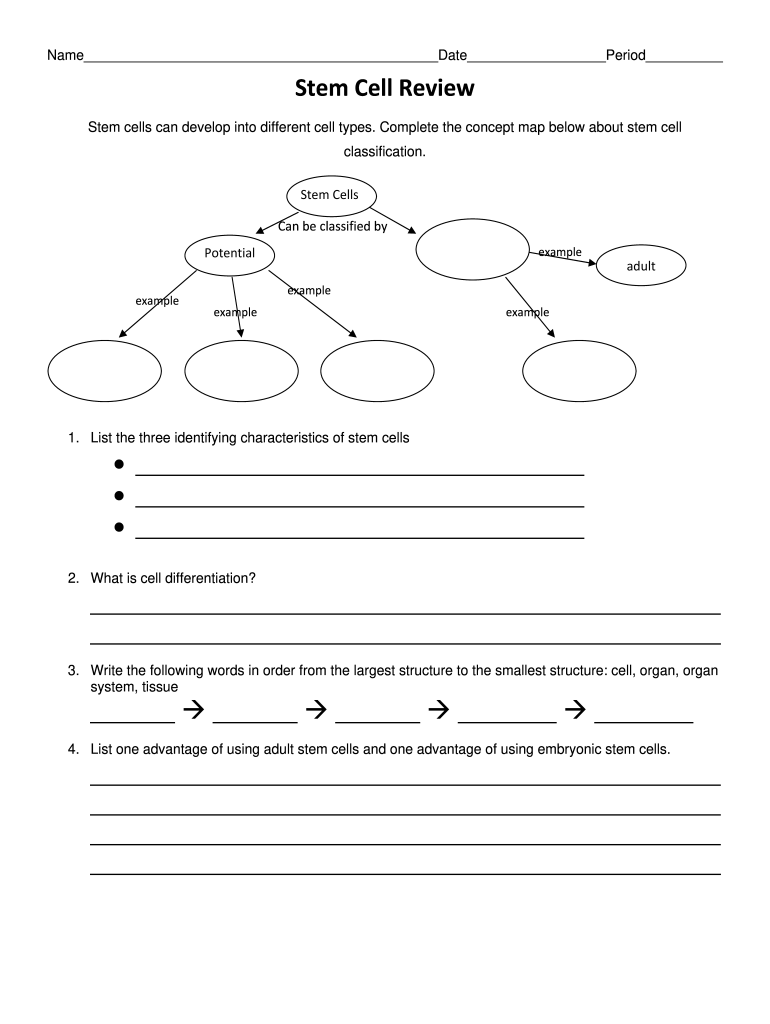
NameDatePeriod Stem Cell Review Stem cells can develop into different cell types. Complete the concept map below about stem cell classification. Stem Cells Can be classified by example Potential adult 1. List the three identifying characteristics of stem cells 2. What is cell differentiation 3. Write the following words in order from the largest structure to the smallest structure cell organ organ system tissue 4. List one advantage of using adult stem cells and one advantage of using embryonic stem cells. Quick Self-Quiz 1. What develops from the middle layer of a vertebrate embryo a brain and spinal cord b bones muscles and kidneys c digestive organs d outer layer of skin 2. Which of the following is correctly arranged from smallest to largest a tissue cell organ organ system b organ cell organ system tissue c organ system organ tissue cell d cell tissue organ organ system a the amount of nutrients it receives b when it was formed in the embryo c its location within the embryo d the ....

Open form follow the instructions

Easily sign the form with your finger

Send filled & signed form or save
How to fill out the Concept Map About Stem Cell Classification online
This guide will assist you in accurately completing the Concept Map About Stem Cell Classification online, ensuring a thorough understanding of stem cell classification. By following these steps, you will effectively navigate the form and contribute valuable information.
Follow the steps to successfully complete the concept map.
- Click the ‘Get Form’ button to access the online document and open it for editing.
- Begin with the section labeled 'Stem Cells.' Here, you need to provide the three identifying characteristics of stem cells. Ensure that your answers reflect the most relevant attributes, such as their ability to self-renew and differentiate into specialized cells.
- In the next section, define 'cell differentiation.' This should capture the process through which stem cells develop into various cell types, outlining key factors that influence this transformation.
- For the structural hierarchy question, list the words 'cell,' 'organ,' 'organ system,' and 'tissue' in the order from largest to smallest structure. This demonstrates your understanding of biological organization.
- Next, provide one advantage of using adult stem cells and one advantage of using embryonic stem cells in the relevant fields. Be clear and concise in your explanations.
- After you have filled out all sections, review your responses for accuracy. Once finalized, you can save your changes, download, print, or share the completed form as needed.
Start filling out the Concept Map About Stem Cell Classification online today to enhance your understanding of this important topic.
Experience a faster way to fill out and sign forms on the web. Access the most extensive library of templates available.
Related content
Feb 13, 2018 — How WIPP Works. At first, the entire concept of live cell imaging...
by TS Hilbert · Cited by 5 — concept map about the topic of stem cells. To this...
Hematopoietic stem cells (HSCs) are the stem cells that give rise to other blood cells...
Get answers to your most pressing questions about US Legal Forms API.
What is the classification of stem cells?
Stem cells can be classified by the extent to which they can differentiate into different cell types. These four main classifications are totipotent, pluripotent, multipotent, or unipotent. The ability to differentiate into all possible cell types (Fig-3).
What are the 5 types of stem cells?
Totipotent (or Omnipotent) Stem Cells. Pluripotent Stem Cells. Multipotent Stem Cells. Oligopotent Stem Cells. Unipotent Stem Cells.
Stem cells: What they are and what they do - Mayo Clinic
Stem cells can be classified according to their differentiation potential as a totipotent, pluripotent, multipotent, unipotent and oligopotent (Figure 1). Totipotent stem cells: Totipotency means that it has the total potential to give rise to all types of cells.
Stem Cell: Basics, Classification and Applications
In stem cell transplants, stem cells replace cells damaged by chemotherapy or disease or serve as a way for the donor's immune system to fight some types of cancer and blood-related diseases, such as leukemia, lymphoma, neuroblastoma and multiple myeloma. These transplants use adult stem cells or umbilical cord blood.
How can stem cells be classified?
Stem cells can be classified by the extent to which they can differentiate into different cell types. These four main classifications are totipotent, pluripotent, multipotent, or unipotent. ... Examples are the zygote formed at egg fertilization and the first few cells that result from the division of the zygote.
Do You Know the 5 Types of Stem Cells? | BioInformant
Stem cells are broadly classified as either adult or embryonic. Technically, even stem cells that come from fetal tissue or umbilical cord blood are classified as adult stem cells, and so most researchers prefer the term tissue stem cells for all stem cells other than those from embryos.
Types of Stem Cell | Stem Cells | University of Nebraska Medical ...
What are the 3 characteristics of all stem cells? Stem cells are unspecialized, can divide and renew themselves for long periods of time, and can be induced to become differentiated cells with specialized functions.
Stem Cells, Classifications and their Clinical Applications
Hematopoietic Stem Cells (Blood Stem Cells) Mesenchymal Stem Cells. Neural Stem Cells. Epithelial Stem Cells. Skin Stem Cells.
Types of Stem Cell | Stem Cells | University of Nebraska ...
Embryonic stem cells. Tissue-specific stem cells. Mesenchymal stem cells. Induced pluripotent stem cells.
What are different categories of stem cells?
Hematopoietic Stem Cells (Blood Stem Cells) Mesenchymal Stem Cells. Neural Stem Cells. Epithelial Stem Cells. Skin Stem Cells.
Use professional pre-built templates to fill in and sign documents online faster. Get access to thousands of forms.
If you believe that this page should be taken down, please follow our DMCA take down process here.