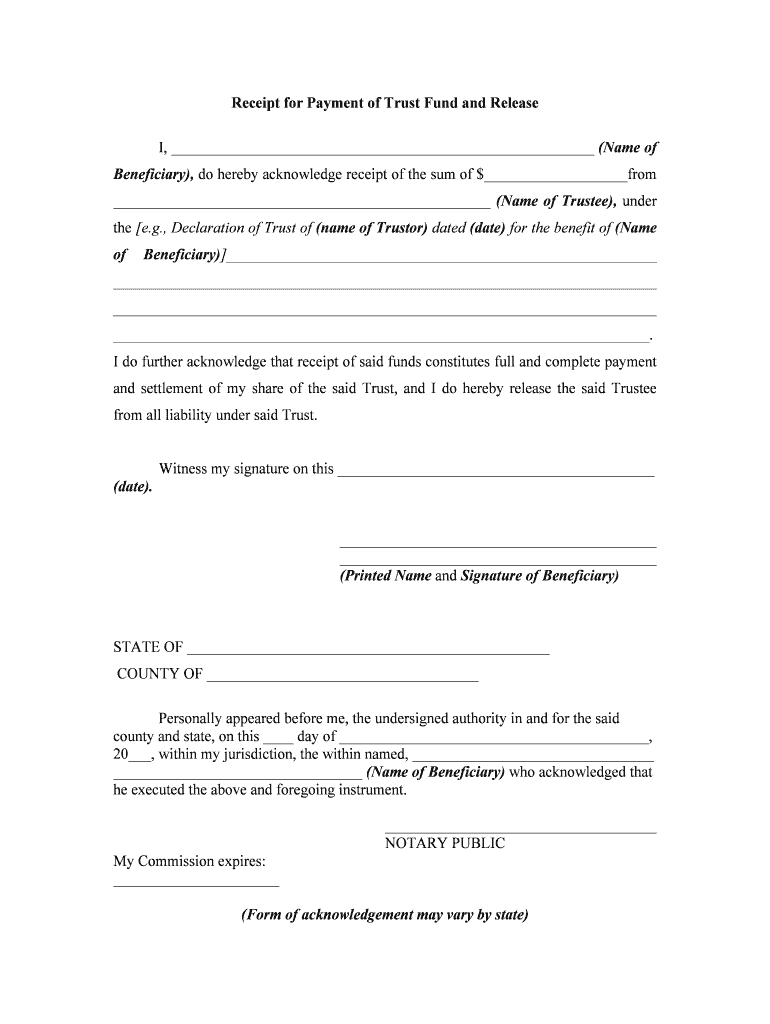
Receipt for Payment of Trust Fund and Release I, (Name of Beneficiary), do hereby acknowledge receipt of the sum of $ from (Name of Trustee), under the e.g., Declaration of Trust of (name of Trustor).

Open form follow the instructions

Easily sign the form with your finger

Send filled & signed form or save
How to fill out the Irrevocable TrustFree Legal Forms online
Filling out an Irrevocable TrustFree Legal Form is an important step in managing trust fund distributions. This guide provides clear, step-by-step instructions to help you navigate the form with confidence and ease.
Follow the steps to complete the Irrevocable TrustFree Legal Forms easily.
- Click ‘Get Form’ button to obtain the form and open it in the editor.
- Begin by entering your name in the designated field as the beneficiary of the trust.
- Next, indicate the amount you received in the space provided for the sum.
- Fill in the name of the trustee from whom you received the funds.
- In the subsequent sections, provide details about the Declaration of Trust, including the trustor's name and the date of the trust.
- Acknowledge that the receipt of funds represents full and complete payment for your share of the trust, affirming your release of the trustee from any further liability.
- Date the document in the specified area where it asks for your signature.
- Sign your name and print it clearly in the designated fields.
- Complete the acknowledgment section by providing the state and county where the signature was witnessed.
- Ensure a notary public completes the acknowledgment of your signature, including their own commission expiration date.
- Finally, review all entered information for accuracy, save your changes, and choose whether to download, print, or share the completed form.
Start filling out your forms online today to ensure proper management of your trust.
Experience a faster way to fill out and sign forms on the web. Access the most extensive library of templates available.
Related content
May 3, 2021 — Forms, guides, laws, and other information for trusts and wills....
Apr 22, 2021 — American Jurisprudence Legal Forms 2d. ... for Community Property)...
A grantor transfers property into an irrevocable trust in exchange for the right to...
Get answers to your most pressing questions about US Legal Forms API.
Irrevocable Trust Filing Requirements - The Nest
Irrevocable trusts are private documents and not subject to public record.
What is the average cost of setting up an irrevocable trust? | Lawyers ...
The main downside to an irrevocable trust is simple: It's not revocable or changeable. You no longer own the assets you've placed into the trust. In other words, if you place a million dollars in an irrevocable trust for your child and want to change your mind a few years later, you're out of luck.
How do I Set Up an Irrevocable Trust? - Finance - Zacks
Irrevocable trusts can be valuable tools for protecting your assets if you're planning on qualifying for Medicaid, and for minimizing probate when you pass away- but can also be wonderful tools for lawyers to rip off clients. A trust should cost no more than $2500- $3,000.
Can I set up an irrevocable trust myself?
Irrevocable trusts are most often used to protect assets from creditors or to obtain certain tax advantages. While it is advisable to enlist the help of an attorney when setting up this type of trust, it is possible to do it yourself.
How to Set Up an Irrevocable Trust (with Pictures) - wikiHow
Plan the purpose and scope of the irrevocable trust. ... Choose a trustee. ... Prepare an irrevocable trust agreement. ... Obtain a taxpayer identification number for the trust from the Internal Revenue Service.
Irrevocable Trust - Investopedia
Irrevocable trusts require a legally enforceable trust agreement. ... Once the trust agreement is ready for signature, the parties must sign in the presence of witnesses and the document should be notarized.
Do-It-Yourself Living Trust | legalzoom.com
The grantor (as an individual or couple) transfers their assets to an irrevocable trust. However, unlike other irrevocable trusts, the grantor can be the income beneficiary. Their children or spouse would be the residual beneficiaries.
How much does it cost to set up an irrevocable trust?
Irrevocable trusts can be valuable tools for protecting your assets if you're planning on qualifying for Medicaid, and for minimizing probate when you pass away- but can also be wonderful tools for lawyers to rip off clients. A trust should cost no more than $2500- $3,000.
Can you write your own irrevocable trust?
Irrevocable trusts are most often used to protect assets from creditors or to obtain certain tax advantages. While it is advisable to enlist the help of an attorney when setting up this type of trust, it is possible to do it yourself.
Use professional pre-built templates to fill in and sign documents online faster. Get access to thousands of forms.
If you believe that this page should be taken down, please follow our DMCA take down process here.