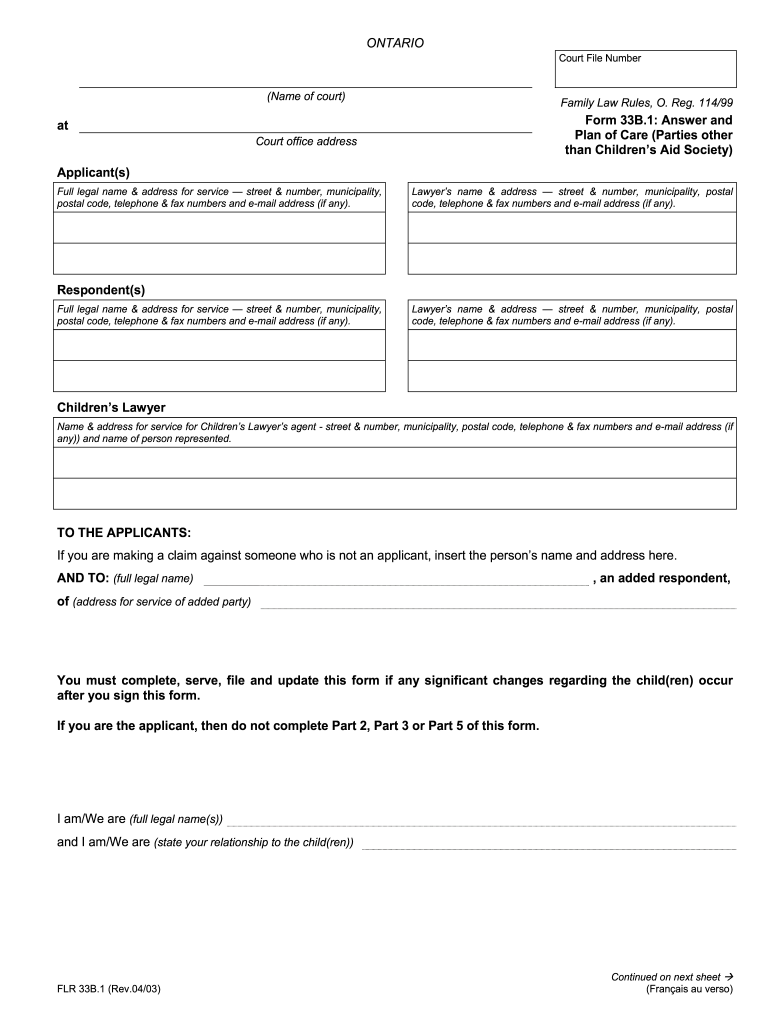
S) Full legal name & address for service — street & number, municipality, postal code, telephone & fax numbers and e-mail address (if any). Lawyer’s name & address — street & number, municipality, postal code, telephone & fax numbers and e-mail address (if any). Respondent(s) Full legal name & address for service — street & number, municipality, postal code, telephone & fax numbers and e-mail address (if any). Lawyer’s name & address — street & number, municipality, postal code, t.
Loading

Open form follow the instructions

Easily sign the form with your finger

Send filled & signed form or save
How to fill out the Ontario FLR 33B.1 online
The Ontario FLR 33B.1 form, titled 'Answer and Plan of Care,' serves as a crucial document in family law proceedings, specifically for parties other than the Children's Aid Society. This guide will provide you with a clear, step-by-step approach to successfully complete this form online.
Follow the steps to fill out the Ontario FLR 33B.1 form online effectively.
- Press the ‘Get Form’ button to obtain the document and open it in your chosen editor for online completion.
- Begin with the Court File Number, ensuring that you accurately enter the number assigned to your case.
- Fill in the names and contact details for both the applicant(s) and respondent(s) in the appropriate sections, including their full legal names, addresses for service, and contact numbers.
- If you are making a claim against someone not listed as an applicant, include their name and address as directed.
- Provide necessary information about each child involved in the case by detailing their full legal names, birthdates, ages, and sexes in the designated area.
- In Part 1, specify the individuals who have cared for the child(ren) in the past year, including their names and the time periods when care occurred.
- Complete either Part 2 or Part 3 based on whether your application is a child protection application or a status review. Indicate your agreement or disagreement with facts in paragraph 6, as applicable.
- In Part 4, outline your proposed plan of care, answering each question carefully to address the child's best interests, including living arrangements, school details, support services, and income.
- List individuals who have relevant information to support your plan in Part 6, ensuring to attach additional pages if necessary.
- In Part 5, if making claims against the Children's Aid Society or another applicant, detail your claims clearly and include important facts supporting your claims.
- Review the completed form carefully, then save your changes. You can choose to download, print, or share the form as needed.
Complete your documents online with confidence and ensure accuracy in your submissions.
Experience a faster way to fill out and sign forms on the web. Access the most extensive library of templates available.
Related content
Jun 5, 2025 — ... 1,DOS Process Address 2,DOS Process City,DOS Process State,DOS Process...
Mar 10, 2020 — The TY 2021 value increase is consistent with prior years value increase...
Get answers to your most pressing questions about US Legal Forms API.
What forms do I need to file for custody in Ontario?
When filing for custody in Ontario, you will need to complete specific forms, including the Application Form and Notice of Motion, per the guidelines of Ontario FLR 33B.1. Each form should clearly outline your custody intentions and the reasoning behind them. Utilizing a service like UsLegalForms can simplify the process by providing the necessary forms and instructions.
How do I write a motion letter to court?
Writing a motion letter to court requires clarity and structure. Start with your contact information, the court's information, and a clear statement about the motion you are requesting, referencing Ontario FLR 33B.1. Be sure to explain your reasons for the motion concisely, and attach any supporting documents as necessary.
How to file a separation agreement in Ontario?
Filing a separation agreement in Ontario usually involves drafting the agreement with both parties' consent and signatures. Once completed, you can file it with the local court to ensure it's recognized under Ontario FLR 33B.1. Platforms like UsLegalForms can provide templates and guidance to streamline the preparation of your separation agreement.
How do I file a motion notice?
Filing a motion notice involves filling out the appropriate forms found on the court's website or through legal resources. After completing the forms, you must submit them to the court clerk, as specified under Ontario FLR 33B.1. Be sure to keep copies for your records and to serve them to the involved parties in a timely manner.
Can I file a motion myself?
Yes, you can file a motion yourself in Ontario. Many individuals choose to represent themselves, especially in straightforward cases, by following the guidelines set out in Ontario FLR 33B.1. However, it is often advisable to consult with a legal professional or use resources from platforms like UsLegalForms to ensure proper filing and adherence to regulations.
How do I file a motion notice in Ontario?
To file a motion notice in Ontario, begin by preparing the required forms, including the motion form itself. You must file these documents with the court where your case is located, adhering to procedures outlined in Ontario FLR 33B.1. The court will then provide you with a date for the hearing, so ensure you keep track of all deadlines.
Can a mother deny a father access in Ontario?
In Ontario, a mother can deny a father access, but this action must be justified and in the child's best interest. The court system, including guidelines from Ontario FLR 33B.1, typically prefers shared parenting arrangements unless there are safety concerns. It’s essential to understand that denying access without a valid reason may lead to legal repercussions.
How does CAS work in Ontario?
The Children’s Aid Society (CAS) in Ontario works to protect children and support families facing various challenges. Guided by the Ontario FLR 33B.1, CAS intervenes in situations of abuse or neglect and offers support services to promote child welfare. The organization conducts assessments, provides resources, and advocates for children’s best interests. Familiarizing yourself with how CAS operates can empower families to engage positively with the system.
How to fill out form 36 affidavit for divorce in Ontario?
Filling out the Form 36 affidavit for divorce in Ontario requires clear and accurate information about your circumstances. You must include relevant details concerning custody, support, and the welfare of any children involved, all in accordance with the Ontario FLR 33B.1. It is essential to document your statements truthfully, as this affidavit serves as a sworn declaration before the court. Consider consulting legal resources for guidance in this process.
When can CAS take your child in Ontario?
CAS can take a child into protective custody when there is reasonable belief that the child is at risk of harm. This involves assessing situations under the guidelines of the Ontario FLR 33B.1. Factors include abuse, neglect, or any other circumstances endangering the child's welfare. Understanding your rights and seeking assistance can make a significant difference during this distressing time.
Use professional pre-built templates to fill in and sign documents online faster. Get access to thousands of forms.
If you believe that this page should be taken down, please follow our DMCA take down process here.
This form is available in several versions. Select the version you need from the drop-down list below.