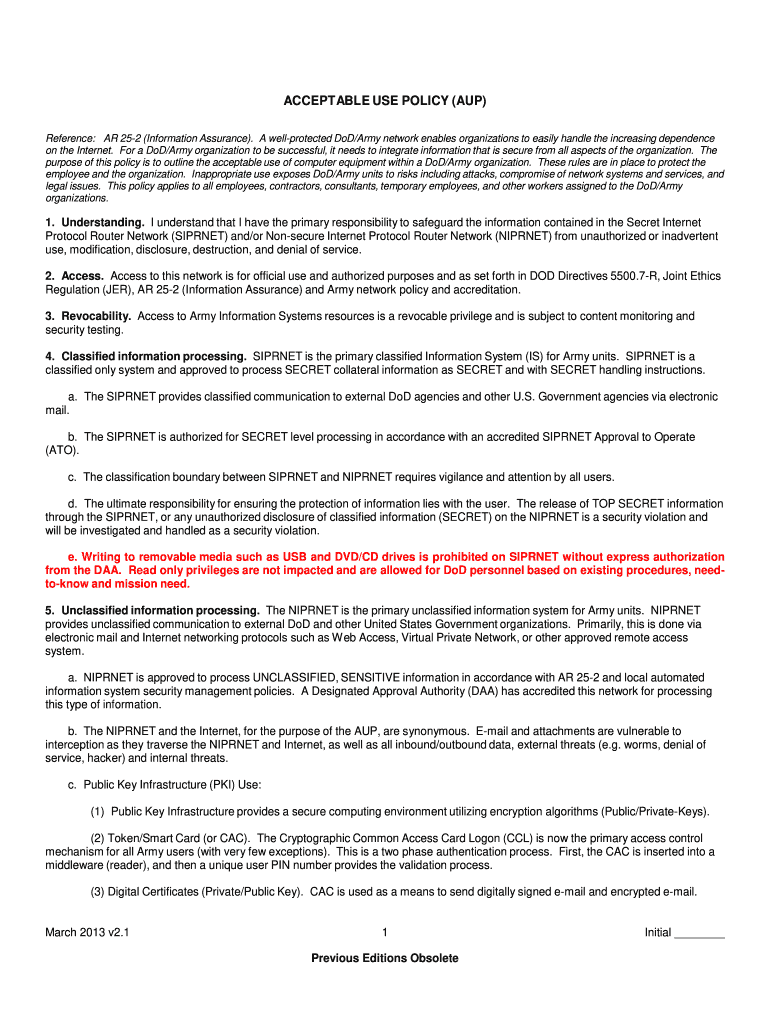
My organization to be successful, it needs to integrate information that is secure from all aspects of the organization. The purpose of this policy is to outline the acceptable use of computer equipment within a DoD/Army organization. These rules are in place to protect the employee and the organization. Inappropriate use exposes DoD/Army units to risks including attacks, compromise of network systems and services, and legal issues. This policy applies to all employees, contractors, consultants,.

Open form follow the instructions

Easily sign the form with your finger

Send filled & signed form or save
How to fill out the Acceptable Use Policy (AUP) online
Filling out the Acceptable Use Policy (AUP) online is essential for understanding the rules governing computer equipment usage within DoD/Army organizations. This guide provides clear, step-by-step instructions to ensure you complete the form accurately and efficiently.
Follow the steps to complete your Acceptable Use Policy (AUP) form.
- Press the ‘Get Form’ button to obtain the AUP document and open it in your preferred editor. This step allows you to access the necessary form for completion.
- Read the introductory section carefully to understand the purpose of the AUP. This will guide you in filling out the form by providing context on usage policies and responsibilities.
- Complete the 'Understanding' section by acknowledging your primary responsibility to safeguard sensitive information as outlined. Make sure to check all the conditions listed.
- Fill out the 'Access' section. Here, confirm your agreement to use the network for official and authorized purposes only, and ensure you are familiar with relevant DOD directives.
- Proceed to the 'Revocability' section and acknowledge that access to resources is a privilege that may be revoked based on adherence to usage policies.
- In the 'Classified information processing' section, confirm your understanding of the guidelines pertaining to the SIPRNET and your responsibilities when processing classified information.
- Address the 'Unclassified information processing' requirements as specified for the NIPRNET. Acknowledge the security measures in place and your role in abiding by these protocols.
- Continue through the 'User Minimum-security rules and requirements' section, ensuring you adhere to all password security, equipment usage, and software installation guidelines.
- After all mandatory fields are filled, review the content for accuracy. Ensure that all sections are completed, and any required training has been acknowledged.
- Once you have confirmed that all sections are complete and accurate, you can save your changes, download, print, or share the AUP document as per the instructions provided.
Complete your Acceptable Use Policy (AUP) online today to ensure compliance and secure usage of DoD/Army networks.
Experience a faster way to fill out and sign forms on the web. Access the most extensive library of templates available.
Related content
The intention for publishing an Acceptable Use Policy is not to impose restrictions that...
An Acceptable Use Policy is like a set of digital guardrails. It outlines the rules and...
May 27, 2020 — This Acceptable Use Policy (“AUP”) applies to all services provided...
Get answers to your most pressing questions about US Legal Forms API.
What is in an AUP policy?
An Acceptable Use Policy (AUP) includes guidelines outlining acceptable and prohibited behaviors regarding the use of organizational resources. It typically covers internet usage, email protocols, and data protection measures. Furthermore, an AUP may address the consequences of violations and the procedures for reporting misuse. This comprehensive approach fosters a culture of responsibility and helps safeguard the organization's assets.
What is the AUP acceptance user policy?
The AUP acceptance user policy refers to the process by which users acknowledge and agree to adhere to the Acceptable Use Policy (AUP). This may involve signing a document or clicking an acceptance button on a digital platform. The acceptance process is crucial, as it formally establishes user accountability. By ensuring that users accept the AUP, organizations can help maintain compliance and security.
What is included in an AUP policy?
An Acceptable Use Policy (AUP) typically includes sections on user responsibilities, acceptable and unacceptable uses, security protocols, and the consequences of policy violations. Additionally, it may contain guidelines for personal device use and remote access. By encompassing these elements, the AUP sets clear expectations for user behavior. Organizations that utilize a robust AUP can improve compliance and create a safer online environment.
What is an example of an AUP?
An example of an Acceptable Use Policy (AUP) might specify that users are prohibited from accessing or distributing illegal content on the organization's network. It may also detail guidelines for reasonable personal use of resources, defining what is acceptable during working hours. By providing clear examples, organizations help users understand their responsibilities. This clarity ultimately leads to a more secure and efficient work environment.
What are the common components of an acceptable use policy?
Common components of an Acceptable Use Policy (AUP) include scope, user obligations, and enforcement mechanisms. The scope determines who the policy applies to and what resources it covers. User obligations outline what behaviors are expected, while enforcement mechanisms explain the consequences of non-compliance. Together, these components create a strong foundation for responsible usage within an organization.
What are the three items typically found in an acceptable use policy?
Typically, an Acceptable Use Policy (AUP) includes definitions of acceptable behavior, a list of prohibited activities, and consequences for violations. These elements provide clarity for users and help them understand expectations. By highlighting these key items, organizations can foster a culture of responsibility and trust. Having a comprehensive AUP in place can help organizations mitigate risks associated with misuse.
Which are two important inclusions to an AI acceptable use policy?
An AI Acceptable Use Policy (AUP) should clearly outline user responsibilities and prohibited actions with artificial intelligence tools. Additionally, it is essential to include guidelines for data privacy and ethical usage to ensure compliance with relevant laws and regulations. These inclusions help safeguard sensitive information and promote responsible use of AI technologies. Organizations can benefit from having a well-defined AUP in place as they navigate the complexities of AI.
What is acceptable use policy standards?
Acceptable Use Policy (AUP) standards refer to the rules and guidelines that govern how users can interact with organizational resources. These standards aim to protect both the user and the organization by outlining acceptable behavior. By adhering to these standards, users contribute to a secure and efficient environment. It is crucial for organizations to establish clear AUP standards to prevent abuse and maintain integrity.
What are the 6 key elements of AUP?
The six key elements of an Acceptable Use Policy (AUP) include purpose, scope, acceptable behaviors, prohibited actions, enforcement procedures, and the agreement process. Each element serves to clarify user responsibilities and set boundaries for acceptable technology use. An effective AUP ensures all users are informed and engaged in maintaining a secure digital space.
What are good examples of acceptable use policy?
Good examples of Acceptable Use Policies (AUP) typically encompass clear and concise rules, practical scenarios, and tailored guidelines for various user groups, such as employees, students, and guests. These policies often include provisions for reporting misuse and regular review processes. They should also reflect an organization's commitment to fostering a safe and respectful online environment.
Use professional pre-built templates to fill in and sign documents online faster. Get access to thousands of forms.
If you believe that this page should be taken down, please follow our DMCA take down process here.