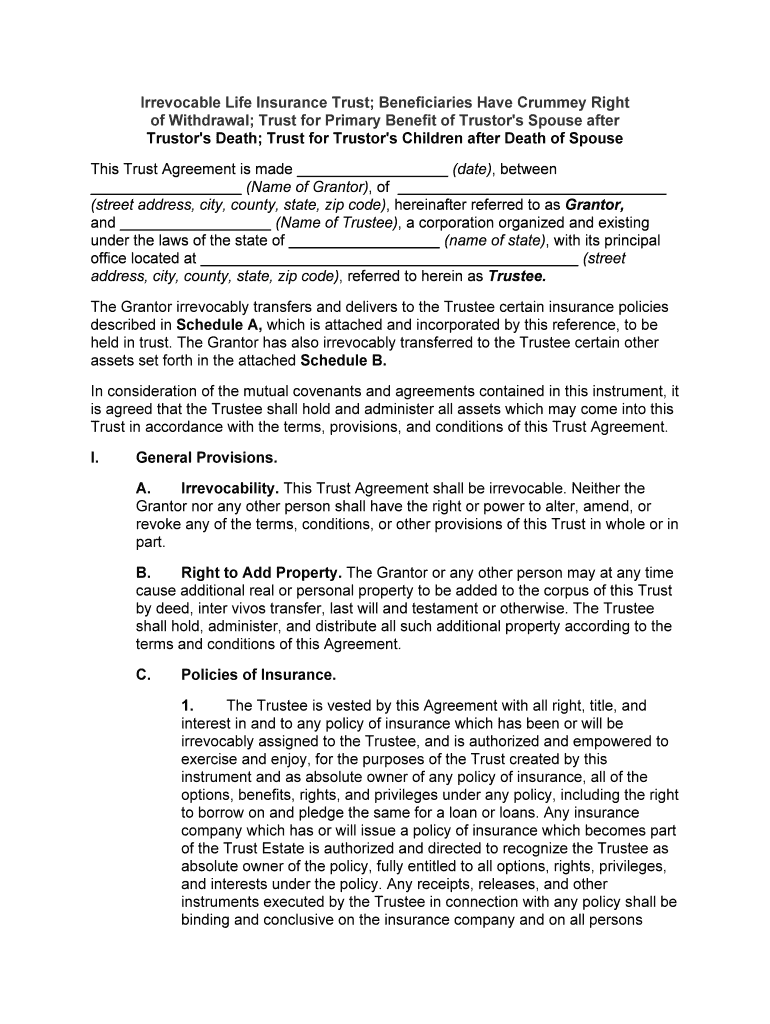
Irrevocable Life Insurance Trust; Beneficiaries Have Crummey Right of Withdrawal; Trust for Primary Benefit of Trustor 's Spouse after Trustor 's Death; Trust for Trustor 's Children after Death of.

Open form follow the instructions

Easily sign the form with your finger

Send filled & signed form or save
How to fill out the Irrevocable Trust Withdrawal online
Navigating the process of completing an irrevocable trust withdrawal can seem daunting, especially without legal experience. This guide aims to provide clear, step-by-step instructions on how to fill out the form accurately and efficiently, ensuring you understand each component along the way.
Follow the steps to complete your irrevocable trust withdrawal process successfully.
- Begin by selecting the ‘Get Form’ button to access the Irrevocable Trust Withdrawal document. This action will prompt the form to open, making it accessible for input.
- In the first section, you will provide the date of the agreement and include the name of the grantor. Ensure you fill out your full street address, city, county, state, and zip code.
- Next, input the name of the trustee and their organizational details, including the corporation name and address. This information identifies the party responsible for managing the trust assets.
- You will then indicate the specific insurance policies being assigned to the trust, making sure to reference Schedule A for complete details.
- After that, describe any additional assets included in the trust as outlined in Schedule B. Provide thorough details to ensure clarity in the trust's composition.
- Regarding the irrevocability clause, reaffirm that the trust agreement cannot be amended. This section is crucial for the finality of the trust arrangement.
- Fill in sections pertaining to the right to add property and the policies of insurance. Be meticulous in detailing any insurance the trustee will manage, ensuring that rights and responsibilities are clearly outlined.
- As you reach the portions concerning distribution, clearly specify the entitlements of the grantor's spouse and children, including any conditions contingent upon their status.
- Once all sections are completed, review the entire form for accuracy. Errors can lead to misunderstandings and potential legal issues.
Take the first step in managing your trust by completing the Irrevocable Trust Withdrawal online today.
Experience a faster way to fill out and sign forms on the web. Access the most extensive library of templates available.
Related content
Jun 26, 2021 — The rights, duties, and powers of the trustee;; Distribution ... An...
by A Newman · 2006 — If a beneficiary of a spendthrift trust has a right to withdraw...
A charitable remainder unitrust (known as a "CRUT") is an irrevocable trust created under...
Get answers to your most pressing questions about US Legal Forms API.
Can you take money from an irrevocable trust?
The trustee of an irrevocable trust can only withdraw money to use for the benefit of the trust according to terms set by the grantor, like disbursing income to beneficiaries or paying maintenance costs, and never for personal use.
Are distributions from an irrevocable trust taxable to the beneficiary?
As noted above, an irrevocable trust must pay income tax on its earnings. ... Typically, the beneficiary isn't required to pay income taxes on distributions that come from principal because tax law presumes that the grantor already paid income taxes on it when he placed it in the trust and tries to avoid double taxation.
Are disbursements from an irrevocable trust taxable?
When you receive a distribution of principal from irrevocable trust funds, you will be required to report this income on your standard IRS Form 1040 tax form, as this money will almost always be taxed at normal income tax rates.
Can a grantor take money from an irrevocable trust?
An irrevocable trust has a grantor, a trustee, and a beneficiary or beneficiaries. Once the grantor places an asset in an irrevocable trust, it is a gift to the trust and the grantor cannot revoke it. ... To take advantage of the estate tax exemption and remove taxable assets from the estate.
Who pays taxes on an irrevocable trust?
Trust beneficiaries must pay taxes on income and other distributions that they receive from the trust, but not on returned principal. IRS forms K-1 and 1041 are required for filing tax returns that receive trust disbursements.
Can a trustee withdraw money from a trust?
Trustees Can Withdraw For Trust UseTrust law varies from state to state, but under no circumstances can a trustee withdraw funds from the trust for the personal use of the trustee. ... Common trust law dictates that the trustee (or trustees) are the only parties that can disburse funds from a trust account.
Can grantor receive income from irrevocable trust?
The grantor (as an individual or couple) transfers their assets to an irrevocable trust. However, unlike other irrevocable trusts, the grantor can be the income beneficiary. ... The grantor can receive income from the trust to the maximum amount allowed by Medicaid.
Who owns the assets in an irrevocable trust?
At its most basic level, Asset Protection and Estate Planning with an Irrevocable Trust stems from this fact: if properly drafted a person can give assets to an Irrevocable Trust and his future creditors cannot take that asset. The Grantor no longer owns the asset; the Trust owns the asset.
Can a beneficiary withdraw money from an irrevocable trust?
An irrevocable trust cannot be revoked, modified, or terminated by the grantor once created, except with the permission of the beneficiaries. The grantor is not allowed to withdraw any contributions from the irrevocable trust.
Can you get out of an irrevocable trust?
The terms of an irrevocable trust may give the trustee and beneficiaries the authority to break the trust. If the trust's agreement does not include provisions for revoking it, a court may order an end to the trust. Or the trustee and beneficiaries may choose to remove all assets, effectively ending the trust.
Use professional pre-built templates to fill in and sign documents online faster. Get access to thousands of forms.
If you believe that this page should be taken down, please follow our DMCA take down process here.